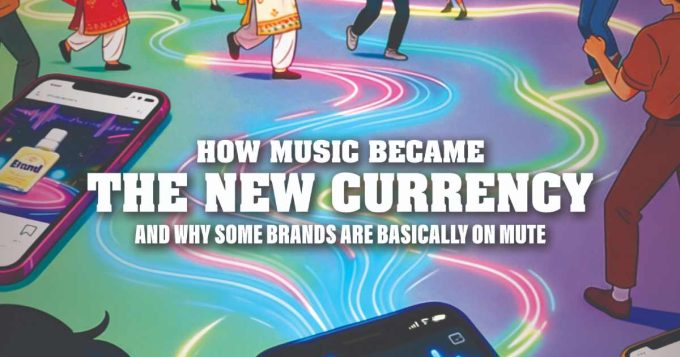

Music has always had the power to unite, even when politics divides. This piece explores how political and social campaigns in Pakistan use melody to soften their message, turning ideology into entertainment. Even if you don’t support the party, you probably still hum their anthem, because music transcends belief, wrapping conviction in rhythm, and making politics sound… surprisingly good.
In Pakistan, politics is never subtle, mainly because it does not need to. In this country, loud and charged rallies and open propaganda are a common occurrence. Yet when politics wants to be liked rather than obeyed, it often turns to music. Melody has become the country’s softest political weapon, turning hard ideology into something you can tap your foot to.
This is because music works by lowering defences, and people rarely question something if it’s a vibe, no matter the political views. Dilan Teer Bijan, PPP’s party anthem, is a major example. Nobody cares about arguing to a tune if it is making their mehendis memorable. Before they process the message, they have already absorbed the mood.
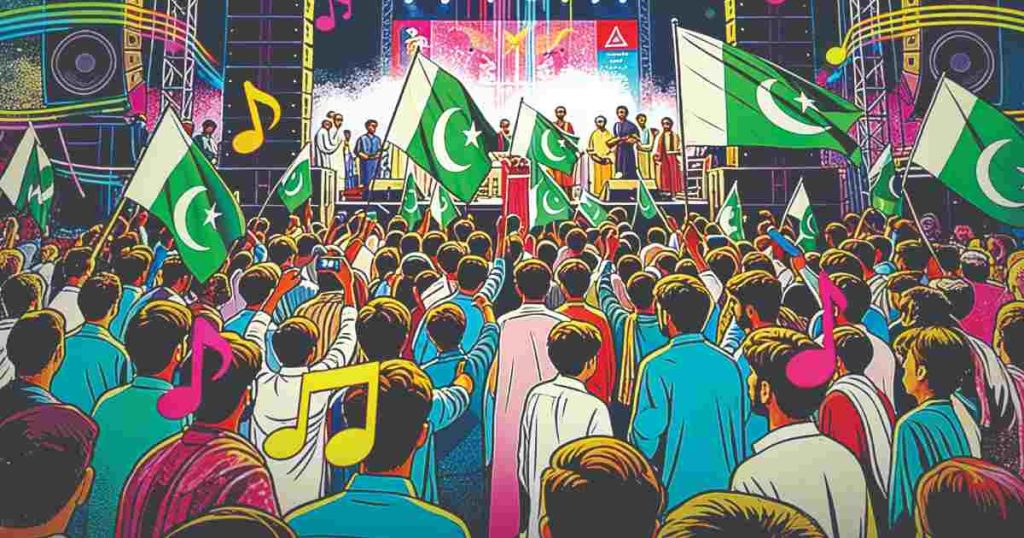
PTI’s rise and popularity also proved this ideology. Their rallies felt less like traditional jalsas and more like concerts where party anthems blasted from speakers, attracting the youth of Pakistan and making them listen even when they didn’t care about politics. Talk about aura farming one’s way into politics.
Nostalgia as a Political Instrument
PML-N, on the other hand, took a different route. Their anthems and music leaned more towards nostalgia. These songs were not meant to excite the young as much as reassure the older voter. It gave them a feeling of continuity, almost like a memory you wanted to return to. Even critics found themselves humming along because the music reminded them of something personal rather than political.
PPPs approach has been on the instinctive side. From Benazir’s era to Bilawal Bhutto’s campaigns, the party has relied on catchy choruses and folk-influenced tunes that travel easily across provinces, especially in the interior Sindh, which feels presented by these tunes.
These days, even Indian rave parties are enjoying the infamous party anthem despite the political rivalry.
What makes these songs powerful is not what they say but how they make you feel, because a political promise feels lighter when it comes with a beat. Propaganda’s power lies in how familiar it feels before you question it.
This strategy extends beyond party politics; social campaigns in Pakistan also deploy the same tactic. Whether it is voter awareness, public service messaging or unity-themed ads, music becomes the bridge between instruction and emotion. The anthems released during the 2025 India-Pakistan war were a prominent example.
The 2016 U.S presidential election is often cited as a turning point in modern political marketing. Donald Trump’s campaign demonstrated how music could construct a persona as effectively as policy. Many scholars and practitioners cite the 2016 U.S. presidential election as a turning point in modern political marketing.
Why is Music Being Used in Politics?
Decades of research show that music directly affects how the brain processes information. According to studies published in Nature Neuroscience and Psychology of Music, music activates emotional centres of the brain before areas responsible for analytical thinking. In simple terms, people feel before anlyse. This is precisely why political campaigns use music as a speech, while a song asks you to feel first. Political communication studies have found that listeners exposed to political messages paired with music were significantly less likely to critically challenge the message compared to those who heard spoken messaging alone. As a result, the music did not change opinions outright, but it increased openness and familiarity.
One of the clearest examples of music directly enabling political change is the Singing Revolution of the late 1980s in Estonia, Latvia, and Lithuania. Under Soviet rule, political expression was heavily restricted, but music remained a culturally sanctioned space.
Mass gatherings centred on song became acts of nonviolent resistance. The trilingual anthem “The Baltics Are Waking Up” symbolised unity across the three nations, each singing in its own language yet moving towards the same political goal.
This was not just symbolic. In 1989, roughly two million people, about a quarter of the Baltic population, formed the Baltic Way, a human chain stretching over 690 kilometres. Songs were not background noise; they were the organising principle, the emotional glue that allowed collective action without weapons.
The success of the Singing Revolution eventually led to the independence of all three states. UNESCO later recognised Baltic song celebrations as Intangible Cultural Heritage of Humanity, underscoring that music was not just expressive but historically consequential.
All this raises an uncomfortable issue, though. If music bypasses rational evaluation, where does persuasion end and manipulation begin? Researchers argue that political music can shape bias before conscious thought intervenes. This turns music into a tool for emotional redesign, which can become dangerous when used with harmful intent.
As an element of contested history, music reminds us that power does not operate only through institutions and symbols made of stone. It also operates through sound, memory, and shared emotion.
And while speeches fade and regimes fall, songs often remain. Because long after the argument ends, the music still plays.