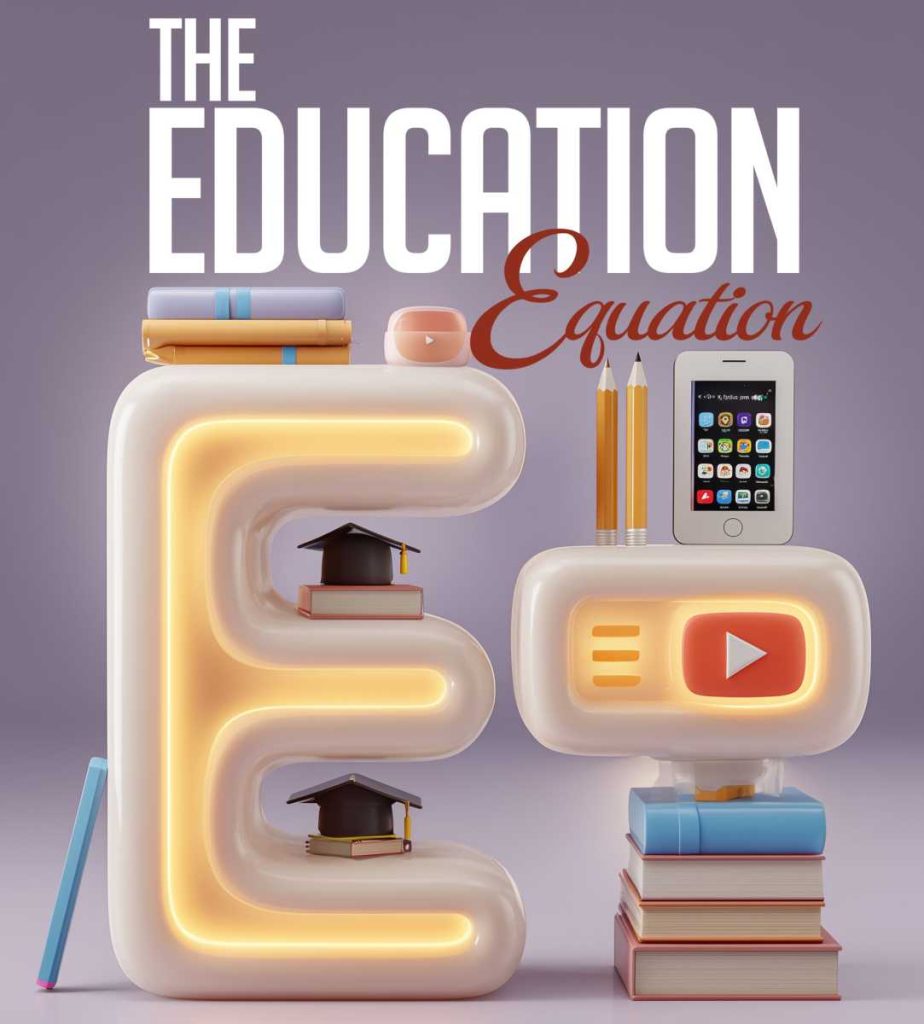


In this issue, we talk about education from every angle. We step into Pakistan’s classrooms, where children arrive with dreams, teachers shape futures with resilience, and parents invest in hope. Our cover story traces both the divides and the dreams shaping education, and what it will take to make learning a promise for every child.
The school year has begun, and across Pakistan, the rituals are already in motion. Bookshops spilling over with parents bargaining for fresh syllabi, stacks of notebooks, and schoolbags sturdy enough to last another term. Teachers are back in staff rooms and sunlit classrooms, scribbling timetables, pinning charts to walls, and shaping lessons that will guide the year ahead.
Outside, the heat presses hard. In some schools, air conditioners hum; in others, ceiling fans turn lazily when the power holds. A few rely on coolers, UPS units, or solar panels to keep classrooms alive through summer afternoons. Many have nothing but open windows and the will to continue. Colleges and universities are already back in session. Their campuses split between state-of-the-art lecture halls and rooms where even a projector feels like luxury.
This is Pakistan’s education in miniature: familiar, uneven, yet quietly moving forward. According to the Economic Survey 2024–25, the national literacy rate has climbed to 60%. A sign of progress, though still far from where it should be. Men lead at 68%, women at 52%. Punjab tops the chart at 66%, followed by Sindh (57%), Khyber Pakhtunkhwa (51%), and Balochistan at 42%.
The gaps are real, but so is the momentum. What matters now is not whether progress is happening. It is, but how quickly it can be accelerated, and whether it can reach every child, everywhere.
Pakistan currently spends just 2.1% of its GDP on education, barely half of UNESCO’s recommended minimum. Budgets have grown on paper, from PKR 498 billion in 2012–13 to PKR 1,345 billion in 2022–23, but as much as 30% of these funds vanish each year into bureaucracy, mismanagement, or outright corruption.
The result is visible in the dropout crisis. Of the 71 million children in Pakistan between ages 5 and 16, some 25.3 million, 36%, are out of school. More than half of them, 53%, are girls. Rural Pakistan carries the heaviest burden. 74% of these children live in areas where schools are too far, too unsafe, or simply do not exist.
This gap is not just about inequality; it actively produces it. Every child locked out of school is a future cut short, and every community left without access falls further behind. Yet beyond these numbers lies the deeper story: access, quality, and opportunity are not the same everywhere, and the map of Pakistan’s classrooms is one of stark contrasts.
Pakistan’s classrooms do not tell one story; they tell three. In government schools, more than 150,000 across the country, children sit in crowded rooms, often forty to a teacher, with textbooks that have changed little in decades.
Lessons are delivered in Urdu or regional languages. A comfort for early learning, but a barrier later when higher education and many professions demand English. Resources are stretched thin, and the promise of free schooling too often means little more than survival.
At the other end of the spectrum, elite private institutions operate almost like gated communities of learning. They offer international curricula, robotics labs, debating clubs, and English fluency that opens global doors.
The student–teacher ratio drops to 25:1, and the connections forged here often matter as much as the certificates. But access comes at a cost: monthly fees of PKR 5,000 to 15,000 (estimated) in urban areas, an amount that, for many families, means choosing between education and putting food on the table. Even so-called low-cost private schools remain inaccessible to millions.
Between these two worlds stand the Madaris. For families with no means, they are often the only option, providing meals, discipline, and religious instruction. Their numbers have doubled in just five years. Government data shows, reflecting how deeply they have filled the gaps left by public schooling. Yet their curriculum rarely goes beyond theology, leaving graduates with few pathways into the broader economy.
The result is not just a difference, but a distance. According to the Annual Status of Education Report (ASER) 2021, 65% of private school students in Grade 5 could read a story in Urdu, compared to 43% in government schools. In arithmetic, the gap was 58% to 42%. These numbers reveal how early learning outcomes begin to diverge, shaping futures in ways families cannot always control.
This layered system does more than divide; it cements inequality. The privileged secure entry into top universities and higher incomes, while the majority are locked out. Every additional year of schooling can raise an individual’s income by 10%, the World Bank notes. Opening doors to education for all is the surest way for Pakistan to turn its young population into its greatest economic strength.
If education can unlock prosperity, then the real test lies in how we design what is taught and how it is delivered. At the heart of Pakistan’s recent reform effort is the Single National Curriculum (SNC), launched in 2020 with the ambition of levelling the playing field across public, private, and religious schools. On paper, it offers the promise of equity – a single framework meant to bridge divides.
But the classroom reality is more complicated. Teachers across the country have reported uneven training and limited preparation to implement the new content. The SNC aspires to promote critical thinking and shared values. Yet many classrooms still fall back on rote memorisation and standardised testing.
The challenge grows sharper when it comes to English: a blanket rollout of English-medium instruction has left many teachers struggling. Particularly in rural schools, and risks widening the gap between students from different regions and backgrounds.
The Single National Curriculum reflects a step toward reimagining equity, but reform on paper cannot succeed if the system delivering it remains fragile. That fragility shows most starkly in the persistent problem of ghost teachers and ghost schools.
According to UNICEF, thousands of teachers continue to draw salaries without ever entering a classroom. One of the key reasons Pakistan still ranks second in the world for out-of-school children.
In rural areas, especially, the absence of teachers leaves entire schools hollow. The problem extends beyond personnel. More than 30,000 ghost schools have been identified nationwide, institutions that exist on government records but were never built at all.
In such places, learning ends before it begins. What Pakistan needs now is a transparent and reliable system that guarantees every school exists not only on paper but in practice.
Yet, even where schools and teachers are present, a new challenge has emerged. The pandemic exposed just how wide the digital divide runs in Pakistan. Separating those with access to technology and connectivity from those left entirely outside the modern classroom.
The COVID-19 pandemic exposed the digital divide in Pakistan’s education system like never before. With schools closed, only 41% of students could access online learning, leaving the majority disconnected overnight. What should have been a transformation turned into a stark reminder of how unprepared the system was for disruption.
Today, internet access reaches just 39% of the population, dropping to 27% in rural areas. Only 18% of schools are equipped with computers, and even fewer have teachers trained to use them. Many students simply disappeared from the classroom the moment it went online.
While edtech platforms and nonprofits stepped in with mobile lessons and WhatsApp tutorials, these efforts remained scattered patches on a system in need of structure. The Asian Development Bank estimates that the digital gap still deprives 30% of students of educational opportunities, while only 5% of Pakistan’s population possesses the digital skills required for today’s economy.
The divide is not only technological, but structural shaped by geography, gender, and income. In some homes, children are coding before the age of ten; in others, there is no electricity to power a fan, let alone a laptop.
For millions, “Digital Pakistan” is still more slogan than solution. Yet the potential remains enormous. Expanding digital infrastructure equitably and training teachers and students to succeed in online and hybrid environments can transform education access and outcomes.
Pakistan has the chance not just to bridge the gap but to leap forward, turning classrooms into engines of innovation that prepare the next generation to compete globally.
But inequality in education is not only about devices and internet access. It is also about branding. Where the name of a school can matter more than what is taught inside it.
At the upper end of the educational spectrum, private institutions have built a parallel track, one defined as much by reputation as by results. These schools attract families with international curricula, English-medium instruction, and modern facilities that often rival those abroad.
For many parents, securing admission is as much about opportunity as it is about status, with limited entry windows, high fees, and selective criteria shaping who gets in.
While these schools do provide strong academic environments and extracurricular opportunities, the emphasis on prestige often fuels an education culture where tutoring centres and high-profile private instructors become routine. In urban centres especially, education can double as a marker of social belonging. The result is a landscape where access depends not only on ability, but also on affordability.
Yet where the state falls short, others are stepping up.
Nonprofit initiatives have stepped in. The Citizens Foundation (TCF) runs over 2,000 schools, reaching more than 300,000 children nationwide. The model blends national and global curricula, with strong teacher training, digital tools, and in-house textbooks designed for real classrooms.
Saylani Welfare Trust, best known for food and health services, has expanded into education through schools, IT training, and vocational programs. It covers fees, offers scholarships, and supports employment pathways, reaching thousands who would otherwise be excluded.
At the grassroots, campaigns like the British Council’s “Ilm Possible” mobilise 12,000 youth volunteers who go door-to-door in marginalised communities. Enrolling children and mentoring them back into learning.
While these efforts expand access, national initiatives are now beginning to look toward the skills and technologies that will define the classrooms of the future.
As global education embraces Artificial Intelligence, Pakistan is beginning to take steps in the same direction. Initiatives like the Presidential Initiative for AI and Computing (PIAIC), Sino-Pak AI Centres, and the country’s first AI university reflect a growing recognition of what the future demands. Pilot projects, STEAM labs, and e-learning platforms, though still small in scale, signal intent and possibility.
Challenges remain, limited connectivity and uneven infrastructure among them, but the conversation is shifting. Digital literacy, coding, and interdisciplinary learning are making their way into policy debates, with frameworks like Education 5.0 pushing the idea that classrooms must prepare students for the world ahead, not the one behind.
By scaling and sustaining these efforts, Pakistan can start bridging today’s divides and create an education system that is both inclusive and future-ready. And that brings us back to the bigger question: what should we change now to make that future possible?
Pakistan now has the chance to move from patchwork fixes to real transformation. The focus must shift to relevant curricula, stronger teacher training, and early education rooted in local languages, with clear bridges to multilingual fluency. Pakistan should treat digital access as a basic right. And implement oversight to ensure resources reach the classrooms that need them most.
Signs of progress are already visible. Vocational institutes have grown by 22 per cent, private investment in higher education is on the rise, and families are seeking models that combine access with quality. If Pakistan can scale skill-based training, bring Madaris into a national framework, and balance public and private responsibility, it can reset its trajectory.
The foundation has been laid. The next step is to invest, integrate, and accelerate so that every child’s classroom is not just a place of learning, but a launchpad into the future.
The classroom of tomorrow does not have to mirror the divides of today. Pakistan now stands at a moment where it can transform gaps into growth by making education not just about access, but about opportunity, equity, and future readiness. The challenges are real, but so are the signs of progress: stronger partnerships, rising investment, and communities refusing to give up on learning.
Reimagining education means treating every school as a space of possibility. Every teacher is a builder of futures, and every student as part of the nation’s promise. If intent turns into action, Pakistan’s classrooms can move beyond survival and become engines of innovation, growth and hope. That is not just the future of education, it is the future of Pakistan.