
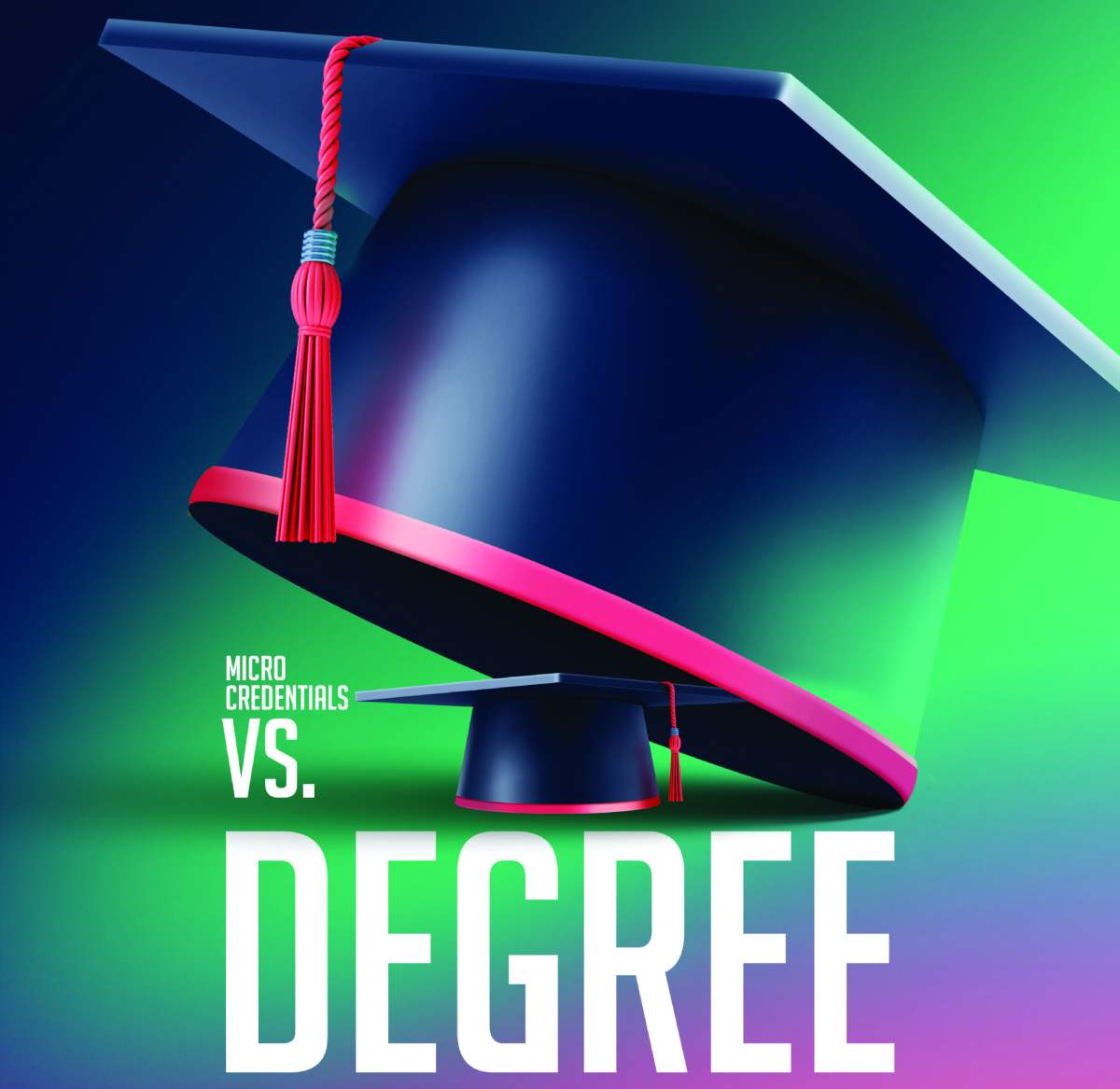
As degrees lose their shine and micro-credentials rise, the question is not “which one wins?” but “which one pays off?” In a world moving faster than ever, the real edge lies in knowing how to use both.
Let me start off by saying that we live in a world that is moving extremely fast, and the education system seems to be still catching up. That is why we are now facing a major debate: Should you invest a significant amount of years and money into a traditional university degree, or should you opt for faster, more flexible micro-credentials that claim to make you job-ready in months?
When I graduated from university with my business degree, I thought I was set. Four years, millions of rupees, countless all-nighters, surely employers would be lining up. Instead, I found myself googling “free digital marketing courses” the week after convocation.
That’s when I realised: a degree is not always the golden ticket. In a world where industries shift faster than trends, the question is hard to ignore.
Degrees: The Traditional Route
Degrees, especially from well-reputed institutions, have always been considered the gold standard. There is prestige attached to them. A bachelor’s, master’s, or PhD comes with credibility, structure, and a broad base of knowledge. It shows that you can commit to something long-term, work through a curriculum, and emerge with a well-rounded understanding of a field.
But here is the hard truth: they are expensive and slow. A degree from LUMS can cost PKR 1.2–2 million in a year. Add transport, living expenses, and books, and the bill climbs even higher.
According to the Pakistan Bureau of Statistics, graduate unemployment is 16.5%. Many classmates found they still needed extra training for entry-level jobs. One engineering friend struggled for a year, until a 3-month coding bootcamp landed him multiple offers within weeks.
Micro-Credentials: The Fast Lane to Jobs?
On the other hand, micro-credentials, online certificates, bootcamps, and short courses are often marketed as the “future of education.” Platforms like Coursera and Google Career Certificates, and even local options like DigiSkills.pk, are giving people access to skills in weeks or months instead of years.
The biggest win is accessibility. With just an internet connection, you can skip exams, fees, and long applications, learn skills like digital marketing, UX, or coding and enter the job market fast.
That said, credibility is still a concern. Employers in Pakistan and other parts of the world still tend to look more favourably at degrees, especially for formal, high-ranking positions. But the tide is slowly turning. Tech companies in particular are starting to care more about what you can do rather than where you studied.
ROI: Degrees vs Micro-Credentials
A local bachelor’s degree costs PKR 600,000 to 2 million over four years, and that is before adding living expenses, transport, books, and the income lost while studying.
Compare that with a Google UX Design certificate on Coursera, which might cost you under PKR 50,000 and take just six months. Now, if you land a job paying even PKR 80,000 per month afterwards, you are already seeing returns in your first month.
But! And this is a big but, the long-term success often depends on how you build upon those micro-credentials. A short course might get you in the door, but to climb the ladder, you will need experience, networking, and possibly, further credentials. Degrees, on the other hand, often provide those alumni networks, formal internships, and a longer runway for growth.
Global vs Local: Are Ivy League Dreams Overrated?
There is this glorified image of studying abroad, especially in countries like the US, UK, Canada, or Australia. And while I will not deny the exposure, quality of education, and prestige, the costs are jaw-dropping.
A single year at an Ivy League university can cost upwards of $70,000. Add other mandatory expenses and it is easily $100,000 a year. That is nearly PKR 30 million for a two-year master’s. If you are lucky, you might get a scholarship or a fully-funded program. But most people I know end up in student debt that takes years, sometimes decades, to pay off.
Compare that to a high-quality, well-ranked local university like LUMS or NUST, or even a European university that offers more affordable or fully-funded programs. You get similar exposure (maybe not as shiny), but without the crushing debt.
The Ivy League dream is romanticised; it suits those with privilege or financial backing. But if your goal is employability, financial stability, and impact, there are smarter and more cost-effective paths.
Privilege and Social Capital
Privilege, whether it is access to elite universities, global opportunities, or even awareness of what is possible, not everyone starts from the same place. Someone with a network of well-connected professionals will always have an edge over someone who is the first in their family to go to college.
This is where micro-credentials level the field, opening doors for small-town, low-income, or non-traditional learners. I have seen freelancers from rural Pakistan earn in dollars after a few online courses.
Jobs and Long-Term Outcomes
In Pakistan, the job market is increasingly favouring practical skills. A marketing manager is more likely to hire a certified Google Ads expert than a fresh MBA with no hands-on experience. The same goes for coding, design, data analysis, and even content writing.
But there is still space for degrees, especially in fields like medicine, law, engineering, and academia. These areas require deep, structured knowledge that micro-credentials cannot replace.
However, for emerging industries and the gig economy, micro-credentials are becoming just as valuable, if not more. They are modular, stackable, and adaptable. You can keep learning and upgrading as the industry evolves, which is something degrees struggle to match.
The Future of Pakistan
I think the future of education in Pakistan lies in a hybrid model. Degrees will still matter, but they will need to evolve. Curricula must be updated, practical skills must be integrated, and learning should become more personalised.
Meanwhile, micro-credentials will continue to rise, especially as more companies recognise their value. Imagine a future where you do a three-year degree, but every semester you also complete an industry-recognised certificate. That is where we should be headed.
The Final Credential
Success comes from talent and ambition, but academics shouldn’t be ignored. Degrees offer prestige and structure, while micro-credentials provide speed and job-readiness. The best path is often a blend, using degrees as a foundation and micro-credentials to stay relevant. Education is not a one-time investment; it is a lifelong process.