
How AI reshapes creativity, not by replacing imagination, but by rewiring how ideas are born, built, and brought to life.
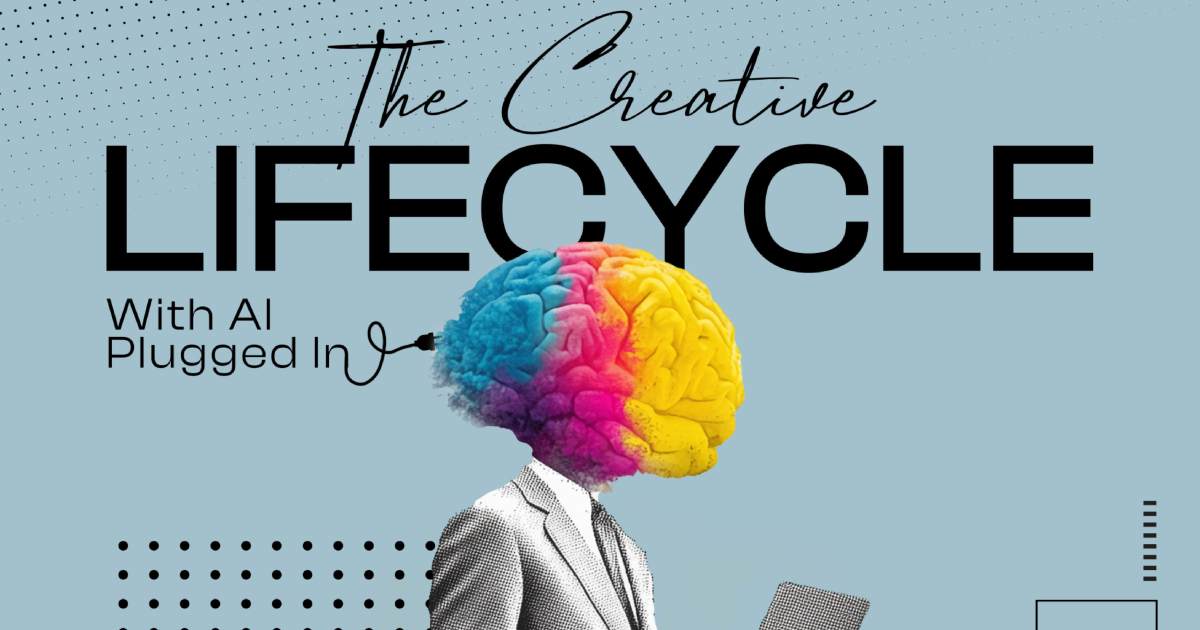
In an era when speed is the currency of relevance, the creative campaign no longer moves from brief to billboard in a linear march of human effort. Instead, it traverses an ecosystem in which human intuition and artificial intelligence (AI) partner in a redefined rhythm. The phrase “plugged in” is not metaphorical; it denotes that at each stage of the campaign journey, algorithms, data models, and predictive systems are already at work. What follows is a detailed roadmap of how the modern campaign unfolds, and how AI enhances every phase, even as it introduces new challenges for creative integrity, diversity, and ethics.
Client Brief →Data Insight & Predictive Definition
Traditionally, the brief arrives as a document or meeting call: objectives, target audience, tone, and budget. Today, agencies and in-house teams augment that intake process with AI-enabled analytics. Market-listening tools sift through vast volumes of social data, sentiment-analysis engines flag cultural shifts, and predictive models estimate campaign resonance.
According to one survey, 94% of organisations now use AI to prepare or execute marketing activities. The global AI marketing market is projected to grow at a compound annual growth rate (CAGR) of approximately 36.6% to reach around USD 107.5 billion by 2028.
These figures indicate that what was once “nice to have” is now foundational. The creative brief thus becomes less about guesswork and more about data-informed hypothesis setting. From an editorial perspective, this means the brief is richer, more precise in audience segmentation and more realistic in expected outcomes. The risk, however, is that creative teams may feel constrained by data pre-decisions rather than free to explore.
Brainstorming → Augmented Ideation
In this phase, the team meets, physically or virtually, and opens the whiteboard. Now, AI enters as a collaborator rather than a replacement. Generative tools produce mood boards, suggest iconography, propose metaphors, and even generate headline variants.
Empirical research shows that access to AI-generated ideas can improve the usefulness of creative output by roughly 9% compared to teams without AI access. Another study found that human-AI collaboration yields better average performance but can reduce the diversity of ideas generated.
The key insight is that AI broadens ideation bandwidth, producing faster and more numerous sparks, but may simultaneously narrow creative diversity unless the human lead ensures deliberate divergence. Practically, this means teams must consciously prompt for outlier thinking to avoid an echo chamber of predictable ideas.
Story Crafting → Personalisation & Precision
Once concepts are selected, story-crafting begins – messaging strategy, tone of voice, copywriting, platform adaptation, and asset mapping. Here, AI contributes across several vectors: natural-language generation helps draft copy variants, sentiment modelling predicts phrase resonance, and micro-targeting engines recommend audience-specific tweaks.
Most creative teams now turn to AI to fine-tune their work, spark new ideas, and even shape the final product. Many in the industry admit it’s helped them craft sharper, more confident content—though the real magic still happens in human hands.
Story-crafting shifts from monolithic “one message fits all” to branching “variants fit segments.” The human writer acts as a curator and quality gatekeeper, while AI acts as a scribe and rapid variant generator. The craft value lies increasingly in editing, choosing, and contextualising rather than generating from scratch.
Execution → Smart Strategy in Motion
When the campaign goes live, numerous moving parts must align: media placements, scheduling, asset adaptation, and A/B testing. AI streamlines and optimises these elements. Ad-placement platforms now utilise machine learning to dynamically allocate budgets; visual-asset automators adjust creative formats; and performance-monitoring tools provide real-time insights.
A recent report found that nearly two-thirds of marketers say AI-assisted content performs just as well, or even better, than traditional work. For most, it is not just about efficiency anymore; it is about using AI to uncover insights and make creative decisions at a pace the old system could never match.
Execution has thus become a continuous feedback loop; AI monitors performance, suggests tweaks, and adapts placements in real time.
Production →Virtual Creativity & Rapid Iteration
Production, traditionally the most time-consuming stage involving photoshoots, editing, and localisation, has been transformed by AI. Generative visuals, AI-assisted editing suites, and automated localisation pipelines reduce lead times and costs. Klarna, for instance, reported saving approximately USD 10 million annually by using generative AI for image production and reducing reliance on external suppliers.
Where production once acted as a throttle on creative agility, today the bottleneck is more often internal sign-offs or brand governance rather than technical limitations. Campaigns can now afford a “live editing” mindset: test, revise, and repeat.
Post-Production → Continuous Performance & Optimisation
Campaigns no longer end; they evolve. Post-production in the AI-enhanced lifecycle involves ongoing monitoring, sentiment analysis, real-time adjustment, and asset refreshes. For example, monitoring tools can flag underperforming content segments and suggest AI-powered revisions to better align with audience preferences.
Studies confirm that AI integration in creative processes is positively correlated with performance, but they also caution that human oversight remains essential. Post-production now asks not only “how many clicks?” but “is the story still relevant?” and “are we still speaking our audience’s language?”1
Synthesis: The New Creative Economy
Three overarching observations emerge from this new model:
- · AI is augmentative, not substitutive. Human-plus-AI collaboration consistently outperforms human-only workflows.
- · The speed and scale of creativity have shifted. Campaigns that once took weeks can now be produced in hours, with multiple micro-variants.
- · The risks are real. Reduced diversity of ideas, ethical concerns about ownership and bias, and creative homogenisation are all growing issues.
- · The creative professional’s role now centres on orchestration, setting the right prompts, selecting the strongest outputs, and ensuring cultural and emotional resonance.
Regional Perspective: Pakistan and Beyond
While much of the data originates from global markets, similar dynamics are visible in Pakistan. As digital penetration increases, brands face shorter consumer attention spans and pressure for rapid turnarounds. AI tools address these demands, enabling quick content creation, Urdu-English localisation, and real-time insights. The challenge lies in training creative talent, ensuring data privacy, and maintaining cultural authenticity.
The creative lifecycle has evolved from a linear process into a continuous loop. With AI integrated into every stage, from brief to post-production, the campaign becomes a living system: faster, smarter, and more responsive. Yet, despite automation and analytics, the human element remains irreplaceable.
Creativity still demands empathy, context, and meaning, qualities no algorithm can fully replicate. The task for today’s creatives is not to compete with AI, but to collaborate with it, ensuring that technology amplifies imagination rather than dilutes it.