
The rise and fall of Pakistan’s music channels mirrors a story far bigger than shifting playlists. From cassette-lined underground markets to 24/7 VJ-led dreamscapes. Finally, the algorithmic scroll, this is a look at how a once-electric ecosystem dimmed and why its echoes still linger in our collective memory.
I still recall how, during the late 90s, my school friends and I would visit the Regal Market in Karachi’s Saddar area. Where an underground passage connected the two sides of the road. The passage, on both sides, was lined with small shops selling audio cassettes.
That is when I began purchasing my first cassette, of the many hundreds that would follow. The twenty-five-rupee cassette held six to eight songs per side. To hear the tracks on the other side, one had to remove the cassette from the player or Walkman, flip it over, and reinsert it. The same ones you may have come across in memes or nostalgic posts.
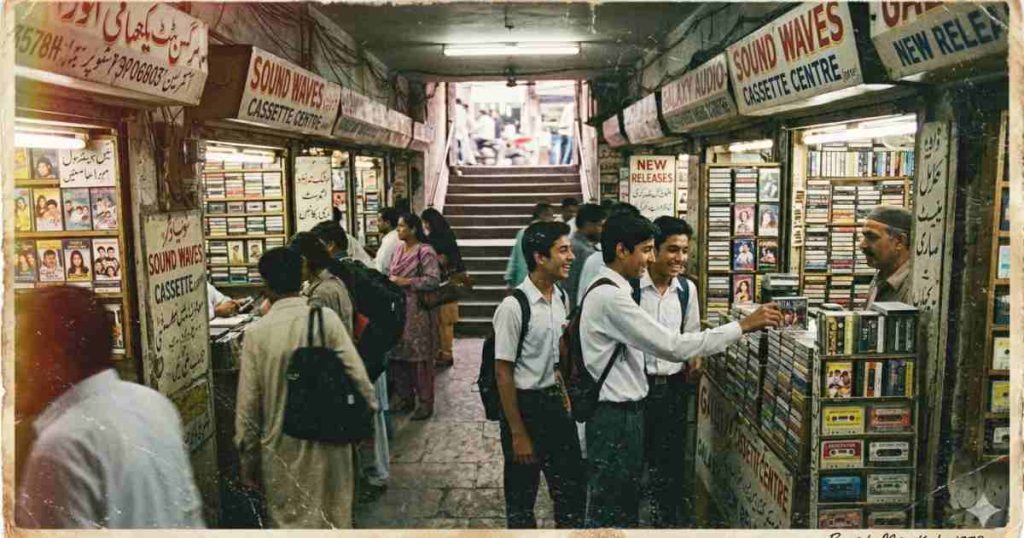
Mostly, the cassettes would be dedicated offerings with all the tracks from a popular band, an individual singer, or a single film, regardless of nationality or genre. With an increased music appetite and market exposure.
I learnt that you could select, jot down song titles and prepare your own cassette with multiple songs for as low as Rs 35 to Rs 65 only. Soon, I was exploring the Rainbow Centre and beyond in search of more optimally sound options.
The music scene was thriving during the 90s. Pakistan was already a world champion in four sports. The winning players would acknowledge how different music helped them cope with the pressure. In the years that followed, a string of newly released patriotic songs heralded every upcoming tournament, with performers delivering them enthusiastically for the event.
An air of healthy competition always accompanied them. Music recording companies, studios, and music video directors were coming up with unique concepts, and even the underground music was thriving there. Pakistani singers and bands hailing from different genres were making headlines globally. Even then, we just couldn’t get enough!
We would queue at eateries, malls, or renowned stores just to buy expensive concert tickets. Posters of the era’s heartthrobs decorated wardrobes, tabletops, and bedroom walls.
Weekly shows like Music Channel Charts, with their witty and humorous hosts, were eagerly awaited, followed, and debated by teens and young adults. Who spent the following week predicting and justifying the next week’s song rankings.
Even in the early 2000s, I was part of a team that regularly met singers such as Junaid Jamshed, Sajjad Ali, Ali Haider, Hasan Jahangir, Atif Aslam, Ali Zafar and Naeem Abbas Rufi for annual concerts and other major events at our Medical College.
Access to music content multiplied with the rise of affordable bandwidth, greater internet availability to the masses. New dedicated channels from broadcasting houses. And, of course, the proliferation of landlines, desktops, and digital mobile phones paving the way for smartphones and tablets.
The celebrity autographs on your shirt and books were replaced with a selfie with your favourite singer. From selected sixteen songs on a cassette and a few dozen on a CD or a DVD. The scene changed to almost unimaginable storage capacities with thousands of songs, whether in a USB or on an application.
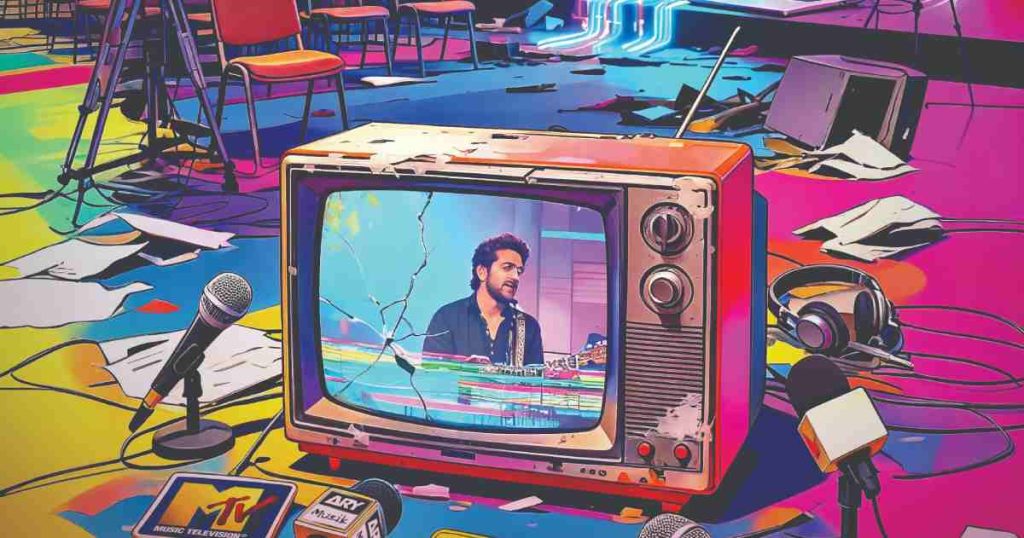
Come the 2000s, channels like ARY Musik, Indus Music, Jalwa, 8XM, Play TV, Aag TV, Oxygene TV and even MTV Pakistan were now on-air. They would run non-stop, 24-hour-long transmission dedicated to songs. Many new faces and teen sensations began hosting the one-hour show slots, becoming overnight successes with their dedicated followings.
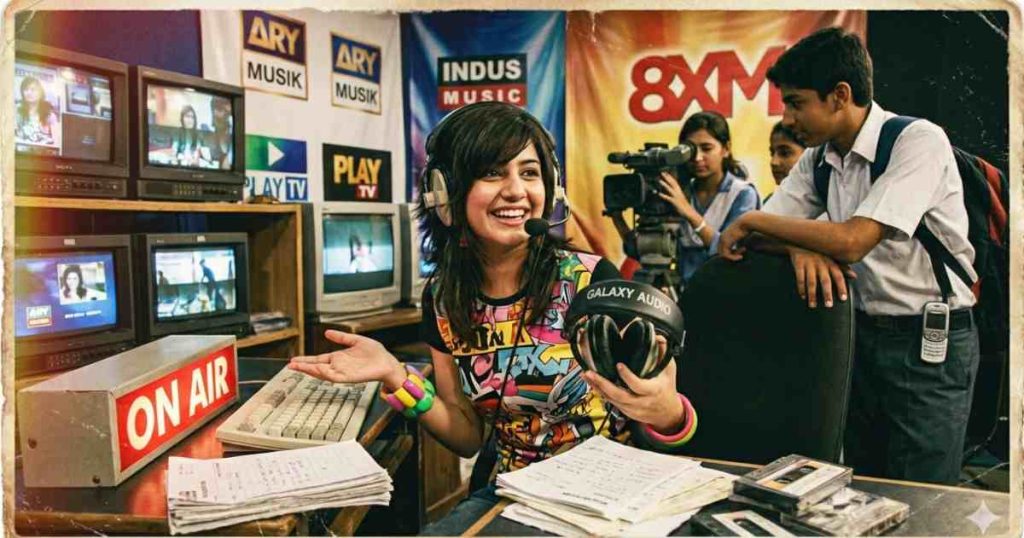
The music scenario of Pakistan, however, flipped even before the beginning of the 2010s. Multiple factors contributed to this significantly. Finding any song with lyrics and translation is now just a touch away. With access becoming easier, almost everything is now available on Google and YouTube.
From a couch potato family or an individual watcher engaging the family’s TV or LED. The shift was towards a more single-person-in-charge, nuclear set-up where every individual had the independence of hearing what they wanted to, for any length of time, absolutely any time and at any place.
Post 9/11 and later, the increased resurgence of radicalism also derailed the once-thriving live music situation of Pakistan. Security concerns resulted in reduced outdoor participation from the masses, decreased involvement of international performers.
Therefore, reduced economic viability for the organisers of such events. The lack of a system for royalties to the singers and the piracy issues. Which also pushed many singers to the digital channels and, sometimes, even to other professions.
All this coincided with the PEMRA 2002 Ordinance application as well. During the 1990s, there was no concept of PEMRA (Pakistan Electronic Media Regulatory Authority).
In hindsight, however, the unregulated music industry proved to be more brimming with creativity. Which all evaporated within a few years as the PEMRA censorship policies on the music content took hold.
Simultaneously, longer videos paved the way to the likes of TikTok, YouTube shorts and reels being swiped within a few second. As the attention span across the globe reduced significantly. Digital music platforms like Spotify and Patari proved to be the last nails in the on-air music channel’s coffins. VJs’ contribution to new music shifted to algorithm-based calculations.
Listeners were now vibing more to the new music and tunes being put forward by Velo Sound Station, Coke Studio and Nescafé Basement. Where multiple singers and musicians would contribute to bring forward a collective and even better effort.
Many new artists, musicians and singers started emerging thanks to these platforms. Although many mainstream Pakistani channels have tried introducing singing talent hunt shows.
Yet the dust has seemingly already settled on the music generation via traditional broadcasting channels. The music channels from the two decades back feel like a century-old phenomenon. It seems almost impossible for TV channels to ever make a comeback.
The moment we describe as “the day the music stopped” was a convergence of structural blows that quietly dismantled an entire broadcast culture. By the late 2000s, Pakistan had over half a dozen dedicated music channels airing round the clock. With Indus Music alone at its peak airing more than 40 original shows a month and ARY Musik reaching millions across urban centres.
Yet, between 2009 and 2015, terrestrial TV viewership in Pakistan shifted rapidly as cheap broadband and 3G/4G access expanded. From fewer than 7 million internet users in 2004 to more than 30 million by 2012. And, eventually, beyond 70 million by 2016. That shift in infrastructure pulled audiences away from scheduled programming faster than channels could adapt. The economy collapsed too.
Piracy had already eroded the music industry’s revenues by an estimated 80% in the early 2000s. Especially, without a functioning royalty system, labels that once supplied constant content to TV simply could not sustain production.
Add to this the chilling effect of post-9/11 security fears, which slashed concert culture and the sponsorship ecosystem that music TV depended on. And where channels once relied on VJs to curate taste.
Global platforms arrived with algorithmic personalisation; by 2018, YouTube had become Pakistan’s single largest music distribution pipeline. And today Spotify alone has over 600,000 monthly active users in the country, a number that continues to climb.
Under PEMRA’s post-2002 regulatory framework, stricter content controls also curbed the experimental, free-form programming that gave early music channels their spark.
All these pressures created a perfect storm: the business model collapsed, the audience fragmented. Along with the culture of communal music discovery was replaced with private screens and infinite choice.
That collective silence we refer to was not just the disappearance of channels, but the disappearance of a shared ritual. The moment when the entire country tuned in together, argued over charts, rooted for new artists, and met music halfway instead of scrolling past it.
Meanwhile, a generation grew up in the last couple of decades or so; hardly (and sadly) anything seemed to have come in between that era and today. The same songs from the Strings, Junoon, Vital Signs, Awaz and many other bands. That I would put my efforts to hear, are still the ones being put up on-air by the different FM stations.
Other than the new songs from American, English and Korean singers. I have hardly come across any new Pakistani songs that my daughter or her friends enjoy. She would, however, join me at the top of our voices whenever a Pakistani song from the 90s and 2000s plays on YouTube or the radio. The nostalgic Pakistani music scene from the 90s is still relevant!