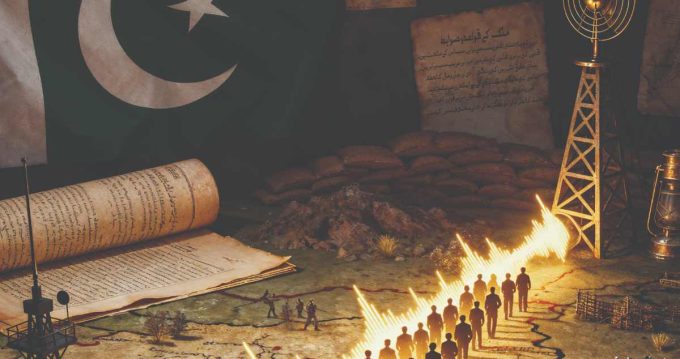

Music in Pakistan has always meant more than entertainment. Today, it drives culture, careers, and commerce alike. This issue, Perfect Pitch: Music Meets Marketing, traces the journey from qawwali to algorithms, and how sound now shapes both identity, influence and economy.
Ah, music, the great unifier, the great escape, the thing that somehow makes everything feel a little more bearable and a little more beautiful. We have been making it for at least 40,000 years, ever since early humans shaped bone and ivory into flutes and discovered that breath could become sound. Something in us is compelled to listen, to create, to return to it again and again.
Why that is remains a question for philosophers and neuroscientists alike. What is certain, however, is that music has never loosened its grip on us. If anything, it has only grown larger, louder, and more central to the way we live.
There was a time when MTV Pakistan put local music on global airwaves, defining a generation through sound. Piracy, censorship, and collapsing platforms followed, pushing the industry into a long, uneasy silence. Then came Coke Studio not as a channel, but as a cultural reset…turning music into identity and restoring Pakistan’s voice on a new scale.
This is not an attempt to explain why music moves us. It is an attempt to understand where that movement has led into a complex ecosystem of artists, platforms and institutions that continues to evolve, adapt, and survive.
Imagine this:
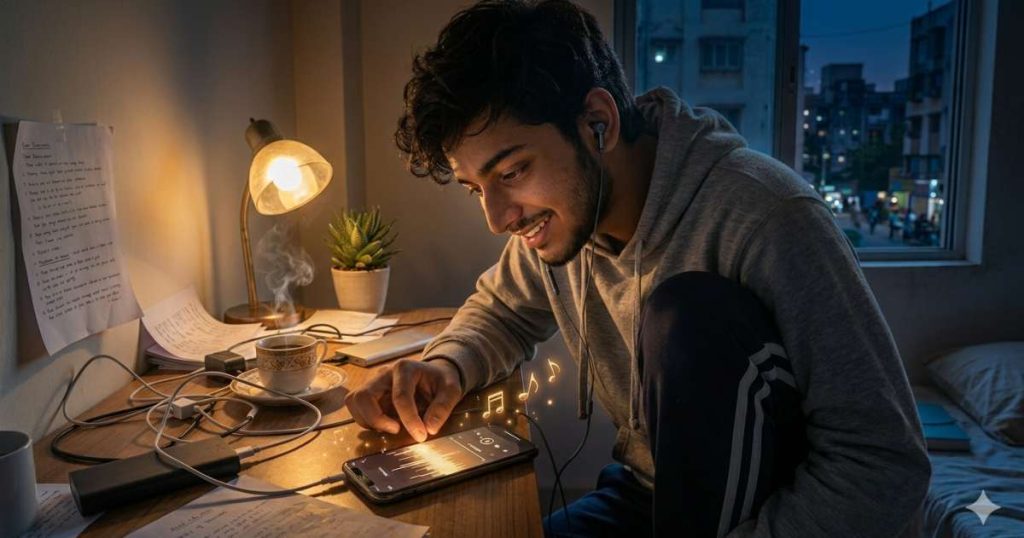
It is almost dawn, and a nineteen-year-old is bent over a cracked smartphone, with the screen glowing and sparking. He hasn’t slept, and it is not because he has been scrolling but because he’s working. A beat made on a free app. A voice note of his grandmother humming an old Punjabi tune, imperfect yet completely sacred.
He drags. Drops. Adjusts. Listens again. Hits upload. By sunrise, the track has already skipped radio stations, record labels, and the three uncles who would have said, “beta, parhai ka kya bana?” It lands instead on playlists in Karachi, Toronto and on cousin’s phone who will absolutely deny liking it.
Rewind – Early 2000s.
A Lahore bedroom. A wheezing computer. A stolen internet connection. Nusrat Fateh Ali Khan downloaded, burned to CD, ripped again, then chopped into loops no one asked permission for. Someone is turning devotion into something danceable, hoping the electricity doesn’t go out before the file uploads. Spiritual risk-taking, powered by piracy.
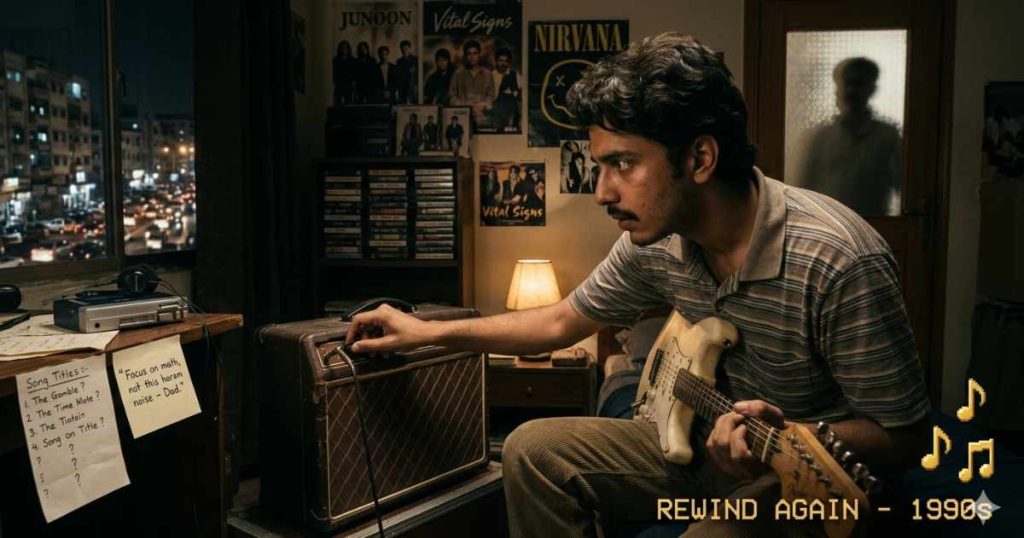
Rewind Again – The 1990s.
A young man plugs in a guitar and turns the volume down not for the neighbours, but for his parents. Pop is suspicious, rock is borderline haram. Yet, he plays. One song feels like a gamble: fame, failure, or being asked to “focus on something sensible.” Possibly all three.
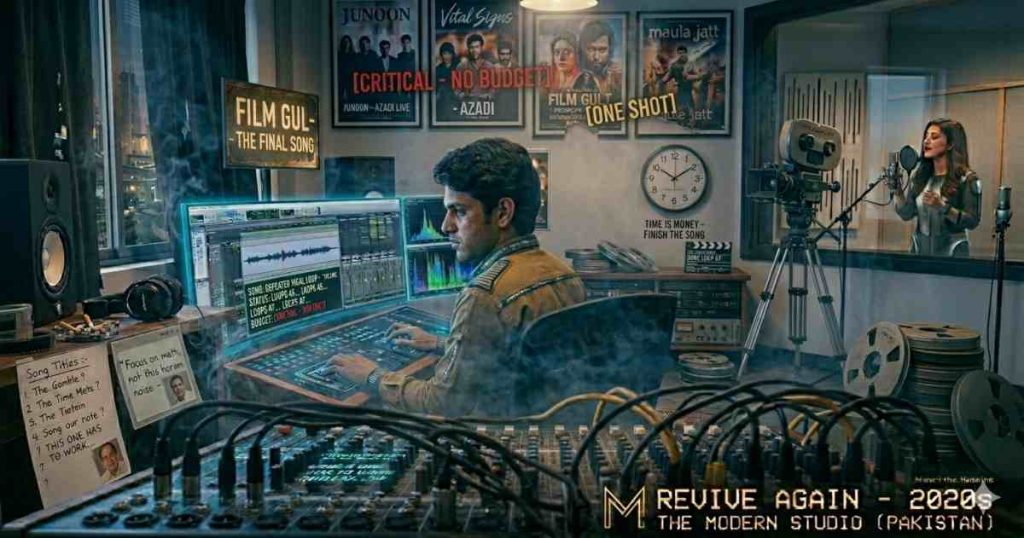
Rewind further – the 1960s.
A film studio thick with cigarette smoke and ambition. A director listens to the same line being sung again and again. This song has to work; budgets are tight, tempers tighter. If this song lands, the film survives. If it doesn’t, no one remembers anything else.
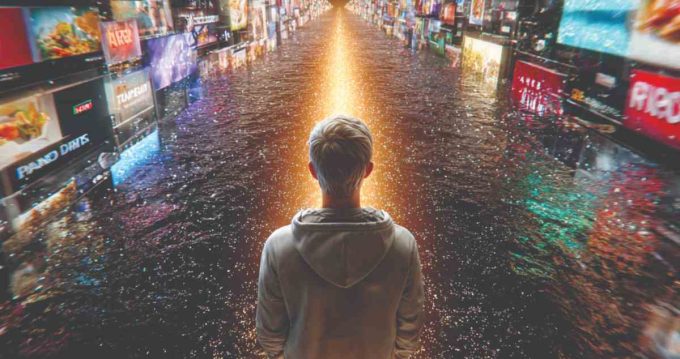
Different decades, different rooms, but with the same madness. Music was never background noise in Pakistan. It was always the main event. What has changed is not the obsession or love; it is the system. The studio has lost its walls. The audience has become the distributor. Somewhere in the background, an algorithm hums softly…deciding your mood, your phase, your playlist, sometimes before you even realise what you want.
This is the Pakistani Sound Machine
Music in Pakistan once lived in bedrooms and mehfils on crackling Walkmans, borrowed cassette players, and tapes passed around like contraband. Families gathered around radios as if they were fireplaces. Children learned the harmonium by ear because there was no other way. Vinyl stayed long after the needle had worn thin, still carrying voices from another time.
Not long ago, I found myself at an open-air event by the beach, listening to Noor Bux Baloch, a Balochi benju artist, perform live. There were barely any lyrics, no chorus to sing along to and yet the entire space felt electric. People swayed, feet tapped almost involuntarily, and eyes closed as if language itself had stepped aside to let something older speak. I had first stumbled upon him online, another algorithmic accident.
A man from Balochistan, who went viral and somehow found himself representing Pakistan on international stages. Sitting there, it hit me how effortlessly music collapses distance. How a single instrument, a stubborn rhythm, one honest note can lift a small-town musician out of geography and drop him straight into the world’s bloodstream.
That’s the thing about Pakistani music.
It doesn’t ask to be understood. It just insists on being felt. YouTube’s Pakistani viewership has exploded, with over 60% of watch time for Pakistani content coming from outside Pakistan. That means our creators are so global, even Canadians are watching Gul Sun on repeat and trying to figure out the lyrics. Pakistan’s digital music market is expected to hit 35 million users by 2030. That’s 35 million people pretending they have ‘eclectic taste’ while secretly looping Pasoori. User penetration will rise to 12.8%, which sounds technical, but really means: more people will argue about playlists than politics.
Now, artists don’t need record labels; they need reels. One viral TikTok and boom, you’re a star. Honestly, social media is the new mehfil. Except instead of chai and samosas, you get comments like ‘bro drop the link.’
Spotify says Pakistani music consumption is up 70%. Talha Anjum is the top artist again. Which means half the country is rapping along, and the other half is Googling: ‘beta, yeh Talha Anjum kaun hai?’
And here’s the kicker, Spotify’s global data shows Pakistani throwbacks, songs over 20 years old, are still dominating worldwide. So somewhere in Brazil, a guy is crying to Ali Sethi, while in London, someone is dancing to Vital Signs. Our old songs are like Pakistani aunties; they never retire; they just keep showing up at every party.
So, from mehfils to algorithms, from cassette rewinds to Spotify streams, the real evolution is this: music used to be about who had the best voice. Now it’s about who has the best Wi-Fi. This shift didn’t arrive with fireworks or press releases. It tiptoed in, like a dhol player warming up before the shaadi actually starts.
How Did We Get Here?
To understand how we got here, you have to rewind to the dusty, tactile decades of the 80s and 90s, the era when music was something you could literally hold in your hand. Back then, EMI Pakistan and Sonic were the gatekeepers of taste, power, and distribution. Between 1993 and 1995 alone, an estimated 25 million physical units moved through the country. Cassettes hissed like angry cats, CDs gleamed like family jewellery, and people made music communal: cousins swapped tapes, listeners waited all week for radio countdowns, and audiences endured endless PTV commercials just to catch a fleeting glimpse of Vital Signs or Awaz.
That world of the Mega Label has now been quietly replaced by the Mega Playlist. According to Spotify Pakistan’s 2024 data, local music consumption didn’t just grow, it surged 54% in a single year. The centre of gravity has shifted: from corporate boardrooms to digital streets, from executives to audiences, from permission to participation. Pakistan isn’t chasing Bollywood’s industrial-scale playback anymore. It’s found its own frequency, raw, unfiltered, fiercely independent and for once, it’s finally loud enough to hear itself.
This democratisation of sound isn’t just a tech upgrade; it is the heartbeat of a whole new economy. The Bollywood music industry still dances around film producers, star power, and choreography budgets bigger than our national cricket board. Pakistan’s strength? Bedrooms. Borrowed laptops. Improvised studios where creativity runs on necessity instead of funding. Indie here is not a lifestyle choice; it is survival. And half the brilliance is accidental, like discovering your cousin’s harmonium actually works as a bassline.
The business world clocked this before anyone else. Marketing executives quietly swapped billboards for beats, realising that in an era of eight-second attention spans, a catchy hook travels farther than a thousand-word slogan ever could. Consumer research backs it up: music-based ads deliver 40% higher retention and recall than boring voiceovers, that’s basically the difference between remembering a shampoo jingle and forgetting your cousin’s wedding date. In a distracted world, music has become emotional shorthand, the language of attention.
Culture is Commerce
A compelling beat can define a campaign more memorably than a slogan, because let’s be honest: nobody hums a tagline in the shower. So, brands aren’t just slapping their logos on concerts anymore…they’re producing tracks, shaping sounds, embedding themselves into the national playlist. In today’s Pakistan, culture doesn’t interrupt commerce. Culture is the commerce. Consider Pasoori, when Ali Sethi and Shae Gill dropped that track on Coke Studio in early 2022, nobody saw the aftershock coming.
It sounded like something your dadi might hum while kneading atta, except stitched to beats slick enough to make your cousin in Toronto feel cultured. Playful but aching, instantly shareable, it was the kind of song that made you cry and dance at the same time.
Social media grabbed it first, playlists followed, and within months Pasoori became the most-streamed Pakistani song on Spotify. It stormed the Viral 50 – Global chart, climbing playlists from India to Canada faster than your phuppo climbs into family WhatsApp groups. It was not just a hit; it was proof. Proof that Pakistani music could travel without subtitles, without translation, without asking permission.
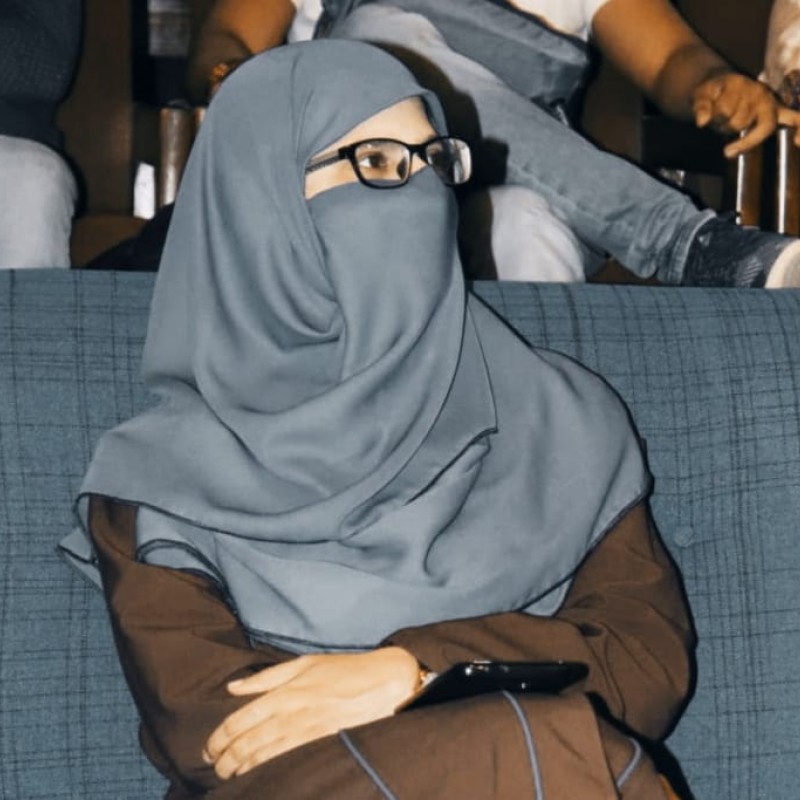
But the sound machine isn’t only selling biscuits, data plans or brand recall jingles that get stuck in your head longer than your school anthem. It’s documenting a nation in motion. Music has quietly reclaimed its oldest role: the language of the street, only now it’s amplified by Wi Fi and wrapped in algorithms. Artists like Eva B, the niqab-wearing rapper from Lyari, and Faris Shafi, whose verses cut sharper than a Karachi barber’s blade, have turned playlists into sites of resistance. Today, when a protest erupts in Islamabad or a meme catches fire in Lahore, it doesn’t stop at a slogan. It arrives with a beat. A remix. A TikTok challenge. Because in Pakistan, even dissent needs a soundtrack and preferably one you can dance to before the police show up.
The numbers don’t just hum, they scream. Spotify’s A.S.L.I. playlist, our hip hop headquarters, saw an 80% surge in listeners over the last eighteen months. That’s not a fad, that’s an archive in the making. A generation isn’t looking for escape anymore; it’s looking for reflection. The grit of Karachi alleyways, the lo-fi hush of an Islamabad winter, the restless spiritual tug of a modern qawwali, all of it bottled into verses and beats. Basically, it’s therapy, but cheaper than actual therapy.
And Pasoori? That song refused to sit still. By 2025, it became the first Coke Studio track to cross one billion streams on YouTube Music, a milestone nobody would’ve bet on back when we were still rewinding cassettes with pencils. But this isn’t just about one song; it’s about how the whole jukebox got hacked by Wi-Fi. Platforms like Spotify, YouTube, and TikTok didn’t just change the playlist; they rewired the mechanics of how music spreads.
Spotify’s partnership with Coke Studio alone pulled in 430 million streams across Season 14, proving that the real studio now lives inside your phone. The gatekeepers’ labels, radio DJs, and the uncle who insisted on ‘proper music’ have all been replaced by algorithms and audiences. Today, an artist doesn’t need a big label or radio play; they just need a cracked smartphone, a beat, and maybe a viral reel where someone’s cat dances to it.
The Shift
The beauty of this shift is its sheer democratisation. A young rapper in Karachi, spitting verses from his living room while his mother yells about the volume, now sees his streams soar. Hip-hop has officially hijacked Gen Z’s ears on Spotify Pakistan, with local streams shooting up 245% since 2022. That’s not growth, that’s a rocket launch. Punjabi music isn’t sitting quietly either: Punjabi pop consumption nearly doubled, and hip-hop listenership more than doubled in recent years. These aren’t fringe numbers; they’re the new national soundtrack. Basically, if you’re not rapping or singing in Punjabi, you’re probably just stuck in traffic.
Even playlist culture now tells the story of collective identity. Pakistanis have created 1.9 million user playlists on Spotify alone. Each one is a personal map of sound, curating everything from nostalgic Vital Signs to fresh urban tracks. And when young people across Karachi, Lahore, and Islamabad stream the same songs, they are not just consuming music; they are syncing into a shared cultural pulse. It is the sound of a country tired of being defined by others, now busy defining itself through basslines and metaphors.
But this evolution is not just cultural, it is economic. Pakistan’s music streaming audience is projected to grow to 10.6 million by 2027, nearly doubling penetration. And it underlines a bigger shift: locals are increasingly turning to legal, digital platforms for listening. In other words, piracy is finally losing to playlists. The cassette era gave us hiss, the CD era gave us scratches, and now the streaming era gives us receipts because every click, every stream, every replay is proof that Pakistan’s sound machine isn’t just alive, it’s thriving.
Streaming may still be a small slice of Pakistan’s entertainment economy, but it is the slice everyone’s fighting over. Its growth signals a bigger shift: from pirated CDs and Bluetooth transfers to monetised, trackable engagement that can actually sustain artists, producers, and creators. And it is not just about volume or reach, it’s about human stories. Take Shae Gill: once an Instagram cover artist in Lahore, now a global name almost overnight. Her leap from bedroom covers to international playlists mirrors an entire generation that treats creativity not as a hobby, but as a career path with receipts. The same goes for countless rappers whose raw verses reflect the realities of their streets…hearts, struggles, dreams, frustrations packaged not by polished studios, but by sheer authenticity and platform access.
Music Never Static But Ever Evolving
Of course, the journey isn’t without its drama. There’s always an undercurrent of debate about what “modern music” means in a society that still treasures mehfils and live qawwalis. Devotees of older formats, those who swear by the raw, jam session magic of early Coke Studio seasons, sometimes lament that the spontaneous musical conversations have been replaced by highly produced, digital-first releases optimised for feeds and algorithms. But that tension is part of the story. Music was never meant to be static; it evolves with the tools and rhythms of its time. From harmoniums to hashtags, every generation remixes the soundtrack of its soul.
Across Pakistan’s cities, global beats and local flavours are living in the same playlist. And the diaspora keeps stirring the pot. Pakistanis in the UK, US, and Canada carry these sounds far beyond borders, feeding a cycle where music from home influences foreign audiences and, in turn, reshapes how the world sees Pakistani culture.
When artists like Arooj Aftab or Taurees Habib win Grammys, it is not just about one person’s trophy; it is about a country’s sound being recognised on the global stage. One Grammy equals a thousand ‘I told you so’ from every Pakistani uncle who swore our music was world-class. The narrative is bigger than individual success; it is Pakistan’s heartbeat echoing across continents, proving that our sound machine is not just local, it’s global, algorithm- approved, and finally getting the applause it deserves.
Yet even as playlists pulse and streams climb, the heart of it all stays stubbornly human. Every remix, every viral hit, every hip-hop verse or folk fusion carries a story. And so, the narrative circles back, full beat ahead. From vinyl and radios to algorithms and playlists, from mehfils to mobile screens, Pakistan’s music has evolved beyond entertainment; it now functions as currency.
Currency of expression, of culture, of connection, of collective identity. Music here isn’t something you simply listen to anymore; it’s something you live inside. It’s the background hum of heartbreak, the bassline of resistance, the chorus of joy. And if you want proof, just check your Spotify Wrapped, it already knows your secrets.
The narrative of Pakistan’s sound machine always circles back to the human pulse. From Vital Signs in the 80s to Junoon in the 90s, and now drill rap and indie folk in the 2020s, every era has carried its own soundtrack. But in 2025, it is no longer about who sings the loudest or who has the fattest marketing budget; it’s about who gets heard. That kid in Faisalabad hitting upload isn’t just sharing a song; he is minting the new currency of a nation.
Music here is no longer a side note to history; it’s the ledger on which history is being written. Every beat is an entry, every verse a headline. And as the algorithm hums in the background, Pakistan’s song keeps evolving faster than we can hit replay, deeper than we ever imagined. Pakistan isn’t just making music anymore. It’s making history, one stream at a time.