
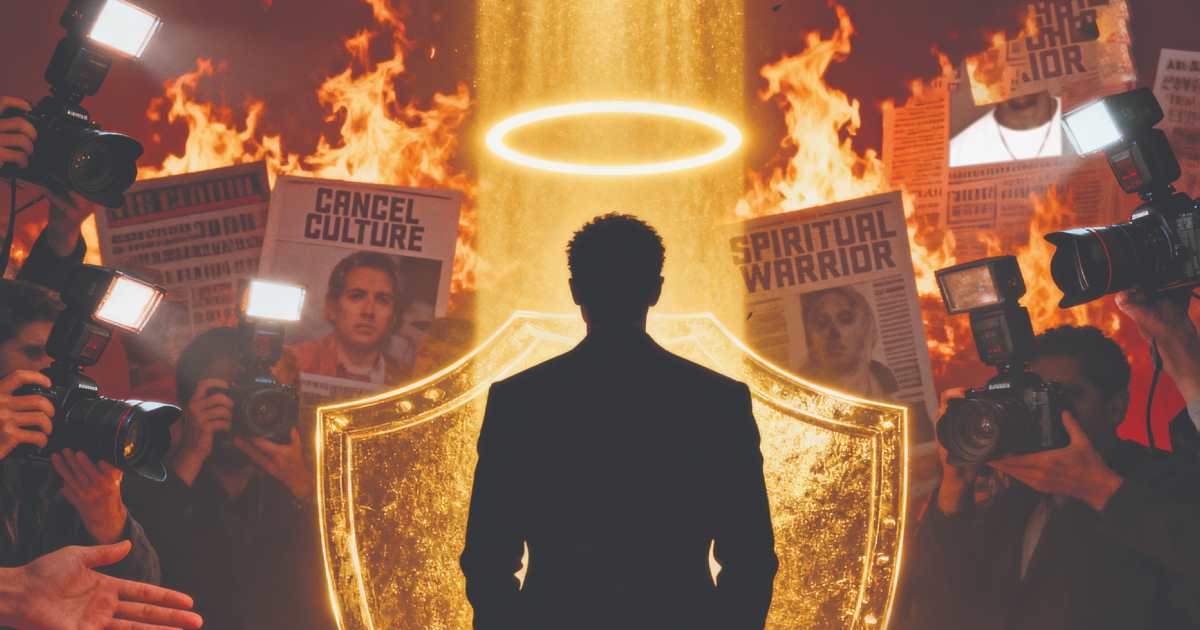
Have you noticed how, in the wake of controversy, public figures often turn to religion—not purely for atonement, but as a calculated strategy to rebuild credibility, recast their narrative, and regain public trust?
Larva creeps out of a cocoon into a prismatic butterfly. A snake sheds its old newspapery skin for fresh, new scales, and the modern celebrity, when confronted with their wrongdoings, pivots to religion.
Humans are social animals, after all, and when the public catches wind of a scandal that could fuel cancel culture, high-profile figures know that sometimes an apology just won’t do. How do you apologise for the unforgivable?
The fire escape is this way – grab the rosary!
It’s the narrative trump card: public figures pick up the sacred and turn it into a weapon to baptise themselves of their sins. Religion makes penance accessible to all, allowing the disgraced to remake their image and shape the legal and moral frameworks through which the public and the system judge them.
Managing the Impression
The public figure stands on what Erving Goffman, in his theory of Impression Management, referred to as the ‘Front Stage’. The flashy, the wiped-clean, the primped and polished version fit for the public. When a scandal hits the tabloids, the ‘Back Stage’ comes up to the front, the wreckage of their reality, the disturbing instances of what goes on in their private life. By extending their palms to religion, it becomes a blunt attempt at restorative dramaturgy, dismissing conventional apologies. The figure thus sets up an entirely new stage, switching their role, their script and the costumes.
For Karl Marx, religion was a sedative for the masses, an ‘opium of the people’. Working with this ideology, when the modern celebrity invokes faith, they drug the collective memory of the public.
The figure is now on a ‘spiritual journey’ that the public must respect, putting aside all moral outrage.
The figure is now in “Year Zero” as the idea of scandal and avarice now begins to appear like the more compelling ‘prodigal son’ narrative.
The Blueprint of Pastoral Power
Kanye West is one such figure. At a certain point in his career, West’s name became synonymous with erratic public outbursts and inexcusable political statements: Nazism, Trump’s America, you name it.
The act went on for a while, with West seeming aloof to it all. But when his multi-billion-dollar empire came under threat, West launched Sunday Service.
In the Sunday Service, West employed what Michel Foucault called Pastoral Power. A form of authority where the leading figure proclaims to be a ‘shepherd’ looking after the souls of the flock. West’s musical direction now swerved to gospel music and feverish affirmations of ‘Jesus is King’. For the public, especially the religious, his past actions now made sense. They were ‘spiritual warfare’; his questionable past was simply the path of a man on his way to enlightenment. He was not a ‘problematic’ artist; he was a man on his path.
At least, that is, until the IRS revoked the charity status of Sunday Service in 2024 due to a failure in filing taxes for a whopping three years, and when West had to fork out $1.35 million in settlements for pay and working conditions. But hey, if anyone saw sincerity in his actions, that’s on them.
The Penitent Monk and “Exomologesis”
While West led the choir, Shia LaBeouf stepped into the cloister. In 2020, LaBeouf was hit with a jarring lawsuit from former partner FKA Twigs, alleging sexual battery along with physical and emotional abuse. This was grounds for total industry exile, and LaBeouf needed a miracle. LaBeouf then performed a modern Exomologesis, a Foucaultian term for a dramatic public performance of penance.
When the matter was boiling over, he starred as a saint in the film Padre Pio and publicly announced a conversion to Catholicism. The news was brimming with claims of him having lived in his car and reaching for an “ego death”. The public sat in the front row, witnessing his suffering and humility. They were no longer judges; they were witnesses to a man in pain.
The narrative no longer spoke of visceral abuse allegations; the discourse now played out philosophical debates on ‘traditional masculinity’ and ‘human suffering’.
The victim in all of this? Nowhere to be found.
The Currency of Conversion
Perhaps most succinctly seen in the digital era, but public figures practically feed off of symbolic capital. This term, coined by Pierre Bourdieu, insists that honour and prestige are what truly permit these figures to govern attention. When a scandal erupts, this capital investment goes bankrupt.
When Andrew Tate, the most notorious name in the ‘manosphere’, faced charges of human trafficking, he switched lanes from toxic masculinity to the faith of Islam. Islam is woven with ideas of modesty, purity, but more relevantly to this conversation, forgiveness. The faith has both a massive and loyal global community as well as the theology of ‘reverting’, where all past sins wash away. When Tate found himself in a Houdini trap of scandals, investment in moral capital was what stabilised his social funds.
Yet the aftertaste couldn’t be looked away from. When Tate posted blasphemous photos of himself with the Holy Quran, it became pretty obvious that it was nothing more than a new way to spin the narrative around his moral choices.
The Spiritual Audit
The ethical vacuum of such spiritual redemption stirs up an ugly conundrum. The narrative is now a flimsy loop between the disgraced and their Creator, but what about the victim? Was their suffering accounted for? Did they receive their due reparations? Did the disgraced earn their forgiveness? It comes as no surprise that an insincere spiritual dash means leaving the victim behind, often as the scorned plot device, no more humane than Eve’s apple.
Genuine metanoia is possible, and worth believing in, but cannot be the default explanation for every religious redirection. The signs of a calculated metamorphosis need to be discerned. It doesn’t take an Ivy League mind to figure it out; it’s a film everyone has seen before. The smoke signal will always billow in the midst of the narrative: the role of the victim, and the aesthetics of apology.
A figure truly on the path to redemption would mend their harm in the secular world, treating the victim with grace and humility, paying legal debts, and keeping their head low.
In this narrative, the consequences are skimmed over, and the disgraced dives headfirst into their new beginning. The response to their actions is to put on a show of this, dress differently, speak differently, and oftentimes either dismiss or actively slander the victim.
Perhaps the only way to discern sincerity from show is to ask yourself what their actions make you feel. Did you think that the victim was treated well, compensated for their pain, and the matter handled with grace? Or did you feel sensationalised, your religious fervour and obligations tapped into, your visual and cognitive spaces bombarded with grandiose religiosity?
If it is the latter, it is worth remembering that forgiveness may be a tenet of religion, but so is accountability and justice for victims.