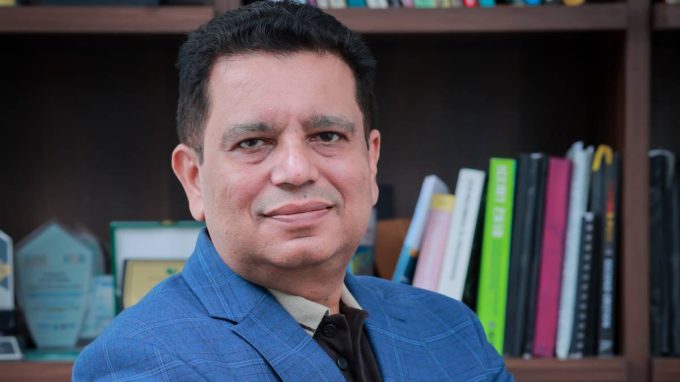


For three decades, Tahir Moosa has been at the heart of Pakistan’s visual revolution: the man behind the colours, effects, and frames that have defined some of our most memorable films and commercials. As co-founder of Sharp Image, his fingerprints are all over the country’s advertising and cinema landscape.
But today, Tahir stands at a new crossroads: AI. From virtual sets to AI-generated avatars, technology is rewriting the rules of creativity faster than ever before. Is this the dawn of limitless imagination, or the slow erosion of human craft? In this conversation, Tahir Moosa talks about the thrill, the risks and the future of storytelling in an age where even reality is up for debate.
Synergyzer: You have been shaping visuals and stories since the 1990s. From coding graphics routines as a computer science student to co-founding Sharp Image. How did you first find yourself in this field? And what was the turning point that made you realise post-production and animation would be your lifelong career?
Tahir Moosa: Like many teenagers in Pakistan, I was unsure about my career path. At the time, computer studies were popular, so I chose computer science. But I soon realised I wasn’t drawn to programming typical inventory or payroll applications; I was fascinated by computer graphics. I started writing code not to generate data, but to create visuals.
In the 1990s, digital tools for visual storytelling were still new in Pakistan, and I was captivated by the way they blended technology with creativity. The real turning point came when I co-founded Sharp Image, with the vision of building a world-class animation studio in a country where this field was still in its infancy.
Through those early projects, I discovered that post-production wasn’t just a technical process; it was where stories truly came alive. That realisation made me commit my career to this craft.
Synergyzer: Sharp Image has become a benchmark name in Pakistan’s film and advertising industry. Looking back, what do you think has made it stand out?
Tahir Moosa: From the very start, our goal was to make Sharp Image stand out by working with proper industry standards and building workflows that blend technology with storytelling. While most studios at the time offered only fragmented services, we set out to create a complete post-production hub, covering animation, VFX, on-set supervision, and colour grading, all under one roof.
Our early investment in infrastructure, including Pakistan’s first digital cinema mastering pipeline, gave us a strong edge. But more than the technology, it was the people who defined us. We built custom workflows, nurtured young talent, mentored upcoming artists, and never compromised on international quality standards. That blend of vision, innovation, and a people-first approach is what allowed Sharp Image to set benchmarks that others in the industry began to follow.
Synergyzer: Which projects or films would you say defined your career and set new benchmarks for VFX and post-production in Pakistan? And among all your work in films, commercials, and animation, which one holds a special place in your heart, and why?
Tahir Moosa: Several films have shaped my journey, each in their own way. Moor was a true milestone, both technically and aesthetically. As Pakistan’s Oscar entry, it set a new benchmark for visual storytelling. Namaloom Afraad was another turning point; it became a box-office hit, won multiple local and international awards, and inspired a new wave of filmmakers, marking the start of a new era in Pakistani cinema.
On the commercial side, working with global brands like Unilever and P&G gave me the chance to push technical boundaries and prove that our work could stand alongside international standards.
But if I had to name the one project closest to my heart, it would still be Moor. It felt like a firstborn. As a post-production professional, I had the privilege of shaping Pakistan’s first 4K production with genuine international appeal. And as the lead colourist, the responsibility of telling that story through colour made the experience deeply personal and unforgettable.
Synergyzer: AI has become the buzzword everywhere. When you think of AI in post-production and animation, what’s the first thing that comes to mind: excitement, caution, or both?
Tahir Moosa: Both. AI excites me because it opens doors we could not have imagined a decade ago, from automating repetitive tasks to generating previews and even simulating creative options. At the same time, I approach it with caution.
Storytelling is not just about producing striking visuals or impressive effects; it’s about emotion, culture, and context. AI can speed up the process, but the soul of a story will always come from human insight.
View this post on Instagram
Synergyzer: Some call AI a “third team member,” helping brainstorm, design, and even script. Do you see it as a true co-creator?
Tahir Moosa: At this stage, AI is more of an intelligent assistant than a true co-creator. It studies patterns from existing work and can produce variations at remarkable speed, which is impressive. But creativity goes beyond recombination; it is about intent, empathy, and vision. Until AI can grasp those layers, it will remain a support tool. The artistry still lies with humans, who decide when to embrace its suggestions and when to push back.
Synergyzer: How does AI change speed, cost, and creative quality compared to a fully manual project, and does it enhance creativity or risk losing the human touch?
Tahir Moosa: AI definitely speeds things up and lowers costs. Tasks like rotoscoping or clean-ups that once took days can now be done in hours. The real risk, though, is when producers see it only as a way to cut budgets instead of raising creative standards.
For me, the best use of AI is when it takes care of the heavy lifting and gives artists more room to focus on the nuances, emotions, and storytelling. Used wisely, it can push creativity forward. Used carelessly, it can strip the art down to something generic.
Synergyzer: Of all the major Pakistani films you have worked on, which challenged you most, and which award or recognition has meant the most to you?
Tahir Moosa: Moor was one of the most challenging projects I have worked on, both technically and creatively, because of its scale and emotional depth. Every frame demanded sensitivity, and as executive producer and VFX supervisor, I had to balance artistry with the pressure of delivering a film that was Pakistan’s Oscar submission.
When it comes to recognition, I feel especially honoured to be the only professional from my country who is a member of the Colourist Society International, and to have been invited to judge international awards like AICP.
Becoming a permanent member of the Telly Awards judging council has also been a highlight. Awards for my own work are deeply rewarding, but being asked to judge global talent has been even more meaningful; it validates not only my craft but also my place among peers at the highest level of the industry.
Synergyzer: Compared to international markets, where post-production can take up 25% of a film’s budget, Pakistan often allocates less than 10%. How does this gap affect the quality and global competitiveness of our films?
Tahir Moosa: That gap is one of the biggest obstacles to our global growth. Post-production is not an afterthought; it is where a film gains its polish, visual identity, and often its international viability. When budgets are thin, corners get cut, which affects everything from colour quality to VFX believability. Globally, audiences are used to seamless visuals. If we want Pakistani films to compete on that stage, we need to recognise that investing in post-production is not a cost, it is a value multiplier.
Synergyzer: Post-production houses here often struggle with recognition, budgets, and payment delays. What systemic changes are needed to better support technical professionals?
Tahir Moosa: Three shifts are crucial. First, contractual discipline, payments must be secured and disbursed on time, as delays kill morale and innovation.
Second, education, producers and agencies need to understand the real value post-production adds.
Third, industry associations, stronger guilds or bodies should advocate for technical professionals, just as directors or actors have. Recognising post-production as an equal partners is the foundation for a healthier industry.
Synergyzer: Globally, AI is transforming film with virtual sets, real-time rendering, and digital avatars. How close is Pakistan to this shift, and where does Sharp Image fit in?
Tahir Moosa: Pakistan is still playing catch-up. Limited budgets and infrastructure slow down the adoption of advanced tools like real-time rendering and virtual production. But the appetite is there, our youth are tech-savvy and exposed to global content every day.
At Sharp Image, we have always been early adopters of new technology, whether it was building customised technical infrastructure, pioneering digital cinema mastering, refining post-production workflows, or now exploring AI-assisted pre-visualisation and execution.
As these tools become more accessible, audiences in Pakistan will expect the same immersive experiences they see abroad. Studios that adapt quickly will be the ones shaping future consumer behaviour here.
Synergyzer: How do you see the next five years for the Pakistani film and animation industry? Do you envision collaborations with international studios?
Tahir Moosa: I see the industry moving toward steady growth and maturity. Local films are beginning to experiment more with genres and storytelling, which is a healthy sign. Animation has great potential, not just in branded content but also in original IP, provided there’s proper investment. International collaborations are also inevitable.
We are already working with partners abroad, and in the next five years, I expect to see more collaborations where Pakistani talent brings specialised skills to global projects. With our mix of creativity and cost advantage, we are well-positioned to be a valuable partner on the international stage.
Synergyzer: If tomorrow AI could replace 90% of what post-production professionals do, what’s the one human element you believe it could never replicate?
Tahir Moosa: Empathy. Machines can analyse data, mimic styles, or generate images, but they cannot feel. They cannot understand the cultural subtext of a smile, the weight of silence in a scene, or the emotion a director wants the audience to carry home. Storytelling is ultimately about human connection, and that spark, the ability to feel and translate emotions into visuals, is something AI will never replicate.