
Congestion in Pakistan isn’t merely inconvenient; it is a persistent economic leak, draining productivity, fuel, public health, and long-term urban competitiveness. Discover how it is impacting Pakistan.
I measure my time in traffic. Not metaphorically, but literally. How long will it take to get from one neighbourhood to another? Or how many calls can be squeezed in between stalled signals? How often does a meeting scheduled for 7 quietly begin an hour later because no one could get there on time? In Pakistan’s major cities, traffic is not a backdrop to daily life; it is daily life. Yet we continue to frame it as an irritation rather than what it truly is: a systemic failure.
Traffic congestion costs Pakistan billions each year in lost productivity, wasted fuel, and health damage. Because these losses accumulate in small increments- minutes lost here, litres of fuel consumed there- policymakers rarely factor them into serious policy discussions. They treat congestion as a lifestyle inconvenience rather than a measurable drain on national output. The result is subtle, but it is a constant erosion of economic momentum.
Time is the most unforgiving currency in any economy, and Pakistan bleeds it daily on its roads. Empirical research conducted by NED University in Karachi estimated that congestion on a single major arterial corridor cost the city approximately PKR 1 million per day, 12 years ago, when researchers factored in fuel consumption and opportunity costs. In other words, traffic congestion cost Karachi an estimated $687 million a year in 2014—roughly 2% of the city’s GDP.
Scaled across the city’s broader road network, this translates into hundreds of billions of rupees annually in economic losses. Adjust these figures for inflation, factor in the additional cars on the road and the economic cost of roads dug up for construction, and the picture becomes even more depressing. We definitely need an updated study for 2026.
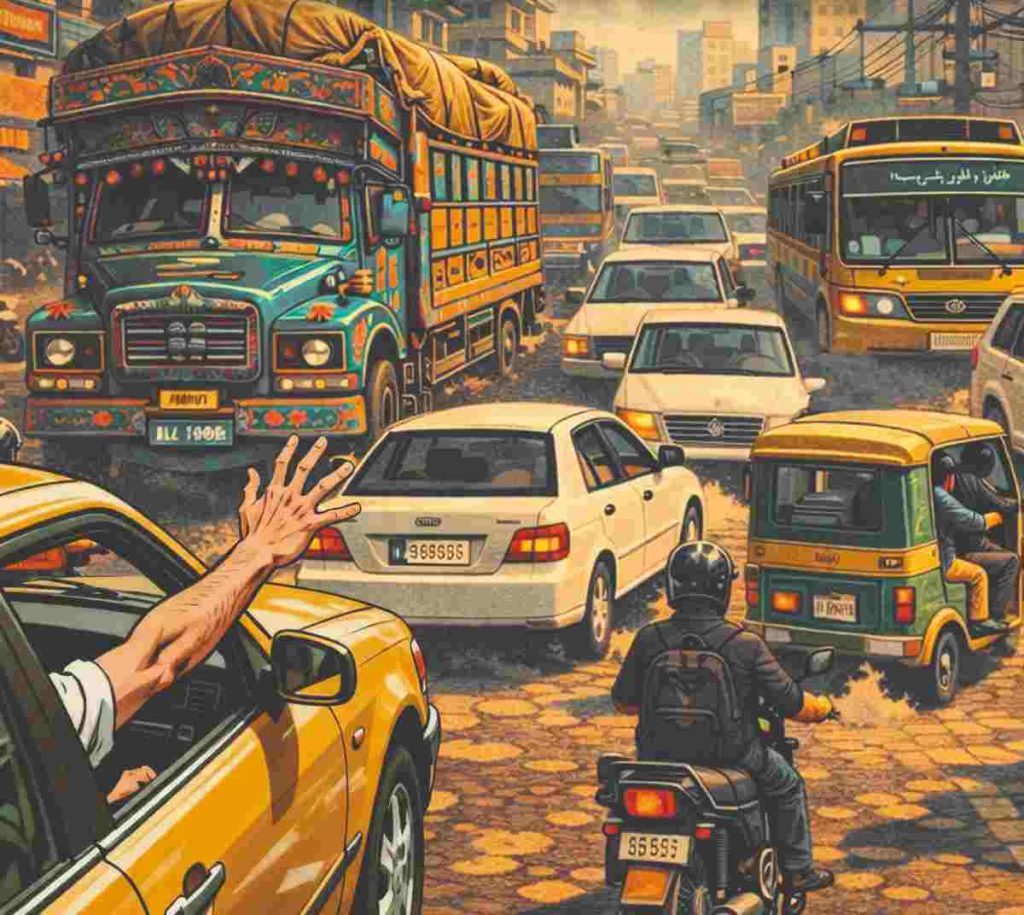
These losses are not abstract. They represent hours not worked, goods not delivered, services delayed, and informal economic activity squeezed into exhaustion. The World Bank has previously estimated that inefficiencies in Pakistan’s transport and logistics sector, including congestion, shave 4–6% off GDP annually, undermining competitiveness and regional integration.
In South Asia, the pattern is familiar: in Dhaka, commuters lose an average of 2.4 hours per day to traffic congestion, resulting in millions of lost working hours daily. In India, the projected traffic congestion costs for New Delhi come to USD 14,658 million for the year 2030. While Pakistan lacks comprehensive national studies of similar scope, urban conditions in Karachi and Lahore increasingly mirror these regional extremes.
Congestion also burns money, quite literally. Vehicles crawling through traffic consume fuel without generating movement or value.
Discussions around urban transport in Karachi have suggested that fuel worth hundreds of billions of rupees is wasted annually due to congestion and inefficient traffic flow. In a fuel-import-dependent economy, this wastage worsens the trade deficit and amplifies exposure to global energy price shocks.
According to the Pakistan Economic Survey 2025, the country now has over 6.13 million registered vehicles. A number that expands rapidly whenever macroeconomic conditions stabilise. Infrastructure and traffic management, however, have not kept pace. More vehicles without systemic reform simply mean more congestion, more fuel burned, and diminishing returns on mobility.
The economic costs of congestion extend beyond time and fuel into public health. Prolonged traffic congestion increases exposure to vehicular emissions, contributing significantly to urban air pollution. Pakistan’s major cities routinely exceed World Health Organisation limits for PM 2.5 particles, driving respiratory and cardiovascular diseases.
Research estimates that air pollution costs Pakistan approximately 6.5% of its GDP each year, as healthcare expenses, lost productivity, and premature deaths add to the economic burden. A cost that rivals or exceeds the damage caused by congestion itself. Transport accounts for a significant share of this burden, yet policymakers rarely treat traffic policy as health policy.
Despite its scale, traffic congestion remains oddly absent from serious economic debate. One reason is narrative framing. Congestion is spoken about as discomfort, something endured individually rather than as a collective system failure. Without being quantified and framed economically, traffic never becomes urgent enough to demand structural reform.
Urban responses tend to favour visible infrastructure, such as flyovers, underpasses, and bypasses, over integrated mobility strategies. Intelligent traffic systems, mass transit expansion, pedestrian infrastructure, and regulatory consistency receive fragmented attention. Congestion is managed tactically, not strategically.
Interestingly, the private sector often understands traffic better than public institutions. Marketing in Pakistan has adapted to congestion. Billboards cluster at choke points, “busy roads”, because dwell time is guaranteed. Ride-hailing platforms sell convenience in cities where public transport fails. Motorcycles thrive precisely because congestion punishes larger vehicles.
Traffic has sort of created this “captive audience”, commuters stuck long enough to consume audio content, mobile advertising, and in-car entertainment. Entire media habits now orbit traffic, which presents an opportunity for media agencies. But also a responsibility for us as society at large.
Mobility-related brands, from automakers and fuel companies to startups and insurers, do not simply operate within traffic; they shape how people move through it. There is scope for brands to promote efficiency, cleaner vehicles, shared mobility, and smarter routing, not as moral gestures, but as long-term market building. A city and even a country that moves better consumes better. The sooner we realise this, the better.
Traffic congestion must be reframed as what it truly is: an economic strain with social and health consequences. Measuring lost time, fuel waste, and health impacts should be central to urban policy, not peripheral concerns. Mobility is productivity, movement is access, congestion is inequality made visible.
Pakistan’s roads reveal more than poor planning; they show how the country loses value every day, and how unevenly it bears those losses. Until policymakers treat traffic as a national economic issue rather than a personal annoyance, the country will continue to pay for stagnation, one stalled intersection at a time. And we will keep measuring our lives in traffic, pretending that this, somehow, is normal.