
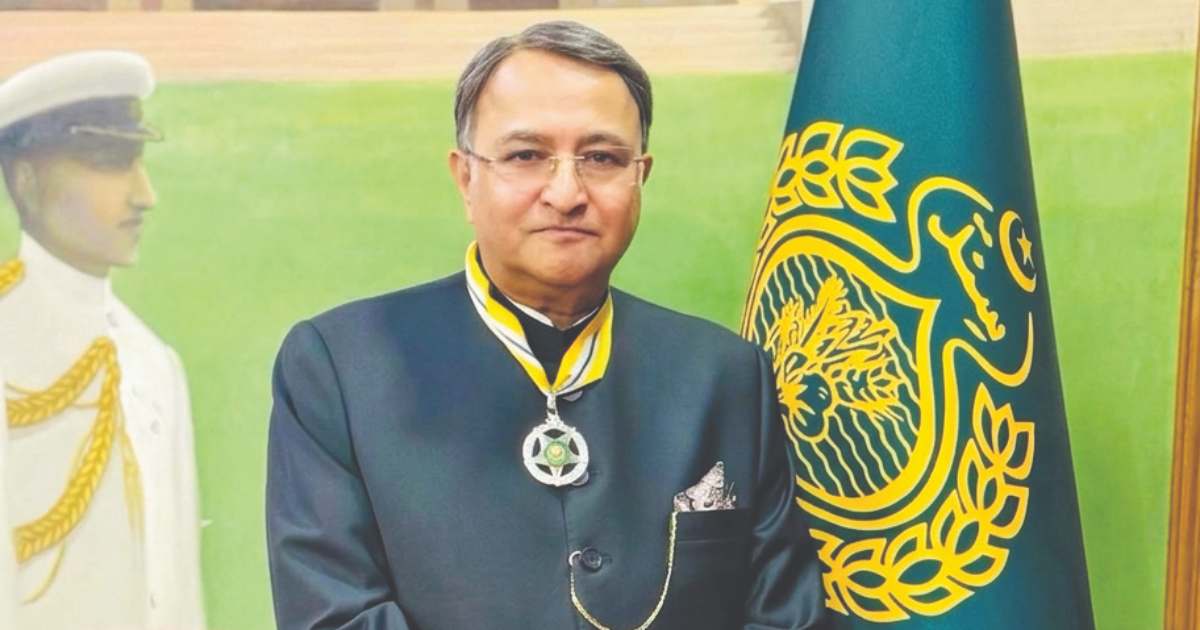
For over three decades, Senator Sarmad Ali has been a guiding force behind the conversations shaping Pakistan. Long before “narrative building” was a buzzword, he was watching our national stories unfold and reinvent themselves, in print newsrooms, and now through the chaotic lens of the digital age.
As a Senator from Sindh, President of the All Pakistan Newspapers Society (APNS) and Managing Director of the Jang Media Group, his impact is undeniable, a legacy recently honoured with the Sitara-i-Imtiaz. We sat down with him to look past the official titles and talk about what really matters: authenticity, influence, and how we tell Pakistan’s story today.
Synergyzer: Before you began shaping narratives professionally, what people, books, or experiences helped shape your own narrative and way of thinking?
Sarmad Ali: To become a well-rounded person, you need an understanding of arts, literature, culture, and history alongside an area of specialisation. Today’s education system pushes young people into narrow disciplines, but does not expose them enough to broaden their horizons with social sciences, humanities, or liberal arts. That creates professionals who are skilled, but not necessarily complete in their understanding of the world around them.
In some systems, like in the US, students are encouraged to take courses outside their major, and that makes a difference. When I was studying in the US, I also had exposure beyond my core subjects. During my undergraduate studies in Pakistan, I studied Political Science in my BA, along with Pakistan, European history, and journalism. Later, I studied communication and even took courses in Marxism and political thought in the US.
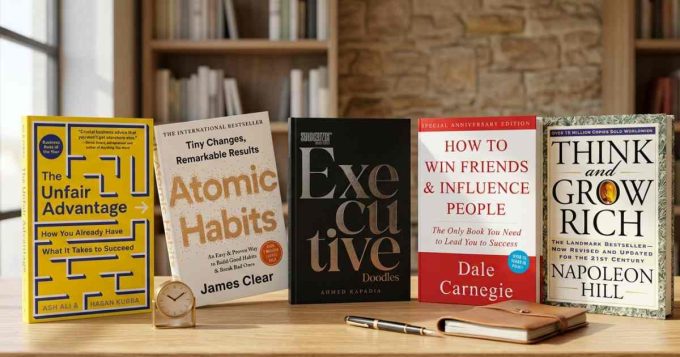
A lot of my learning also came from outside classrooms. At home, there were books everywhere because of my father. I read widely from an early age, even attempting works like Das Kapital in school, though I struggled with it then. I was also fortunate to be around people like Faiz Ahmed Faiz, Sufi Tabassum, Sadequain, and others who were close to my father. Listening to them, sitting at their feet, and reading poets like Mir, Ghalib, Iqbal and Faiz, shaped my understanding of culture and thought.
Alongside that, I read works of fiction like P.G. Wodehouse and Agatha Christie. All of this together, books, people, and conversations, formed my worldview more than any single discipline ever could.
Synergyzer: You began your career in a very different media era. What defined journalistic truth and craft then that you feel has been lost or diluted today?
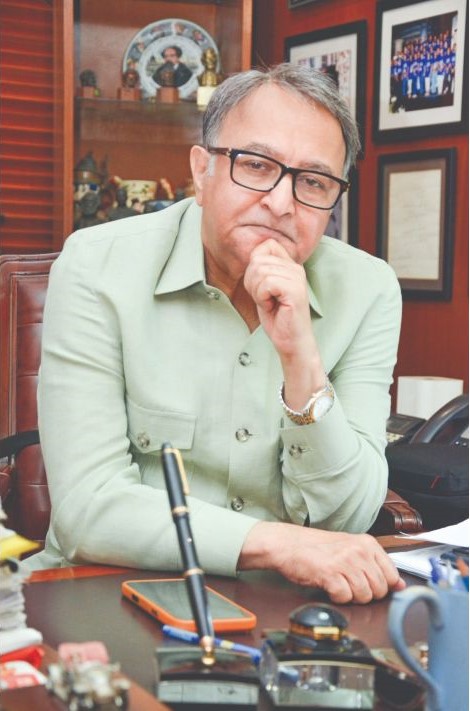
Sarmad Ali: What we have today is often not journalism in the true sense, but a mix of information, misinformation, and disinformation. Legacy media represented truth and facts; it may be declining, but in many ways, we contributed to that ourselves.
There was a time when newspapers were a daily habit, much like books. Today, much of print feels outdated by morning because audiences have already seen it on TV or online. Journalism therefore needs to evolve. Perhaps we need to move from being “newspapers” to becoming “views-papers”, focusing less on hard news and more on analysis, context, and situations. People no longer just want to know what happened, but why it happened and what it means.
Journalism must return to deeper questions, shifting from what and who to why and how. Ultimately, audiences are not platform-centric, but content-centric. They will follow wherever meaningful content exists. Journalism will survive only if it restores that meaning.
Synergyzer: You have often described Pakistan as a great product but a poor brand. Is the bigger challenge our image abroad, or our inability to consistently define and tell our own national story?
Sarmad Ali: For the last 77 years, Pakistan has not told its story clearly or consistently. As I often say, we are a great product but a poor brand. The ingredients are all there, but they have never been connected into a coherent narrative. As a result, much of the world sees a narrow image of Pakistan, shaped more by external perceptions than by our own voice.
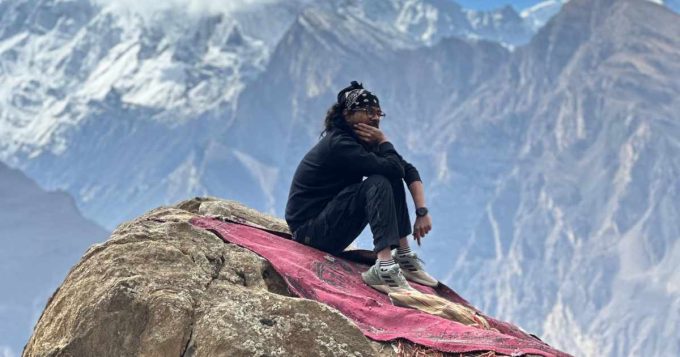
The reality is far richer. Pakistan is a country of remarkable landscapes, towering mountains, rich food traditions, and extraordinary hospitality. Yet even parts of our cultural heritage have often been absorbed into other identities because we have not consistently presented them as our own.
The deeper issue is not just perception, but authorship. Since its creation, Pakistan has struggled to define itself through a stable, shared narrative. In that vacuum, others have often defined us more easily than we have defined ourselves.
There have been moments when global perceptions shifted, but we failed to build on them. What is needed now is simple: first define our story, then tell it consistently. Only then can perception begin to reflect reality, and Pakistan move from being an unclear image to a credible and coherent brand.
Synergyzer: Trust is often described as the most valuable form of capital today. In your experience, is it built through storytelling, or through consistently living up to that story over time?
Sarmad Ali: There have long been studies measuring trust across different media. Traditionally, newspapers and established news channels ranked among the most trusted sources. Today, however, much of what people consume comes through social media, and that is where the challenge begins.
A significant amount of content circulating on these platforms is false or misleading. Repeated exposure to distorted information shapes perceptions and emotions, often creating anger, frustration, and confusion. Over time, this can contribute to a more reactive and polarised society.
We are already seeing some of these effects, particularly among younger populations. When direction and clarity are lacking, misinformation can easily fill the gap. That is why societies must take responsibility not only for telling stories, but also for ensuring that what circulates as truth does not undermine the emotional and intellectual well-being of their people.
Synergyzer: If Pakistan were a narrative, what would you say is its strongest, most enduring story, and what is the biggest myth about the country that no longer reflects reality?
Sarmad Ali: The strongest story of Pakistan is its story of hospitality, diversity, cultural heritage, food, music and, above all, the vibrancy of its youth and its resilience.
Our music is simply brilliant. From the traditional to modern fusion. You just have to tune into Coke Studio. Then there is our food, often mistakenly referred to as Indian food. What is called Indian food is actually Pakistani food. Karahi, seekh kebabs, tikka, kebabs, balti gosht and biryani are not Indian by any sense of definition. They are Pakistani. We need to take ownership of our own food and culinary experiences.
This country is not defined through a narrow lens of films such as “Dhurandar”; it is a nation defined by everyday hospitality, normalcy, diversity, liveliness and openness, qualities that rarely feature in oversimplified global narratives.
That resilience is not spoken about enough. Nor is the country’s natural beauty. The northern regions, in particular, offer some of the most breathtaking landscapes in the world, yet we often overlook them while looking elsewhere. Around 70% of our population is under 30, giving the country tremendous energy and potential.
We have also endured extraordinary challenges. Our founder passed away within the first year of independence, our first prime minister was assassinated soon after, another Prime Minister was judicially murdered, and yet another was mercilessly killed. We have lived through the traumas of war, martial law, natural disasters and even the separation of part of the country. Yet Pakistan has continued to endure and move forward.
Synergyzer: You have witnessed decades of Pakistani advertising. Is there a well-known campaign that was widely celebrated at the time but failed to change into a lasting narrative or cultural impact?
Sarmad Ali: We never really created sustained campaigns for Pakistan as a country. In the 1960s and 1970s, the Department of Tourism did attempt some early work, and a few pieces from that era were genuinely strong. Some of the best advertising work about Pakistan was produced in that period.
I remember one campaign in particular, produced by IAL that was Javed Jabbar’s early professional work there. It beautifully captured the northern areas of Pakistan in a way that was rare for its time. It was titled: ‘Guess who came to Pakistan the other day?’, Alexander, of course.
The idea behind it was essentially to present Pakistan as a place worth discovering, even attracting international attention. That was the kind of narrative-led communication we were capable of then, but we did not really build it into a consistent, long-term national brand over time.
Synergyzer: At AdAsia Lahore, you positioned Pakistan as more than just a host for an industry event. Looking back, was that simply a marketing exercise, or an attempt to reshape how Pakistan is seen internationally?
Sarmad Ali: It was essentially a statement, A marketing event, yes, but one designed to show the world a Pakistan beyond the usual stereotypes. We faced some challenges. Around 40 international delegates attended, fewer than we had originally expected.
While there was interest from India, Bangladesh, and Nepal, participation from these countries was limited, largely due to government advice. Nepal sent a small delegation, but India and Bangladesh were ultimately unable to attend.
Despite that, we had people like Richard Quest, Martin Sorrell, Randi Zuckerberg and senior executives from major international media and technology companies attended, many of them visiting Pakistan for the first time.
What stayed with us was their reaction. Several spoke about discovering a country very different from what they had imagined and expressed a desire to return. One of our key objectives was simply to give people a more accurate sense of Pakistan, and in many cases, we succeeded.
Synergyzer: You have said younger audiences are content-driven, not platform-driven, and that legacy media is struggling to adapt. In competing with the attention economy, what do you think print has misunderstood most about storytelling in the digital era?
Sarmad Ali: The core issue is that we are not producing content that genuinely connects with younger audiences. The gap is not technological, but communicational. Young people are not loyal to platforms; they are loyal to content. If it is relevant and engaging, they will consume it in any format.
Across the Wagah border, newspapers continue to thrive. The print economy remains strong, supported by colourful, content-rich editions and pricing models that sustain readership. In our case, we have not adapted in the same way. Too often, content is produced for institutions rather than readers. Newspapers become filled with official statements from political figures and organisations, treated as news even when they add little value for the audience.
What younger readers need is a shift in tone and presentation: more relevance, clearer storytelling, stronger visual appeal, and shorter, sharper content. Print must feel less like an archive of statements and more like a living, engaging experience.
Synergyzer: If Karachi is a fast-moving campaign, Lahore a long-form narrative, and Islamabad a shifting policy memo, which one wins people over in reality, and which one in theory?
Sarmad Ali: Karachi wins, hands down. Nothing matches its pace or energy. It is vibrant, restless, and constantly in motion. I often think of Karachi as a potpourri, or better yet, like haleem. Sindhis, Pashtuns, Punjabis, Saraikis, Urdu speakers, Gujaratis, Baloch, Gilgitis, Kashmiris, and many others all bring their own identities, yet in Karachi they blend into something shared: a Karachi identity. That mix and intensity are unmatched.
Lahore, by contrast, is a long-form narrative. It carries centuries of history, culture, architecture, and memory. Every street in the old city seems to tell a story. It is not rushed; it unfolds. That is its strength.
Islamabad is more like a policy memo, though an evolving one. It represents governance, institutions, and decision-making. Its character continues to change as priorities shift across political, economic, and cultural spheres. It is an important city, but a more structured and controlled one than the other two.
Each city has its own rhythm. But if you ask which one ultimately wins people over, it is Karachi, because of its sheer vitality and unpredictability.
Synergyzer: If Pakistan were reintroduced to the world in a single opening line, what would it be?
Sarmad Ali: World’s best-kept secret.
Synergyzer: Who, in your view, has stronger narrative instincts: politicians, advertisers, or Pakistani mothers at the dinner table?
Sarmad Ali: Pakistani mothers!
Synergyzer: You often say there are no shortcuts to success. In a fast, comfort-driven world, what do people most misunderstand about hard work, and what still separates those who progress from those who don’t?
Sarmad Ali: There is no shortcut to success. You cannot take an elevator to it; you have to climb the stairs. Many young people begin their careers focused on what they will get first – a cubicle, a laptop, or a phone. When we started, there was none of that. Progress came slowly, one step at a time.
Success requires honesty, integrity, perseverance, patience, and hard work. Too often, people look for shortcuts and underestimate that real growth takes time. Whatever you start, see it through. Hard work is a non-negotiable, and commitment is about ownership, not just hours.
Many begin together, but only some move ahead. The difference is not talent alone; it is discipline and consistency. I have spent more than three decades in one organisation, and that continuity came from sustained effort over time.