
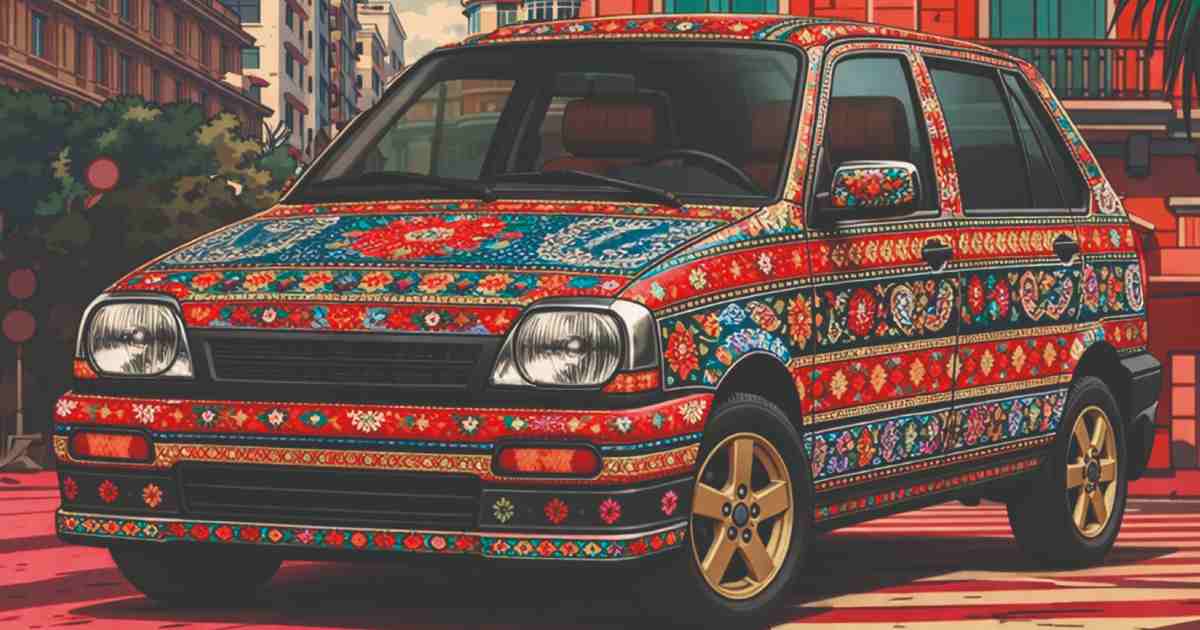
In Pakistan, every vehicle carries a story, not just passengers. What looks like congestion is actually a daily negotiation between desire, status, and survival in an economy constantly on the move.
If you really want to understand Pakistan’s economy, do not start with stock markets or chambers of commerce. Start with a traffic signal. Any major intersection will do. Lahore. Karachi. Islamabad. The light turns red and suddenly the entire ecosystem of Pakistani mobility pulls up bumper to bumper. A motorbike with three passengers. A Wagon-R edging forward with quiet confidence. A rickshaw vibrating like it runs on pure optimism. A delivery rider checking his phone. A bus sustaining the weight of commuters who have already had a long day. Every driver mutters the same resigned phrase, “bas thori der aur.” But the jam never really ends. Because traffic here is not just inconvenience; it is economics on wheels.
It looks chaotic. But it is actually a system.
By 2025, Pakistan had about 6.13 million registered vehicles on its roads, according to CEIC data. But the real story isn’t the cars. Nearly 70–75% of these vehicles are motorcycles, the humble two-wheeler that quietly powers the country’s survival economy. Affordable, repairable, and agile enough to snake through impossible traffic, motorcycles have become the backbone of everyday mobility.
Cars meanwhile, still occupy a different psychological lane. They make up roughly 15–20% of the vehicle fleet, yet dominate aspiration, advertising, and dinner-table conversations about success.
The industry behind these vehicles is substantial. Pakistan produced 128,449 motor vehicles in 2024, according to CEIC figures, a number that rebounded strongly as local assemblers recovered from production shutdowns caused by import restrictions and inflation. Meanwhile, demand for mobility continues to climb as the country urbanises rapidly. The Digital Census 2025 shows that 43% of Pakistan’s population now lives in cities, up sharply from the previous decade. More people in cities means more commuting, more congestion, and inevitably, more vehicles.
Financing has also become a major driver of the sector. By November 2025, auto loans had reached Rs 318 billion, according to State Bank data cited by PakWheels, reflecting renewed demand as interest rates softened and buyers cautiously returned to showrooms.
The Motorcycle Economy
But perhaps the most telling statistic lies on two wheels. Pakistan sold 1.8 million motorcycles in 2025, making it the ninth-largest motorcycle market in the world. In a country where public transport remains patchy and commutes keep getting longer, the motorcycle has become less a lifestyle choice and more an economic necessity.
Which brings us back to that traffic signal. What looks like everyday gridlock is actually a portrait of a country negotiating ambition, affordability, and survival, all at the same time. Pakistan’s roads are not just crowded. They are telling a story, and every vehicle in that jam is part of it.
When Mobility Means Independence
In most countries, a car is a convenience. In Pakistan, it is closer to autonomy. Part of the reason lies in the gaps of the transport system itself. Despite experiments with metro buses and urban rail in cities like Lahore and Islamabad, formal public transport still serves only a portion of commuters.
Estimates suggest around 20–25% of the population relies on public transport, leaving the vast majority to navigate cities through motorcycles, rickshaws, ride-hailing services, or private vehicles. A car thus is not simply about comfort; it represents control over time, safety, and daily logistics.
It is also surprising, Pakistan currently has just 11 cars for every 1,000 people, according to industry estimates cited by PakWheels, a sharp drop from the already modest 18 per 1,000 recorded in earlier years. Compared to global car ownership levels, the figure underscores how exclusive four-wheel mobility remains. This helps explain the dominance of the two-wheeler.
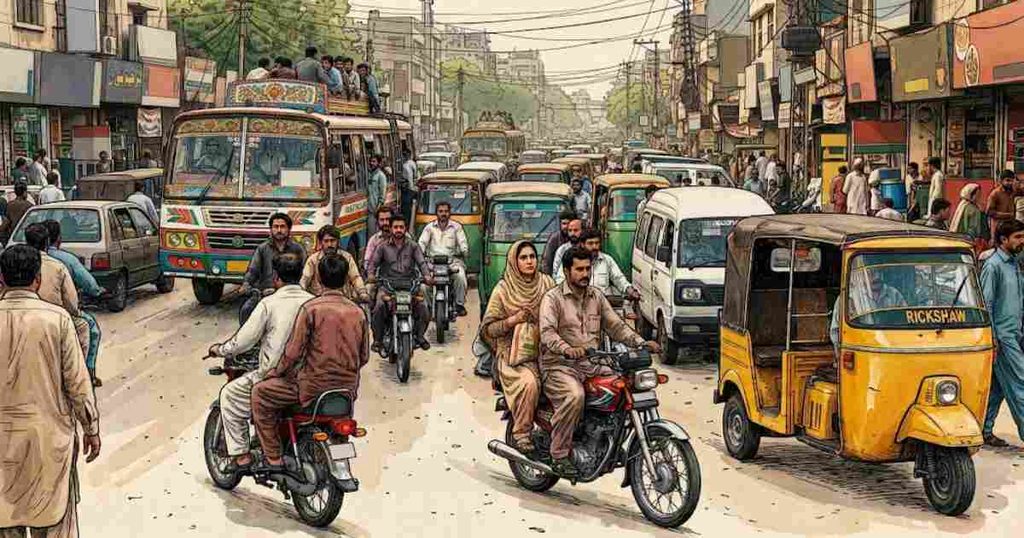
The Freedom to Move
As noted earlier, motorcycles account for roughly 70–75% of vehicles on Pakistani roads, filling the mobility gap left by limited public transport and rising car prices.
Family dynamics add another layer to the equation. Pakistan’s average household size stands at about 6.4 people (is it a ratio), meaning a single vehicle often serves multiple roles: school drop-off in the morning, office commute by day, grocery run in the evening, and a full family outing on the weekend. In that sense, the Pakistani car carries more than passengers. It carries expectation.
It is the difference between waiting for a ride and deciding when to leave. Between navigating crowded buses and controlling one’s own route. Between dependence and independence. Which is why, despite rising fuel prices and import restrictions, the desire to own a car rarely disappears. In fact, in Pakistan’s unusual economic landscape, owning a car can sometimes feel less like spending money, and more like protecting it.
When a Car Becomes a Financial Asset
In most economies, a car begins losing value the moment it leaves the showroom.
In Pakistan, the opposite happens. The reason has less to do with the automobile industry and more to do with the country’s economic instability. Currency depreciation has reshaped how Pakistanis think about vehicles. By 2025, the rupee hovered around PKR 283 US dollar, after losing nearly 20% of its value in 2023. For a market heavily dependent on imported components and CKD kits, every slide in the currency translates almost immediately into higher car prices and these price increases have been dramatic.
Industry estimates suggest new car prices surged by as much as 149% between 2018 and 2023, pushing even entry-level vehicles like the Suzuki Alto into price brackets that once belonged to mid-range sedans. Supply disruptions have only amplified the effect.
During the economic turmoil of 2023, passenger car production dropped by roughly 37%, as import restrictions prevented assemblers from securing critical parts. Showrooms ran dry, waiting lists stretched for months, and buyers began turning aggressively toward the secondary market.
The Resale Economy
The result is an unusually powerful resale ecosystem. In a typical year, around 750,000 used cars change hands compared to roughly 200,000 new vehicles, meaning the secondary market is several times larger than the primary one.
This imbalance has transformed how people think about buying a car. Instead of a depreciating purchase, the vehicle becomes something closer to a financial hedge; a movable asset that can hold value against inflation, currency shocks, and policy swings.
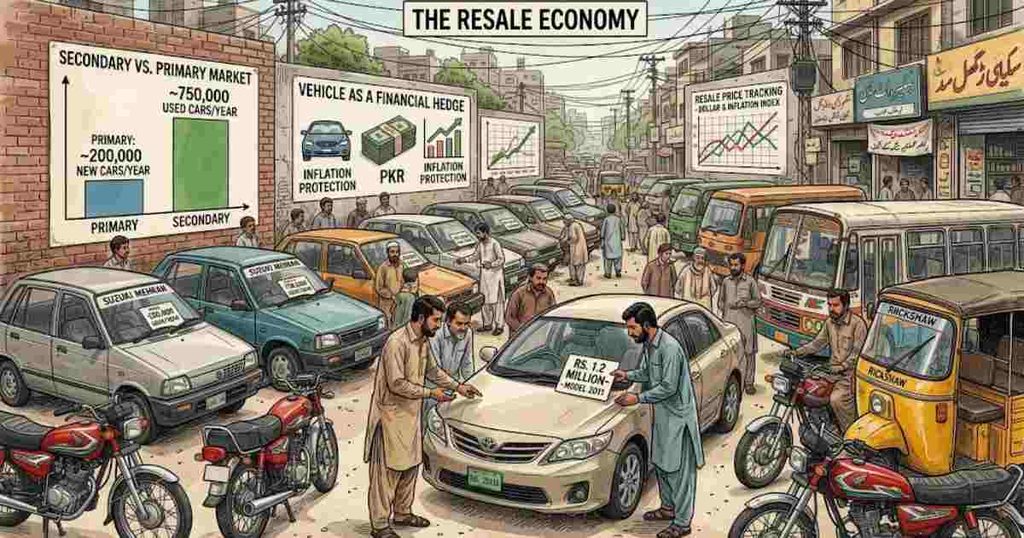
Owners do not just drive their cars, they watch the market. Resale prices are tracked the way investors track exchange rates, and timing a purchase can feel less like shopping and more like entering the market at the right moment.
In Pakistan’s unpredictable economy, mobility and money are often parked in the same garage. Here buying a car rarely ends with the purchase. In many ways, that is where the real economy begins.
The Business Behind Every Vehicle
Every vehicle on the road activates an entire chain of livelihoods: mechanics diagnosing engine problems in roadside workshops, spare-parts traders stacking imported components in crowded markets, paint shops restoring battered bumpers, and brokers negotiating resale deals between buyers who may never meet. The scale of this ecosystem is enormous.
Pakistan’s broader automotive sector supports more than 6.8 million jobs, spanning manufacturing, maintenance, sales and services with the country’s automotive market projected to have reached around $11.4 billion by 2025.
But the most visible layer of this economy sits much closer to the ground. Rickshaws, for instance, remain one of the most important mobility tools in the country. With more than one million registered three-wheelers, they dominate short-distance urban transport in cities from Karachi to Peshawar. For many drivers, the rickshaw is not just a vehicle but a small enterprise; a daily revenue stream tied directly to the rhythms of the street.
Surrounding these vehicles is an equally dense network of traders and intermediaries. Pakistan now has over 5,000 car dealers operating nationwide, many clustered in famous auto bazaars where bargaining, inspection, and negotiation form part of a ritualised marketplace culture.
Behind every polished showroom sits a far larger informal ecosystem: mechanics, electricians, denters, painters, spare-parts wholesalers, and brokers who keep vehicles circulating long after their official lifecycle should have ended.
In Pakistan’s mobility economy, the car is never just a machine. It is an engine for employment, and one of the country’s most resilient informal industries.
From Auto Bazaars to Algorithms
For decades, Pakistan’s car market ran on physical spaces: dusty auto bazaars, crowded showrooms, and long negotiations between buyers, sellers, and brokers. Today, much of that activity has quietly moved online.
Platforms like PakWheels have become the country’s largest digital showrooms. The website now attracts over 25 million visitors annually, generating more than 250 million page views from users researching prices, comparing models, and browsing listings.
In fact, nearly half of Pakistan’s internet population has visited the platform to buy or sell vehicles, reflecting how quickly car discovery has migrated from roadside dealerships to smartphone screens. In January 2026 alone, PakWheels recorded 6.15 million visits, a 22% jump from the previous month, underscoring the appetite for digital vehicle marketplaces.
When Mobility Goes Digital
Mobility itself is also becoming platform-driven. Ride-hailing services have expanded rapidly across urban Pakistan, reshaping the way people move through cities. The international platform ‘inDrive’ now operates in 20 Pakistani cities, reporting 26% growth in rides and 25% growth in active users in 2024.
Its ‘set your fare’ model, which allows riders and drivers to negotiate prices directly, mirrors the bargaining culture already familiar in Pakistan’s informal transport economy.
Likewise, platforms like Yango, launched in 2023, and Bykea, which has powered millions of low-cost bike and rickshaw rides since 2016, show how Pakistan’s mobility shift is not just digital, but deeply local, negotiated, and built for a price-sensitive, always-moving majority.
At the same time, mobility is increasingly tied to the country’s fintech ecosystem. According to the State Bank of Pakistan, digital payment channels now process 88% of all retail transactions by volume, totalling 1.45 billion transactions worth Rs 24 trillion. Ride-hailing platforms, toll systems, and even traffic fines are now integrated into these digital payment networks.
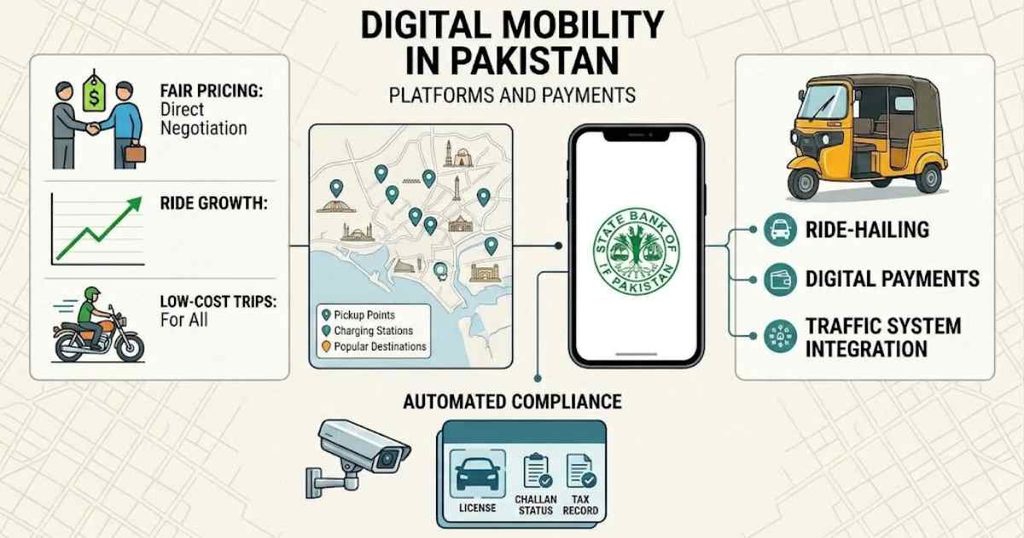
Traffic enforcement itself has entered the data age. Safe City surveillance systems and automated cameras now generate electronic challans, replacing manual fines with digitally recorded violations that can follow a vehicle across ownership transfers, tax records, and resale transactions.
In other words, the Pakistani car is no longer just a machine moving through traffic. It is becoming an intersection in a growing network of apps, payments, data, and algorithms. And as mobility moves online, so does the way cars are sold, branded, and imagined.
Selling Identity, Not Just Mobility
For decades, car advertising in Pakistan revolved around specifications: engine size, mileage, durability. Today, that formula is rapidly evolving as brands compete for attention in a far more crowded market. Brands are no longer selling machines; they are selling identities.
One of the clearest signs of this shift is the explosive growth of the SUV segment. According to estimates from Arif Habib Limited, SUVs now account for roughly 28–30% of Pakistan’s car market, a remarkable rise from just 9% in 2021.
Even conservative figures from the Pakistan Automotive Manufacturers Association (PAMA) place the segment’s share at around 18% in 2025, suggesting a rapid consumer pivot toward larger, more lifestyle-oriented vehicles.
For marketers, the SUV boom represents more than a change in body style. It signals a shift in storytelling. Advertising around SUVs increasingly leans into themes of power, independence, and masculinity, positioning the vehicle less as transport and more as a statement of presence.
At the same time, rising fuel prices and environmental awareness have created a parallel narrative around hybrid vehicles. New launches such as hybrid crossovers and plug-in models are marketed not only as technologically advanced but as responsible choices; vehicles that balance performance with efficiency.
The messaging is deliberate. SUVs promise status and dominance, hybrids signal responsibility and intelligence, while motorcycles continue to be framed as freedom and mobility for the consumers. In Pakistan’s evolving auto market, vehicles are no longer just products on wheels. They are platforms for identity and marketers know it.
The Road Ahead
If the past decade reshaped how Pakistan buys cars, the next may redefine how the country moves.
Government policy is already pointing in that direction. Under the National Electric Vehicle Policy 2025–30, Pakistan aims for 30% of all new vehicle sales to be electric by 2030, gradually rising to 50% by 2040. The policy projects potential savings of 2.07 billion liters of fuel annually, equivalent to nearly $1 billion in foreign exchange, while cutting 4.5 million tons of carbon emissions. The shift may already be taking shape.
According to the Engineering Development Board, Pakistan could soon see its first fully “Made-in-Pakistan” electric car, built entirely with locally manufactured parts. Expected later this year, it is projected to cost under Rs1 million, potentially helping motorcycle users transition to four wheels.
Alongside this, the arrival of Pakistan’s first REEV, capable of stretching over 1,100 kilometers by switching seamlessly between electric and fuel, signals a more realistic future, one where innovation adapts to infrastructure, not the other way around.
But the road to electrification will likely be gradual rather than revolutionary. For now, Pakistan’s mobility transition is likely to be hybrid, both technologically and economically. Our mobility future may not be sleek or perfectly planned, but it will almost certainly be smaller, smarter, shared, and increasingly digital.
Pakistan may still be stuck in traffic, but its mobility economy is already shifting gears beneath the chaos. The real question is no longer who owns the road, but who understands where it is headed.