
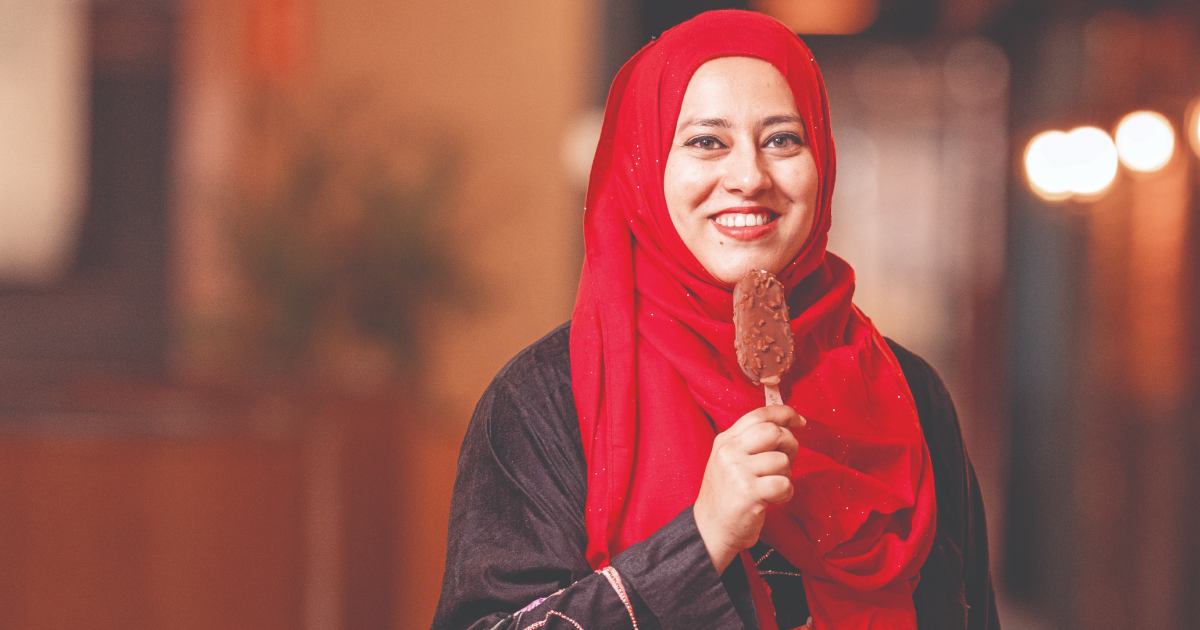
Sidra Modan, Marketing Director at The Magnum Ice Cream Company Pakistan, has spent over 12 years building and growing some of Pakistan’s most loved dairy and ice cream brands. Known for combining consumer insight with innovation, she has led brand transformation and growth across leading FMCG companies. In this conversation, she shares her perspectives on storytelling, consumer trust, and what it takes to keep brands relevant in an increasingly fragmented media landscape.
Synergyzer: Looking back on your career across leading FMCG and indulgence brands, what has most shaped your approach to marketing leadership?
Sidra Modan: During my time in marketing leadership, I have experienced COVID-19, the economic crisis beginning in 2022, and sustained double-digit inflation in the years that followed; those events fundamentally shaped how I think about leadership.
When you start out in marketing, you imagine big budgets, endless creative possibilities, and constant demand generation. But moments like these teach different lessons. First, they teach courage. During COVID-19, we had to decide whether to prioritise business continuity or continue investing in demand generation. Sometimes, the business needs something different from what your function wants. Second, they create empathy. Working on ice cream during COVID-19 reminded me that indulgence is not a necessity. People were scared and uncertain. They didn’t want to hear about new flavour launches; they wanted brands that understood what they were going through. Learning to ask, “What does my consumer need from me right now?” became incredibly important.
Finally, those years taught me discipline and agility. They showed me how quickly priorities can shift and reinforced the importance of localisation, flexibility, and adaptability. You learn that things are not always picture-perfect, and leadership is about responding quickly without losing clarity. That mindset still shapes the way I lead today.
Synergyzer: In a crowded attention economy, consumers rarely remember advertisements alone. Why do you think narrative and emotional memory have become more powerful than visibility itself?
Sidra Modan: When I started my career in 2013, it was all about visibility. Digital media was just taking off, and we were taught that your message needed to be everywhere to make an impact. Visibility itself was the goal. But today, the audience has changed. You can no longer force visibility to the point where people resent it. There is simply too much clutter. People want brands to feel relevant to their lives.
Even the best television commercial will not work unless there is sincerity behind it. If there is no emotional connection, it doesn’t land. The real question is: how do you make your brand part of somebody’s memory instead of just another advertisement?
I realised this when someone told me they associated Wall’s and Jet Sport with childhood summers and memories of grandparents who are no longer alive. That’s the power of emotional memory. It is not about product claims but it is about what people felt while experiencing it.
Today, consumers are looking for sincerity. They want to feel that a brand understands something human about them. That’s why narrative and emotional memory have become far more powerful than visibility alone.
Synergyzer: In Pakistan, indulgence often feels more social and emotional than individual. How do food, comfort, celebration, and family shape consumer behaviour?
Sidra Modan: In Pakistan, food is often a primary love language. It’s how we express affection, celebration, and sometimes even our deepest emotions. We are also, largely a community-oriented society.
That’s why food is rarely an individual act. It’s communal and meant to be shared. In much of our society, especially among women, indulgence is often something experienced together rather than alone. That is also why occasions matter so much. Food and indulgence brands become part of emotionally remembered moments, from celebrating exam results to welcoming a new child. These shared experiences are where brands naturally find meaning. And I think the sincerity of our culture lies in exactly that: people still come together around food, comfort, and celebration.
Synergyzer: Velvetti launched at a pivotal time for Magnum Company Pakistan. What consumer insight led to a vanilla-first proposition, and how do you see the brand evolving in terms of future flavours and variants?
Sidra Modan: Velvetti has, in many ways, become a flagship brand as we expand into dairy indulgence. Magnum serves a different occasion, centred on individual indulgence, while Pakistan is fundamentally a culture built around shared experiences.
The insight behind Velvetti was that consumers want indulgent, creamy experiences that also feel wholesome, authentic, and right for the family. In Pakistan, premium is often associated with something expensive or exotic. Velvetti was about creating something accessible while still feeling elevated.
That is why we began with vanilla. It is perceived as an honest, wholesome flavour. Simple, but when done right, it delivers a rich, satisfying dessert experience. It sits in that sweet spot between indulgence and familiarity. We have already launched praline and cookies and cream, with locally relevant flavours under development. The idea is to build a range that balances indulgence and cultural relevance, while staying grounded, accessible, and designed for shared family experiences.
Synergyzer: As consumers become more conscious about quality and reassurance, what does it take for a brand to build lasting trust and emotional credibility?
Sidra Modan: Long-term emotional credibility is built through consistency and by ensuring every product lives up to consumer trust. But it also comes from transparency and acknowledging when you fall short. For instance, with Cornetto, we worked to restore the quality consumers expect and reclaim leadership. Today, brands cannot simply claim a product is good; consumers, social media, and influencers all have a voice.
The proof is always in the product, the service, and how consumers feel. People are often more forgiving than we think; they value honesty. When we heard, “We love Cornetto, but the cone isn’t the best,” we listened, improved it, and communicated the four elements behind the perfect Cornetto. Trust grows when brands evolve, admit gaps, and show they are listening.
Synergyzer: As audiences shift towards emotionally familiar rather than aspirational brands, how do you approach culturally intimate, family-centred storytelling and avoid performing authenticity?
Sidra Modan: The lines are blurred. As marketeers, all we can do is use the available research, observe the world around us, and identify genuine consumer truths. We look for what will naturally resonate and what might create resentment. That is where authenticity comes from. It has to be grounded in real consumer truth. If your starting point is simply, “Let’s make a viral campaign,” the connection will never feel sincere. I have nothing against virality, but it cannot be the purpose. The real work is finding what is genuinely relevant to both the brand and the consumer. That, in my opinion, is how brands create meaningful emotional connections. They must pursue substance over spectacle and focus on creating work that matters, not just work that wins awards.
Synergyzer: There is growing pressure on brands to balance affordability with experience. How do you create a product that still feels indulgent and premium while remaining accessible to a wider consumer base?
Sidra Modan: Ice cream is a fascinating category because it speaks to everyone, and every consumer is at a different life stage with different spending power. One of my biggest learnings in marketing leadership has been accepting that we all experience products differently depending on what we can afford at a particular point in life. And there is no shame in that.
As packaged food players, we are here to serve people across economic backgrounds. I often think about my first car, a Swift. It was what I could afford at the time, and it was absolutely the right choice for me.
As life evolves, aspirations and choices evolve too, but that does not make the earlier experience any less meaningful. That is how we think about our portfolio. The goal is never to compromise on experience. What changes is the composition, the offering, and the value at each price point. Every product has to feel worth what the consumer chooses to spend.
So yes, we make ice lollies, cones, chocolate sticks, and Magnum. Different consumers define indulgence and value differently, and our role is to serve them all.
Synergyzer: How has independence reshaped Magnum Company Pakistan’s approach to innovation, speed, local consumer understanding, and the use of AI in marketing?
Sidra Modan: A lot has changed because, at the heart of this transition, was the realisation that ice cream needed its own agility, ownership, and competitive set. Earlier, we were benchmarked against categories like household staples and beauty, which are very different from snacking and beverages. Today, as a standalone ice cream company, we are faster, more agile, and better focused on the craft of ice cream. There is greater respect for local nuance. One of the biggest mistakes multinationals make is assuming a cookie-cutter approach for every market. There isn’t one. Kulfi matters in Pakistan, while gelato feels natural in Italy. Magnum Company Pakistan empowers local teams to build what works for their consumers while staying aligned to global brand identity.
As for AI, I see it as a tool. It can improve speed and responsiveness, but human sensitivity, empathy, and judgement remain central.
Synergyzer: With consumers engaging brands across TV, retail, influencers, and digital platforms, how do you maintain a coherent brand voice?
Sidra Modan: This has been quite a journey because, for years, we believed one KV and one ad had to run across every touchpoint. We had endless debates about it, especially with digital agencies. But over time, we realised coherence does not come from using the same visual everywhere. It comes from being clear about what the brand stands for.
As long as you stay rooted in the core idea, execution can adapt across platforms without losing the essence. In fact, content has to feel native to the platform, or the brand starts to feel like an imposter. If a platform is not suited to a 30-second ad, you have to pivot. Instagram is not built for that format, and even YouTube has evolved with short-form behaviour. Today, it is about communicating in the format each platform demands. When I started my career, we created 90-second films and spent huge amounts of time perfecting them. Today, I tell my teams: don’t complain about limited media budgets if you are not willing to create concise, platform-relevant communication.
So, the challenge is not coherence. If the big idea is strong enough, the voice stays intact. The real task is making that idea work naturally across every platform.
Synergyzer: What will define culturally relevant brands in Pakistan over the next decade beyond product?
Sidra Modan: I’ll be honest, I am a bit confused about this one myself. We keep turning every generation into a separate entity. When I started out, it was all about millennials. Now it’s Gen Z, while millennials are raising Gen Alpha. What matters is recognising that nobody is buying a product; they are buying experiences.
Each generation is more informed and expressive than the one before, so the human truth has to evolve. You cannot rely on how things were sold 20 years ago. To stay relevant, you have to stay culturally connected. Today, it is less about what a brand says about me and more about whether it reflects who I am. People want something raw, sincere, and authentic. Even simple products like a water bottle have become identity signals. That’s why understanding your audience matters.
Ultimately, brands need to create meaning beyond the product. Why does it matter in my life? Why does it deserve my attention? Those are the real questions. Personally, we worry too much about generations. A generation is a generation. I am a millennial leader, talking to Gen Z while raising Gen Alpha. If you think Gen Z is the challenge, wait until my daughter becomes the decision-maker.