

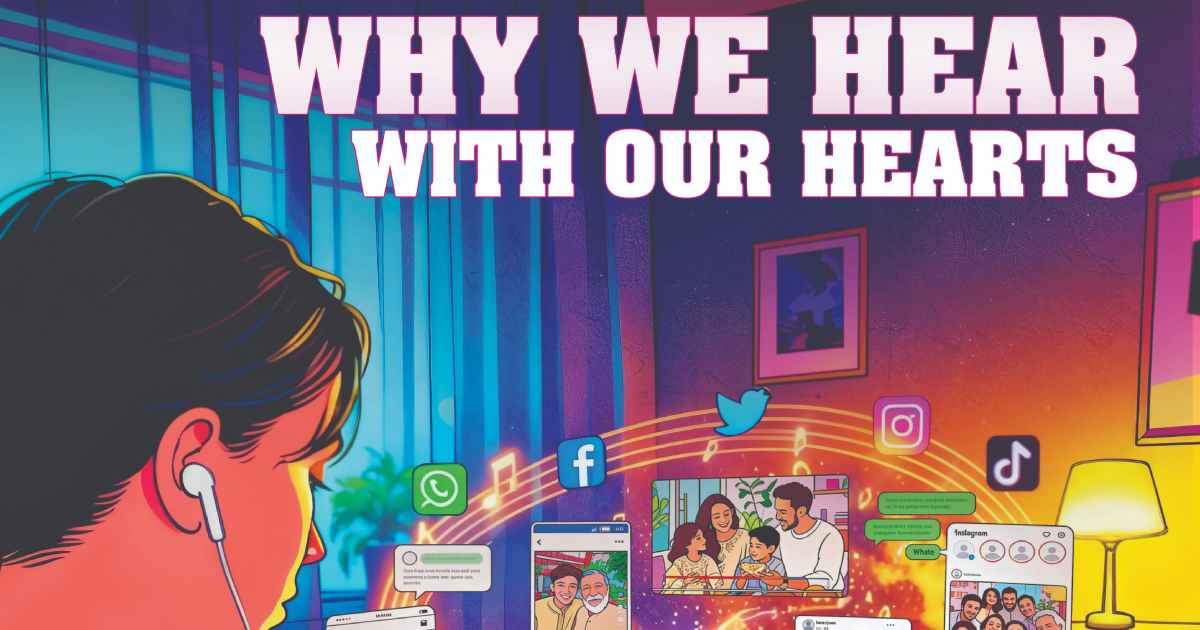
Music moves us on multiple levels: emotionally, socially, and physiologically. Its power to trigger memories, evoke feelings, and create shared moments shows that every note is more than entertainment. For marketers, this means music can be a strategic tool to engage, connect, and resonate long after the first listen. Read more to find out the why, how and what.
Some songs arrive so suddenly that they feel like portals. You are driving, the radio crackles, and a familiar chorus washes over you. In a second, you are a teenager again, a mixture of excitement and uncertainty, the world still wide open.
For me, that moment came with A.R. Rahman’s Dil Se and Taal. As a teenager, I was drawn to the layered rhythms, unusual melodic twists, and sweeping vocals, but I did not yet understand the full impact they were having on my brain. They were not just songs; they were anchors of feeling.
Years later, in my twenties, I discovered Coke Studio under Rohail Hyatt. By then, I was beginning my professional journey, and the live-studio spontaneity of Coke Studio resonated differently; I listened not just to feel, but to notice: how instruments layered, how voices converged, how tradition met creativity.
My teenage obsession with Rahman had taught me what to feel; Coke Studio taught me how to listen. Together, they charted a path from raw emotional impact to attentive appreciation. For me, it was a journey as relevant in marketing and brand strategy as it was in music.
So why do certain songs carry this power? Neuroscience offers some insight. Listening to music engages multiple brain regions simultaneously. The auditory cortex processes the sounds, but the limbic system – home to emotion and memory – activates as well. This is why a song can make you cry, smile, or feel instantly nostalgic.
As psychologist Elizabeth Margulis explains in her podcast, “The right song can transport us back to a particular time or a moment in our life. Music is effectively a time machine for memory.” When Rahman’s music fused with my teenage world, it was not just listening; it was a neurological imprint.
Daniel J. Levitin, in ‘This is Your Brain’ on music, details how music stimulates dopamine, the neurotransmitter associated with reward and pleasure. Dopamine spikes occur not just when the chorus hits, but in anticipation of it. Think of it as a neurological ‘wanting’ before ‘having.’ This explains why certain hooks or rhythmic progressions feel so satisfying: our brains are predicting the sound and rewarding us for successful anticipation. For a marketer, this is critical: human attention and engagement respond strongly to anticipation, tension, and release.
Neuroscientists also describe the ‘reminiscence bump‘, the phenomenon where experiences between ages 15 and 30 are remembered more vividly. The songs we first fall in love with during this period, like Rahman’s compositions for me, embed deeply in identity.
Later, when I listened to Coke Studio in my twenties, my attention shifted from the raw emotional impact to noticing texture and interplay: subtle harmonics, live vocal layering and cross-cultural instrumentation. This mirrors customer journeys in business: initial emotional attraction, followed by attentive, loyalty-building engagement.
Music also relies on a delicate balance of predictability and surprise. Levitin explains that music communicates emotionally through ‘systematic violations of expectation.’ If a rhythm or melody is too predictable, we disengage; if it is too random, we feel disoriented. Effective music hits the sweet spot, i.e., a combination of familiarity and novelty.
Marketing works the same way: brands must surprise without alienating, refresh without losing their identity. Coke Studio’s arrangements exemplify this principle: traditional motifs grounded in cultural familiarity, enhanced with unexpected harmonies or cross-genre experimentation.
Interestingly, research shows music influences physiological states, too. Studies measuring heart rate variability and galvanic skin response show that emotionally engaging music can induce measurable changes in stress and arousal.
Upbeat, rhythmic music can increase alertness and energy – the reason behind the music in gyms – while slow, minor-key compositions can calm or evoke introspection. For us marketers, understanding these effects allows our brands to leverage audio cues strategically, from in-store playlists to sonic branding in digital campaigns.
There is also a social neuroscience dimension. Music often involves synchronisation: clapping, dancing, and chanting. Studies reveal that synchronised activity releases oxytocin, sometimes called the ‘bonding hormone,’ which increases trust and social cohesion. Similarly, live performances by brands like Kaavish are not just auditory experiences; they are social ones, capturing both performer and listener in a shared temporal rhythm.
Music does not just affect the present; it shapes memory and narrative identity. Levitin highlights how music engages the hippocampus, key for episodic memory, and the prefrontal cortex, which integrates experience into a coherent story. Listening to Dil Se on a balmy afternoon in 1998 is not merely a memory of the song; it is encoded with emotional state, the weather, your friends, and your ambitions.
Later, when a Coke Studio arrangement plays, it overlays new textures atop those older memories, creating a layered, enriched narrative. In branding, this principle is akin to layering touchpoints, so each engagement deepens our customer’s story with the brand.
Dr Margulis emphasises that music evokes more vivid sensory detail than visuals alone. When I listen to songs by singer KK, I do not just remember the tune; I recall the smell of the air, the sensation of waiting for the bus going to IBA, and the heartbeat of anticipation. This richness is what makes sonic branding compelling: an effective audio cue does not just signal a product; it resurrects an entire experiential context.
From a practical perspective, marketers can extract several lessons. First, emotion is paramount: capture attention with the raw impact of music’s ability to trigger nostalgia and pleasure. Second, reward anticipation, build expectations and deliver them satisfyingly. Third, layer experiences, enrich basic engagement with nuance, detail, and context.
Finally, consider social and physiological effects. Music does not just entertain, it bonds, energises, and regulates arousal. For me, examples like Coke Studio and A.R. Rahman illustrate these principles naturally. A.R. Rahman gave me the visceral hook; Coke Studio taught attentive, socially and culturally enriched engagement.
Music works because it hits our brains on multiple levels that can be emotional, cognitive, social, and physiological. For us marketers, the implications are clear: design experiences that capture immediate attention, deepen over time, and create shared, memorable moments.
Just as my teenage obsession with A.R. Rahman shaped who I felt I was, and Rohail Hyatt’s Coke Studio shaped how I listened, effective branding shapes not just what people remember, but who they feel they are when interacting with your product. Emotion, memory, and context are everything.