
A sharp examination of how propaganda, media, and digital storytelling shape public perception, political memory, and the modern understanding of war.
During World War II, a single image rose to an iconic status: Uncle Sam pointing directly at the viewer, declaring, “I want you for the U.S. Army.” It was unapologetically direct, visually arresting, and deeply persuasive, soon becoming synonymous with American recruitment efforts. The poster’s power lay not just in its bold design, but in its ability to evoke a shared sense of duty and patriotism, even among those who barely understood the complexities of the war itself. Long before social media amplified messages at scale, this was narrative in its purest, most potent form, proof that storytelling has always been the spark that turns information into conviction.
When Stories Become Weapons
This ability to transform complex geopolitical realities into emotionally driven narratives is not unique to wartime America. Across history, from global conflicts to regional tensions, narratives have functioned as powerful instruments for shaping perception, mobilising populations, and legitimising action, like the current genocides happening. They simplify, select, and sometimes distort, turning multifaceted events into stories of heroes and adversaries, justice and threat.
From the propaganda machinery of the Second World War to contemporary conflicts such as the evolving tensions between the United States and Iran, the fraught relationship between India and Pakistan, and the prolonged war in Afghanistan and Palestine, the pattern remains strikingly consistent.
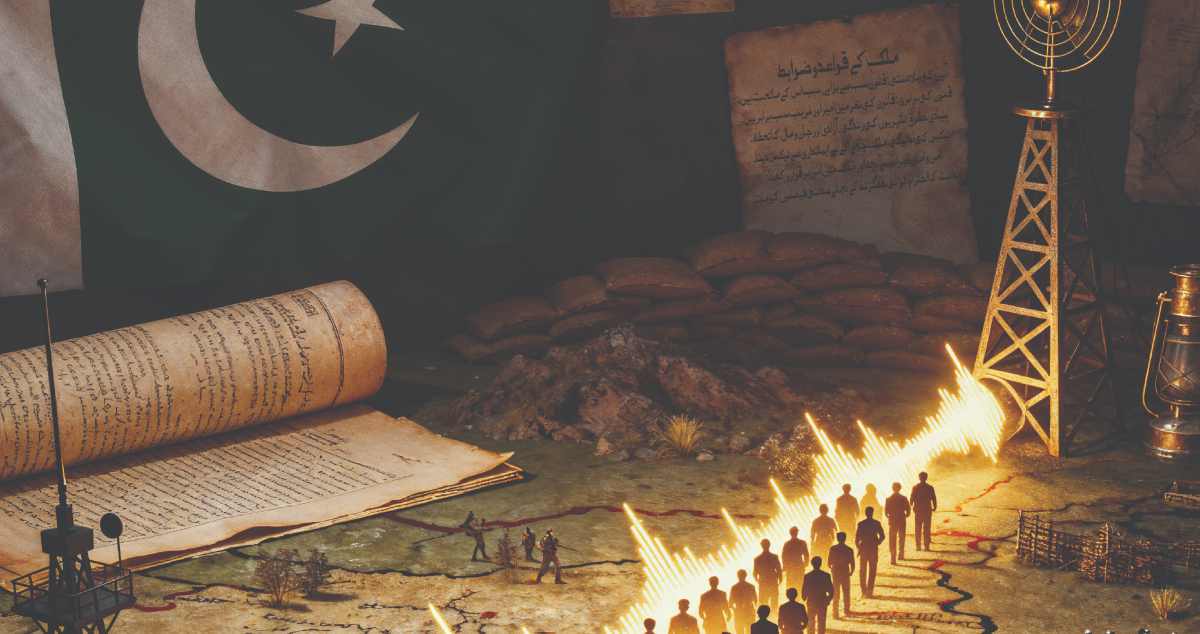
Control over territory may define the outcome of wars, but control over narrative often determines how those outcomes are understood, justified, and remembered.
Assigning Heroes, Victims and Villains
The West has a saviour complex, and every few decades it is reintroduced to the world. Countries like the United States often frame their actions through a lens of moral responsibility, presenting themselves not just as powerful but as necessary. The language is familiar: defending freedom, protecting human rights, restoring order. It is a narrative that positions the West as both judge and guardian, especially when dealing with countries outside its own hemisphere.
This framing became particularly visible in the recent conflict involving Iran. American media and official statements emphasised precision strikes on military or nuclear targets, yet alongside these claims are reports of civilian casualties, families caught in the crossfire, and thousands of lives disrupted or lost. The attack on Shajareh Tayyebeh Primary School in Minab, Iran, is a haunting example of an incident that killed around 170 people, 110 of whom were children. But the US claims to have done it to liberate women from the Iranian regime, but how do dead women feel liberated?
Moral Wars
This pattern is not new. Western powers have been using it for decades, almost perfecting how they shape the story around their actions. We can see it today in how events in Iran are presented, and we saw it clearly during the war in Afghanistan, one of the longest and most destructive wars in recent history. Even after it ended, Afghanistan continues to struggle with instability and the long-term effects of that conflict.
When War Becomes a Story
However, the rest of the world experiences war through media coverage that makes it feel distant, controlled and somewhat uncomplicated. News reports, films, and commentaries reduce a very real and violent conflict into something easier to watch and understand. This created a gap between the reality of war, and how it was perceived by the public, especially in the West.
Over time, the war was often framed as necessary and morally just. The Western soldier was shown as a hero bringing order and protection, while Afghans, and often Muslims more broadly, were placed into simple categories of either victims or perpetrators. This kind of storytelling didn’t just describe the war; it helped shape how people understood and accepted it.
Even today, a White person’s favourite Afghan is a victim of the Taliban regime. It is someone who fears persecution, looks back nostalgically at a pre-Taliban past, assigns blame solely to the Taliban, and aspires to migrate to the West.
The Manufactured Trauma
The idea of the West as a liberator is not new; it is a narrative that has been carefully constructed and repeatedly deployed. But what is framed as salvation for one audience can feel like disruption or devastation to another.
Take Iran before the 1979 revolution. Mohammad Reza Pahlavi, the Shah of Iran, was strongly backed by the United States and its allies. To the West, he represented progress: a modernising monarch who promoted secularism, expanded women’s rights on the surface, and aligned Iran with Western political and economic interests. He was, in many ways, the ideal “friendly” leader.
But this outward image masked a far more troubling reality. His regime was marked by deep corruption, extreme wealth inequality, and brutal political repression. The SAVAK, his secret police, became notorious for silencing dissent through imprisonment, torture, and intimidation. For many Iranians, this was not a period of liberation, but one of fear and control.
Yet, in Western narratives, these complexities were often downplayed or ignored. The Shah remained framed as a symbol of stability and progress because he served strategic interests. This selective storytelling reveals something crucial: the definition of a “hero” is often less about justice and more about alignment.
The Cost of a Convenient Hero
When people experience repression under leaders supported by foreign powers, it creates deep resentment and mistrust, not just toward those leaders, but toward the countries that enabled them. What is remembered locally is not the promise of reform, but the reality of suffering.
The Myth of Liberation
This is where the idea of “manufactured trauma” begins to take shape. Trauma is not only created through war and violence, but also through the stories that justify them.
When entire populations are reduced to symbols, victims to be saved or threats to be neutralised, their lived experiences are flattened. Their voices are replaced by narratives that serve distant audiences.
Truth, Re-Written in Real Time
The tools have changed today, but the objective remains the same: to influence how events are understood. What once took weeks to circulate can now spread globally within minutes, carried not just by governments or media institutions, but by ordinary individuals.
Social media platforms have transformed the nature of narrative itself. Information is presented through clips, captions, and hashtags, which are designed for rapid consumption rather than careful reflection. In this environment, complexity is often sacrificed for clarity, while clarity itself is frequently shaped by bias. People are no longer passive recipients of information; they are active participants in amplifying, reshaping, and defending the narratives they align with.
When Narratives Go Viral
This was particularly evident during the recent escalation between India and Pakistan in 2025. As tensions flared, both states produced sharply contrasting accounts of the same events. India framed its actions as targeted strikes against militant infrastructure, emphasising control and precision. Pakistan, on the other hand, highlighted civilian harm and framed the strikes as unjustified aggression.
The way these stories were sold is what really grabbed people. Jim Norton hit the nail on the head when he compared the boring screens of CNN and BBC to the pure insanity of Indian news during the border clash. Between the flying CGI jets and the dozen people screaming over each other, it wasn’t just hilarious, it was a masterclass in using chaos to distract from the truth.
What followed was not just a political standoff, but a digital one. On social media, millions of users echoed, reinforced, and intensified these narratives. Hashtags trended, videos circulated without context, and emotionally charged content travelled faster than verified information. In this space, truth became less about objective reality and more about which narrative gained traction.
The Death of Truth
The digital battlefield of 2026 has proven that you do not need to drop a bomb to destroy a truth; you only need to drown it out. We are no longer just spectators of war; we are the volunteer infantry of the narrative age, armed with ‘Share’ buttons and hashtags that act as ammunition.
When we consume a story that feels too simple, where the villains are convenient, and the heroes are familiar, we are not just being informed; we are being recruited. The question is no longer who is winning the war on ground, but who is winning the war for your outrage.
In the end, territory can be reclaimed, and buildings can be rebuilt.
But once a narrative is cemented, the truth doesn’t just die; it becomes irrelevant.