
As social media influencers turn lived experience into marketable narratives, the line between authenticity and fabrication blurs, raising questions about who shapes these stories, who controls them, and who ultimately bears the cost.
I began Aamiriat, my blog on Blogspot, back in 2011. There were no strategy decks, just rants disguised as “opinions.” Not to sound pompous, but I was part of the very early cohort writing in Pakistan’s fashion and lifestyle space long before the “creator economy” became a thing. Since then, I have watched everyone evolve and migrate. From blogs to Instagram, from Instagram to whatever is trending now. I moved too. Adapt, or you become irrelevant; there’s no romance in it. Somewhere along the way, influencers stopped being people who shared things and became people who frame things. Narrative builders, essentially.
And that is where it gets interesting. After 14–15 years on both the brand and the agency side, the question I keep circling back to is simple: how much of this is real, and how much of it is just very good performance?
Let’s not pretend that everyone does not curate and perform online. Even the ones who insist they do not are curating the hardest. I’m going to borrow examples from across the border. I’ll take that liberty because their media ecosystem is more structured, more “evolved.” It shows where we are headed.
Take Pujarini Pradhan (@lifeofpujaa). A rural Bengal creator speaking soft English, projecting simplicity that feels almost unfiltered in a very filtered space. That exact simplicity is what pushed her into virality and now, suspicion. People are questioning whether it is genuinely effortless or carefully shaped: clean framing, consistent emotional cues, unusually fast growth. Not necessarily fake, just selectively shown. She denies it all, says she shoots and edits herself in minutes, and that her agency is only for brand deals. But small inconsistencies in her origin story keep surfacing, enough to make you pause. And that is the uncomfortable bit, we do not really know. Maybe this uncertainty is exactly what holds attention now.
Then there was Nancy Tyagi (nancytyagi___), the girl who stitched her way to the Cannes red carpet. It was such a good story, perhaps too good. And of course, it cracked. Turns out one of the key looks she wore was not actually stitched by her; it was bought from a small boutique. And suddenly it wasn’t about the dress anymore, it was about the lie. Because her entire positioning was built on ‘I make my own clothes.’ Once that goes, what exactly are we left with?
At the other end, you have got someone like Becca Bloom (beccaxbloom). Queen of #RichTok, sharing an unapologetically opulent lifestyle with high-end fashion hauls. Critics accuse her of being on luxury brands’ payrolls, of faking the lifestyle and more. Maybe she is, maybe she isn’t. But again, people are not seeing her bank statements. They are consuming the idea of her life. That is exactly what brands and people watching her are buying into.
Even in beauty, we have seen this play out before. Back in 2015, Kylie Jenner was selling lip kits while insisting her fuller lips were just the result of the product. The lip-liner wasn’t the product; the illusion was. We all knew, of course. But that didn’t stop the sell-outs, or the billion-dollar valuation that followed. The admission came much later, more recently, once the business was already built.

Closer to home, we have seen our own moments gain traction and then aggressively amplify them. Instances where virality and narratives ran unchecked. Ducky Bhai and Rajab Butt may not be the first, but certainly two of the more glaring examples. Family drama as content, personal lives turned into episodic entertainment. Did it work? For them, it did. Loud, addictive, constant. and brands loved it. Soon, it became a bit desperate, a bit exploitative, run-ins with the law did not help. Audiences pulled back. Brands disappeared without any accountability.
The cycle no one likes to admit: brands help build these creators, bankroll their narratives, then pretend they had nothing to do with it when things go south.
And now we are in the next phase: young influencers pushing thirst traps and risque’ content.
Some add bite-sized “motivation” to their content, often borrowing from problematic figures like Andrew Tate. They repackage misogyny and incel-adjacent ideas as messages about discipline, hustle and self-respect, making them more palatable to local audiences. Most of it sounds like discipline, hustle, and self-respect. Harmless, almost. But these aren’t the most problematic examples.
And honestly, this is where brands need to wake up. There is a tendency now to just outsource storytelling to anyone and everyone. Find a creator, plug into their life, let them do the talking. It’s efficient, yes. But it is also lazy.
Because when you attach yourself too tightly to someone else’s narrative, you inherit all of their problems too. Today, they’re relatable. Tomorrow they are condemned. The day after, they are being questioned, and you are right there with them, whether you like it or not. Look at the example of Ganji Swag and Adnan Zafar. One badly timed political campaign, and it all went downhill.
There is also the mismatch problem, brands partnering for reach, not fit. We have all seen it. A creator who will promote anything for the right price, after all media planners just want numbers. It may work in the short term. Long term, it erodes the brand’s authenticity and consumers’ trust in both influencers and the brand.
Audiences are not stupid, at least not as much as we marketers wish. They know when an influencer is saying something because they believe it, or when they are saying it because it’s Tuesday and they have to fund their next foreign trip.
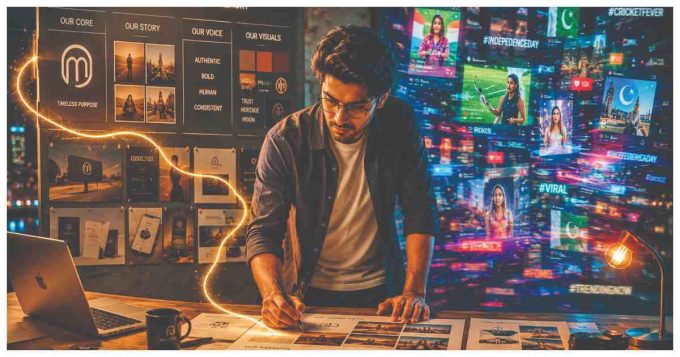
The smarter brands are the ones building their own voice alongside these collaborations. Using influencers as amplifiers, not as the entire script. Remember, influence is borrowed, and borrowed things come and go.
We still like to call it “authentic,” because parts of it are. But it’s a managed kind of real. Something edited, framed, and paced to travel well. Influencers aren’t just endorsing anymore; they are constructing narratives that brands borrow to feel human. That is where the power and the problem lies. Trust today may not be entirely earned; it has to be carefully designed.