
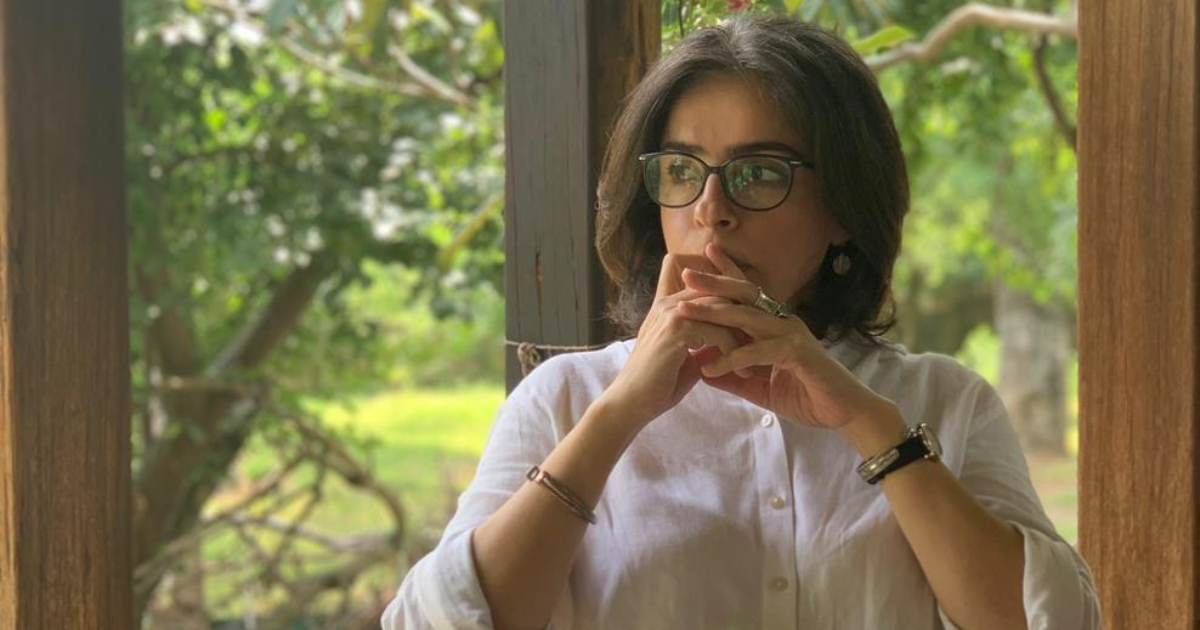
One of Pakistan’s most acclaimed contemporary writers, Bee Gul, has built a career around characters who refuse easy labels and stories that challenge social comfort zones. Whether writing Raqeeb Se, Working Women or the internationally acclaimed Jamun Ka Darakht, she has consistently resisted simplistic narratives. In this conversation, she discusses feminism, censorship, women’s autonomy and why meaningful storytelling must remain willing to unsettle.
Synergyzer: Working across television, theatre, film and digital platforms, which medium gives you the greatest intellectual freedom? And which medium frustrates you the most?
Bee Gul: When I started writing, my natural mode of expression emerged through short-form film scripts rather than long television serials. I think I have always had or still have a need to say things without over-explaining or repeating them.
Initially, writing long episodic television was a somewhat Herculean task for me. And I did find the length and structure frustrating, but after almost a decade, I think I trained my creative mind to think within that extended format as well.
Even today, my most favourite genre remains theatre writing. It frees me from the boxed structure of the screen and gives my imagination an endless, unbound space to move in. I can write more freely there, and I enjoy that sense of release deeply.
Another thing I value about theatre is the immediacy of response; the audience reaction is direct, physical and instant. Which can be both overwhelming and very alive.
However, in our context, where the theatre and film industries are still not fully established. As sustained cultural ecosystems, television continues to hold the most important position both. Also a form of entertainment and as a platform for creating dialogue within society.
Synergyzer: Your stories resist neat moral endings. Is this a challenge to Pakistani television’s expectation of punishment, redemption or a moral lesson?
Bee Gul: Moral values in a society are often shaped and influenced by religious values, and over time. They create a social structure that people feel compelled to abide by to occupy a safe and accepted space within that society.
There is a constant pressure to remain aligned with those values and an equally constant scrutiny of any deviation from them.
In the process, the natural evolution of thought is often interrupted or suppressed. A society either slows down intellectually or, at times, completely loses the ability to grow critically and organically. What remains is a culture of uniform, unthinking, unquestioning minds trying to safeguard their place within the social order.
And because human beings are naturally more complex than rigid structures allow them to be, people often end up adopting a deeply hypocritical way of living.
Outwardly, they conform. Inwardly, they continue to carry their instincts, desires, fears, contradictions and emotional truths in hiding, which then further complicates the system because the very foundations of morality become burdened with dishonesty.
Perhaps my resistance to neat moral endings comes from my discomfort with oversimplified moral binaries. Human beings are rarely that simple or resolved.
My characters evolve with the story, changing their views, behaviour, emotions and reactions as they experience different things. Human growth is slow, complicated and often contradictory. I believe storytelling should embrace that messiness rather than force easy conclusions.
Synergyzer: Pakistani dramas often frame women as symbols of sacrifice, honour, motherhood and purity. Your female characters are different. What is the thought process behind them?
Bee Gul: We live in a centuries-old patriarchal society where all of us are equally conditioned by its values and structures. Over time, this inherited thought becomes internalised and is passed on across generations.
Within this structure, women are assigned specific roles along with expectations and limitations tied to gender. The power dynamics leave very little space for individuality, voice, or independent choice. Women are often told directly or indirectly to belong to the category of a good woman by strictly adhering to patriarchal norms.
Anyone who deviates from that framework is pushed into the category of ‘bad’.
Naturally, a rebellious woman becomes threatening to such a system; she is labelled as disruptive or unacceptable. Eventually, even the idea of the good woman becomes deeply internalised, where women constantly negotiate their existence within a system that does not grant them equal space.
In such a landscape, when a woman asserts herself – questions, resists or refuses to inherit conditioning – she is often labelled as a vamp or a negative character.
For me, this process has not been pre-planned or constructed rigidly; I let my female protagonists emerge organically as opinionated, fiercely independent, questioning individuals.
Compared with the tidy moral frameworks, they may appear messy or non-conformist, but that messiness is closer to lived reality than the simplified categories we are often offered.
Synergyzer: Does Pakistani media favour the appearance of progress over meaningful representation and intellectual depth?
Bee Gul: The growth arc and behaviour of Pakistani television can be read quite clearly if we place it within the country’s political background. Political mapping and television mapping often mirror each other.
By looking at our old dramas, one can roughly bracket them into different political eras, whether the ruling power leaned towards conservatism or liberalism in its outlook.
Our drama trajectory has remained closely aligned with our political history, past, present and in many ways even our imagined future.
Today, there is a global wave of feminism that has inevitably reached our region as well. In order to remain politically and culturally relevant, it can no longer be entirely denied, so yes, we do engage with it, but often superficially.
The narrative is adopted without always being fully understood or internally processed, and as a result, it can feel imposed rather than organically developed. There are, of course, progressive voices within the industry, but even progressive language can sometimes rest on regressive foundations. Feminism is often spoken about more than it is fully inhabited or lived.
Perhaps we need more time to shed inherited values to arrive at a more honest understanding of feminism. Or we need to look more closely at our present political and social reality to understand where these contradictions are coming from.
Even today, a woman who is independent and working is still expected to simultaneously be a good wife, a good woman, and an ideal mother. While carrying a quiet, persistent guilt around her autonomy; her empowerment is often conditional, as though it is granted rather than inherently hers.
To make this shift real rather than symbolic, we will need many more decades of change in mindset. Until then, we must keep pushing through storytelling to release women from guilt, from objectification. And to move towards a fuller sense of liberation, including emotional, financial and physical autonomy.
Synergyzer: In your opinion, what is the biggest lie Pakistani dramas continue to sell about family?
Bee Gul: I believe that the constant effort to place characters within a conforming moral structure has created something very artificial, almost cardboard-like family members. They become uniform, monotonous and begin to follow a fixed pattern of neat ethical behaviour.
They are placed into boxes to fit, and as a result, the families that emerge on screen often feel black and white. Morally burdened and emotionally predictable.
In the fear of safeguarding the idea of the family structure, we often do not allow new conflicts or emotions to emerge.
Instead, they are suppressed or avoided, parents are placed on a pedestal, and the rest of the members work continuously to protect that structure.
Because they believe its artificial balance is too fragile to allow new emotions like fear, insecurity, contradiction or disruption. Everything must remain familiar, controlled and aligned with an approved manual of living.
Synergyzer: How do you navigate artistic integrity within the pressures of censorship, TRPs, and commercial television demands?
Bee Gul: When I say television holds the most important position in the performing arts and entertainment in our context. We cannot ignore the fact that it also holds immense power to shape, influence and sometimes control the mindset of its audience. This makes it both a cultural and political instrument, and it is used as such.
Because of this, the industry enforces strict scrutiny through formal censorship and, more significantly, TRP ratings. Writers are often led to believe that the wider audience rejects or disapproves of their non-conformist ideas, and the industry uses TRP ratings to support this assumption.
In my opinion, TRPs function as the most powerful informal censorship mechanism the industry operates under.
It took me longer to establish an authentic space for my voice. And I consider that the price I paid was a price I paid consciously with both consent and dignity. I do believe that the emergence of OTT platforms and digital media may eventually create more space for non-conformist voices and more diverse storytelling.
At the same time, I have managed to retain a position within the commercial television system, not entirely outside it but not completely absorbed by it either.
I take pride in that balance: I am not willing to lose that space. Rather I remain interested in sharing it with stronger, newer and more progressive voices that continue to emerge.
Synergyzer: Do you think Pakistan censors to protect the audience, or do they mainly reinforce existing social discomforts?
Bee Gul: I believe the policy often endorses social discomfort by framing it as moral protection or fear. The idea becomes that the purpose of telling an uncomfortable story is to prevent society from following that trajectory to instil fear of consequence, rather than encourage reflection.
For example, when my series ‘Working Women’ was aired. There was an interpretation in some circles that it was endorsing the idea of keeping women indoors to protect them from an abusive outside world.
In that reading, the intention was to reinforce values of haya and sharam. And the notion of protecting aurat ki izzat by suggesting that society is too unsafe or too barbaric for women to step into it.
I like to believe that this reading ultimately backfired; rather than reinforcing that perspective, it opened up a conversation. Although an uncomfortable one, about the very structures it was presumed to endorse.
Synergyzer: How do you balance global reach with staying rooted in your own social and linguistic reality?
Bee Gul: As a creative mind and as someone deeply passionate about storytelling, I do enjoy exploring new ways of telling stories. And reaching a broader audience. I am open to writing that engages with a more global sensibility, and I welcome those opportunities whenever they arise.
However, I also believe my stories are rooted in my immediate society; they are anchored in this soil, in its language contradictions and lived realities.
I have never felt the need to adopt an immigrant gaze on my own context. Even when opportunities have allowed me to do so, I prefer to remain within the experience rather than observe it from a distance.
For me, it is important to breathe the same air and walk the same ground as the people. And stories I am writing about, rather than narrating them from afar.
Synergyzer: How does narrative structure shape your socially driven work? And what did the global reach of Jamun Ka Darakht reveal?
Bee Gul: Jamun Ka Darakht was based on the theme of the ‘Me Too’ movement, which emerged within the entertainment industry and the broader creative world. It revolves around gender-based abuse within our own industry across different spaces of performance and storytelling.
I believe the theme was globally resonant because it reflects a reality that exists across many parts of the world. Including ours, within entertainment platforms and structures of power.