
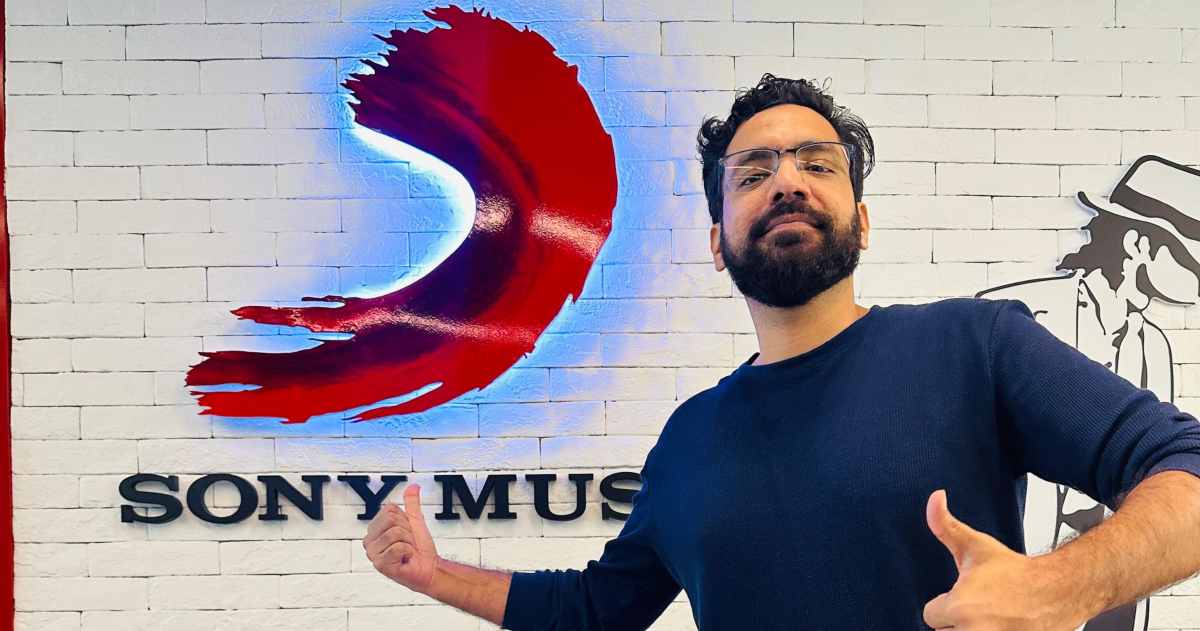
In the music ecosystem, there is a gatekeeper who does not just understand the sound, but the system. Ahmed Zawar is one of those rare figures at the intersection of art, business, and culture. A musician by instinct, a strategist by training, and now an Associate Director for Pakistan Repertoire at Sony Music. He carries two worlds on his shoulders: the dreamer who wrote songs in Karachi, and the executive pushing Pakistani music towards global stages. His work spans artists, rights, IP, digital distribution, strategy and storytelling. If Pakistani music is preparing for a global leap, he is helping build the runway.
Synergyzer: From where you stand at Sony, what is the biggest structural gap stopping Pakistani music from becoming a global export?
Ahmed Zawar: Pakistani music is already a global export in 2025. The talent was always there, and now there is the ease of technology that takes your music to relevant audiences around the globe. Yes, there is a lot of room for improvement at a structural level, starting with the government recognising art and music as a soft economy, and then creating more public and cultural spaces for live music.
As well as teaching music to our kids early by updating decades-old education systems and syllabuses. But that’s always a long road, and I do see improvements there as well. What matters most is that this is the age of the unstructured, with the power of technology and social media in everyone’s hands. Even if you don’t get that conventional support from the top, you can still make it, and that is the beauty of our times.
Synergyzer: When you are scouting artists for Sony, when do you know: “this person will make it”?
Ahmed Zawar: Poetry and melody! No matter how much science one wants to put into scouting methods, there is no denying that music that can create ripples is, at the end of the day, simply really good. Of course, because of the lack of reach to everyone due to our limitations as humans, and also the tendency for constant human error, you will eventually miss out on a lot of great talent, but I like to keep things very simple. I sit down with no distractions, put on my best headphones, and just listen to the music people have sent me, feel it, and then decide if it can work.
Also, Pakistani music that transcends borders is mostly the kind that has great poetry and strong use of Urdu; that is our biggest strength. Despite having a much bigger industry across the border, their general hold on the preferred language of entertainment, that is Urdu, is not as good as ours in fact, not even close. That’s why Karachi rap becomes the front face of South Asian hip-hop, because we write more authentically. Anything that the rest of the world will lack and we will have more of is the kind of music that will cut through the queues internationally.
Synergyzer: Pakistan is still warming up to the idea of intellectual property as power. What is the one misconception about music rights that you want to fix?
Ahmed Zawar: I feel music rights are overrated. A genuine musician will always have the capability to create a huge number of songs at will. They can then decide which rights to give away on a particular song, and when not to give them. You always get something in return when you forego rights. That is not a bad thing because usually it’s money.
Synergyzer: As someone who is both a musician and an executive. Where does the artist in you clash with the business in you, and who usually wins?
Ahmed Zawar: Great question! One challenge all musicians face, myself included, is the tendency to critique other people’s music. We often listen under a magnifying glass and treat our own tastes as superior. But I have learned to recognise that my opinions can be wrong too; this is a broader life lesson, not just a job lesson.
In my work, I trust my instinct and years of experience in judging what’s good, but I also remind myself to avoid bias. I rely on other skills too, understanding the market, social dynamics, and the preferences of young people, our biggest consumers, to make a final decision. It’s a careful balance of both.
Synergyzer: Sony Music invests, not just distributes. What does “investment” mean in today’s world of viral hits and short attention spans?
Ahmed Zawar: Investment means that Sony Music is willing to trust you as an artist before anyone else, even your audiences. We will pay you regardless of how your music performs and market it to the best of our abilities and with our resources, wherever your music can find an audience in the world, without knowing if they will like it. That is the kind of love a label has for an artist.
Synergyzer: You have said IP is an artist’s greatest strength. Why do you think Pakistani artists still treat it like an afterthought?
Ahmed Zawar: The afterthought is just how we are tuned as a society. Our mamus take our mother’s property shares, and chachas make us sign lengthy documents to get more of dada’s estate. Nobody is willing to read any document; it always feels like such a stretch. The core issue is the legal framework being so outdated. It is the same 50-rupee stamp paper and a guy with a desk on a footpath, willing to put random stamps on them because you need them as a requirement. Nobody even tries to understand the system because, like I said, it feels outdated.
So, a bechara artist who is just 19 and wants to make good music will just want to do that, and not get stuck with rights and documents because they are so hard to understand. We need reforms and ease of law for the common citizen; that will change everything.
Synergyzer: Music rights decide who gets paid and who gets erased. Any story that shows how serious it can get?
Ahmed Zawar: I think the most repeated story in Pakistan is that of a famous local company taking money from almost every music show and ad for their usage of a lot of our great music from the 1970s and 1980s. I don’t think there was much discussion or practice of rights back then, so somebody later just saw a vacuum, took these old songs re-recorded, and started claiming licensing money from that. Smart, but built on taking advantage from a lack of understanding among people of the differences between the multiple rights a song entails.
Synergyzer: Pakistani music has had its “global moments” like Coke Studio, Ms. Marvel, and viral OSTs. What would it take for Pakistan to go from moments to momentum?
Ahmed Zawar: I believe we already have that momentum. A few years back, Coke Studio was everything Pakistani music represented on a global stage; every artist was dying to get a chance in it. If you look now, a lot of our young artists are bigger than Coke Studio or any show, for that matter. Tu Hai Kahan by AUR, Sadqay by Aashir, Nayel and Nehaal, Maand by Bayaan, Pal Pal by Afusic, Wishes by Hasan Raheem and Umair, Departure Lane by Talha Anjum, all recent global hits, yet no song was on CS, a viral OST, or in an international film.
Synergyzer: What’s the one thing Sony understands about global audiences that Pakistani artists still underestimate?
Ahmed Zawar: That South Asian Gen Z and Alpha generation around the world are more into sad songs and deep lyrics, not dance beats.
Synergyzer: Funkaarpur is your creative sanctuary. How do you switch between “corporate Ahmed solving rights puzzles” and “artist Ahmed with a guitar”?
Ahmed Zawar: I don’t think I have a big switch like that. My advice to any young artist is the same advice I would give to my artist side: Believe in your own process, and you will find your own audience. Patience!
Synergyzer: As someone managing global distribution, what does a Pakistani song need today to survive the noise of the international market?
Ahmed Zawar: Genuineness. Believe in the power of our language and in our own unique experiences, which translate into melodies and creative ideas in a song. That is what the world will notice most, because they don’t have what you have.
Synergyzer: Sony believes in quality over quantity. But in a country obsessed with “views,” how do you convince an artist to slow down and craft?
Ahmed Zawar: Actually, I never tell an artist to slow down. See, it is such a unique experience for everyone; you just have to trust your own process. In fact, I have been a big proponent of releasing as many songs as possible. For me, creativity is an ever-evolving process, a song you made today, you would not like five years down the line, because you probably won’t be able to relate to it the same way you did when you wrote it. So, my advice is to always keep releasing; don’t hold on to songs.
Synergyzer: Beverages, telecom, FMCGs, everyone uses music now. From your view at Sony, are brands shaping Pakistan’s sound, or is Pakistan’s sound shaping the brand world?
Ahmed Zawar: The Pakistani sound is finally shaping the brand world, and I couldn’t be happier about it. Artists should always rule the landscape; everyone and everything will just follow.
Synergyzer: E-Sharp is back with songs that range from political satire to existential dread. The next, are you aiming to entertain, or make people finally pay attention?
Ahmed Zawar: For me, art should always be political and political not just in the local siyasat sense, but in having an opinion. I find it really hard to write a song that does not voice some opinion of mine, even in a strange or abstract way. Yes, the music style could be anything. People will always dance harder at a rave if, in between the beats for example, they hear the iconic lines, “We don’t need no education, we don’t need no thought control,” from a song by the British band Pink Floyd.
Music is a human experience both emotional and intelligent. It will always create more ripples when you want to communicate something to your audience, because there is nothing humans love more than talking to each other. So, it is not about provoking anyone for attention; that would just be preachy. I just want to talk, and always in an entertaining way, because I love to be entertained as well. So, it’s a very cool mix.