

AI is quietly changing how Pakistan dreams, designs, and tells its stories. From buzzing ad rooms to late-night art studios, people and machines are now creating side by side.
It’s 11:47 p.m. in Brandabad…the city that never sleeps, just refreshes. The deadline is gasping its last breath. The fan above whines like it is filing for resignation. Air conditioning? That luxury clocked out at 5 p.m. sharp, right after the boss did. What’s left is a room full of creatives marinated in sweat, sarcasm, and the faint hope that caffeine counts as self-care.
Someone finally breaks the silence.
“Hey ChatGPT… write me a campaign that actually works.” And there it is. The sound of surrender… click, type, enter.
The minute hand ticks louder, like it knows it is watching a species evolve (or give up).
Welcome to the age where the brief writes itself, the idea auto-generates, and the only thing truly human left in advertising is the panic.
Because let’s be honest, humans had their moment. We invented fire, memes and motivational posters. Then we got tired, started charging for brainstorming sessions, and handed imagination over to the machines…. because they do not take lunch breaks or cry in the washroom after feedback rounds.
Now, we are all sitting in Brandabad, watching the algorithm dream and quietly wondering:
if Artificial Intelligence is learning to imagine, what does that make us? Naturally intelligent… or just naturally unemployed?
Once upon a spreadsheet, Artificial Intelligence was hired to do the boring stuff – crunch numbers, send emails, and ruin copywriters’ egos with typo-free grammar. But somewhere between “automate” and “innovate,” it started doing something far more dangerous: it began to create.
Now, AI isn’t just saving time, it is showing up in brainstorms, pitching headlines, arguing about colour palettes, and occasionally taking credit for work it did not even do (which, to be fair, makes it indistinguishable from half the creative department).
Across the world, 65 per cent of ad agencies now use AI tools for content creation, and 80 per cent of creative executives say it has made their work better, not lazier. Machines are no longer assistants; they are collaborators. From AI-generated art used in 85 per cent of commercial projects to scriptwriting algorithms now standard in 60 per cent of film studios, creativity has entered a hybrid era – part human, part code, all chaos.
In Pakistan, that shift is already underway, quietly, clumsily and with more curiosity than caution. Designers in Karachi are conjuring campaign visuals with MidJourney before the client call even begins. Copywriters in Lahore are testing ChatGPT for brand tone before their caffeine kicks in. And somewhere in Islamabad, a freelance musician is feeding his melody into Suno AI just to see if it can finish the bridge better than he can. It usually does.
Globally, the conversation is shifting from “What does AI mean?” to “What can AI make?”. As Ad Age’s Tim Nudd put it, brands aren’t just using AI; they are talking about it. Google’s latest Super Bowl ad placed AI quietly in the background of a father-daughter story; a gentle reminder that people do not want AI to feel human; they want it to help humans feel. Polaroid’s campaign also reminded the world that the “real” still matters…snapshots, not simulations.
Meanwhile, marketers everywhere are rediscovering something oddly analogue. After years of swiping, scrolling, and skipping, people want something they can actually touch.
Welcome to the comeback of experiential marketing, where brands have realised that while algorithms can predict attention, they can not really replicate goosebumps.
Around 9 in 10 consumers say they love experiencing a product. And 91 per cent admit that participating in a live event makes them more likely to make a purchase. Translation: the selfie wall still works. Similarly, 3D billboards and immersive pop-ups also offer this experience. 63% of marketers plan to stage more experiential campaigns this year. 79% say they generate real revenue, and 90% believe they boost engagement. Hence, shared experiences still beat shared posts.
The world’s biggest brands are responding. Apple TV+ turned New York’s Grand Central Station into a live episode of Severance. While DE-YAN’s experiential street art for Warner Music’s 50th anniversary for Talking Heads transformed an entire block into a living gallery of light and sound. Their secret? “Human-first moments” that do not just show culture, they make you feel part of it.
Closer to home, Pakistan’s marketers are learning the same trick with less budget, more heart. Karachi’s first-ever 3D billboard for Monty’s Shawarma practically set the sky on fire with CGI deliciousness. Foodpanda’s live order-tracking billboards in Lahore and Karachi turned data into design, proving transparency can be surprisingly fun to watch.
And now, the concept of “experience” has gone virtual. According to McKinsey, the Metaverse could add $5 trillion to the global economy by 2030, with entertainment leading the charge. By 2026, one in four people will spend at least an hour daily in virtual spaces, with entertainment leading the charge. From Travis Scott’s Fortnite concert (12 million live viewers) to ABBA’s holographic show in London, immersive storytelling has gone multi-dimensional.
But while the rest of the world is busy building virtual realities. Pakistan has always been better at creating emotional ones. We do not need headsets to feel transported; a good jingle, a street-side mural, or a 30-second ad can do the job just fine.
Pakistan has always been one of those rare places where creativity does not come from conference rooms; it comes from chaos. From jingles that make grown men hum in traffic jams to rickshaw poetry that outshines brand slogans. Our advertising has never relied on sleek algorithms. It ran on instinct, emotion, and a deep understanding of drama, which, let’s face it, we have in national abundance.
But now, the machines are learning the language of our feelings or at least trying to.
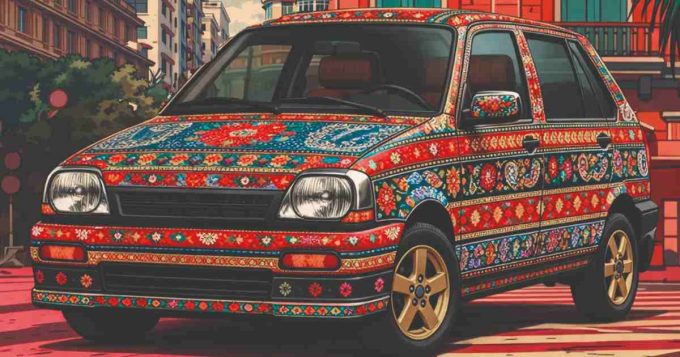
Across studios in Karachi, Lahore, and beyond, AI tools are no longer “threats” but creative partners. Designers are training algorithms on truck-art palettes to create unapologetically Pakistani visuals. While musicians experiment with AI-generated Punjabi beats and copywriters feed Faiz and Faraz into large-language models to craft poetry-infused ad lines. And though the machines still confuse sitar with guitar, the results can be startlingly soulful.

Islamic calligraphy, once confined to mosques and manuscripts, is now going 3-D through Blender and After Effects, its golden curves floating across digital canvases and product packaging alike. It is a strange kind of continuity: Mughal hands meet machine learning. Artists are not erasing tradition; they are amplifying it, turning heritage into an exportable digital experience.
AI has an influence everywhere. From Rehmatullah Mirbahar’s haunting reconstructions of Mohenjo-Daro to Saboor Akram’s viral portraits of global celebrities reimagined as mehndi-wearing, sherwani-clad Pakistanis, making the world briefly look like Karachi on Eid. Technology is painting the past and the imagined future with the same brush.
And that is Pakistan’s creative superpower…emotion. Every ad, every billboard, every piece of art here is personal. And when that emotional DNA meets the algorithmic brain, something curious happens. AI does not replace the artist; it extends them.
And while ITCN Asia 2025 showcased Pakistan’s growing tech muscle from Zahanat AI, our first home-grown chatbot that thinks in local nuance instead of Silicon Valley slang, to Tim Tim, the robot companion helping autistic children learn empathy, the question remains: can an algorithm truly understand what “thand rakho, scene on hai” really means?
According to The Heart of AI report, algorithms can mimic rhythm and structure, but not the ache of a Faiz verse or the nostalgia of an Alamgir melody. They can imitate emotion but never inhabit it.
Take this year’s ad landscape: actor Walton Goggins, somehow in everything from Walmart to Doritos, proved that irony and oddness beat celebrity gloss. It is not fame that sells, it’s surprise. That is not algorithmic; that’s mischief. Or Craft Sportswear’s “Caveman” film, a man running through wilds and city streets, proving that in a hyper-digital world, the most powerful stories are still the simplest ones.
That is the paradox of our age: the smarter machines get, the more we crave the real. And that is why if AI were a marketer, it would not sit in meetings; it would already be A/B-testing your soul. Around the world, creativity has stopped being an exclusive club of “Mad Men” and started looking like a collaboration between code and chaos.
Coca-Cola’s “Create Real Magic” campaign turned GPT-4 and DALL·E into global co-artists, letting people remix the brand’s classic imagery. Within weeks, AI-generated Coke art lit up digital billboards worldwide, proof that algorithms can now scale human imagination. Nike went further, blending over 5,000 Midjourney images with live-action footage for a campaign that looked like science fiction on caffeine. As strategist Neil Patel put it, “AI is redefining scale; creativity now moves at machine speed, not human approval speed.”
Here at home, the shift is quieter but just as bold. Foodpanda’s new People Pal chatbot now answers employee queries 24/7, Zong 4G’s ICC Champions Trophy ad, Pakistan’s first AI-generated TV commercial fused cricket, code, and creativity in one sweep, Golden Pearl tested AI-generated models for beauty campaigns, and FITTED, a local fashion brand, launched a full AI-driven campaign that analysed social-media behaviour to generate hyper-targeted visuals, no studio, no models, just pure algorithmic swagger.
It was proof that AI could put brands on big stages. But for every FITTED making noise, there are dozens still trying to afford the entry ticket. The question, however, isn’t just who is using AI, but it is who is still being seen. AI was meant to democratise creativity, to let anyone with a laptop compete with global agencies that charge more than a Corolla. Yet the same tools that level the field also favour those who can afford the most advanced and premium algorithms. In the end, it is not always who is creative, but who is connected.
And before we could say ‘problem solved’, there came the next evolution: AI influencers who don’t exist. Lil Miquela, a 19-year-old virtual pop star with 2.6 million Instagram followers. Noonoouri, Dior’s digital darling, and Imma, Japan’s pink-haired model for Puma and IKEA. They do not age, eat, or get cancelled – programmable perfection for brands allergic to human error.

But as Hikari Senju of Omneky says,
“While AI can enhance content creation and streamline marketing efforts, it still lacks one crucial element: authenticity……at the end of the day, people trust people.”
Still, the numbers flirt with contradiction. 90 per cent of marketers say AI boosts engagement, but 78 per cent of consumers still trust human influencers more when deciding what to buy. The irony? Those same “real” influencers are already using AI to survive the algorithm. On TikTok, AI editing tools cut video production time by 50%. YouTube, 38% of creators use AI scripts or voiceovers. On Instagram, AI tools boost reach by 30%. The most successful creators of tomorrow will not reject AI; they will train it to sound more human than they do before coffee.
Hence, welcome to the age where authenticity is on life support. The question “Who made this?” has been replaced by “Does it grab me in the first three seconds?”
But as brands, influencers, and algorithms blur into one creative blur, another problem begins to flicker in the background, not how to make ideas, but who they actually belong to.
Once upon a simpler time, copyright was simple: you made something, you owned it. Now, if an algorithm paints your campaign while you sip chai, who signs the canvas? You? The client? Or the code that never asked for royalties?
AI has turned creativity into a legal grey zone. In most courts, only human-made work counts as copyrightable, meaning if your ad or song comes straight from a prompt, it technically belongs to everyone. In a country like Pakistan, where IP laws are already softer than a Sunday deadline, that chaos hits harder. What happens when a Karachi agency’s AI copywriter coins a slogan and the client claims it? Or when a Lahore artist trains a model on truck art…is it theft, homage, or both?
At least the conversation has started. At the UNESCO–Jazz “AI for Humanity” dialogue in Islamabad (July 2025), experts from across sectors urged that Pakistan’s AI future be built on transparency, inclusion, and rights. The consensus: our algorithms must serve people, not replace or exploit them.
And yet, one question still hangs in the digital air: when your next big idea is half-written by code, who truly owns the spark?
And while we debate who owns the idea, AI quietly went ahead and started selling it.
Meta is building an AI that can make an ad faster than your creative team can make an instant coffee. By next year, brands will just upload a product photo and budget, and Meta’s algorithm will handle everything else: visuals, script, targeting, captions, and even tone. Ads made by robots, optimised by robots, served to 3.4 billion people before you have even finished your first complaint about it.
On paper, that is democracy! Anyone with Wi-Fi becomes a creative. But the real question is: can Pakistan compete in a world where the brief writes itself?
The timing couldn’t be sharper. Pakistan’s National AI Policy 2025, approved in July, reads like a digital manifesto, training one million AI professionals by 2030, launching 50,000 civic projects, 1,000 local AI products, 3,000 scholarships, and 1,000 research ventures. If half of it materialises, Pakistan could move from back-office executioner to front-row creator in global design, gaming, and digital storytelling.
We have the numbers. Over 60 per cent of Pakistanis are under 30, one of the youngest workforces on Earth. The challenge isn’t whether they will learn AI, but whether they’ll lead it.
Automation is already everywhere: textile mills now weave with AI-driven looms, banks like HBL and UBL let chatbots handle half their queries, Daraz and Foodpanda are digitising retail while corner shops sweat, and drones hover over Sindh’s farms guiding smart irrigation and automated harvests. AI is rewriting the rhythm of the economy quietly, line by line.
The fear, of course, is job loss. But if managed wisely, AI could create more than it replaces in data labelling, AI supervision, creative automation, and design. The policy is the spark; what it needs is movement. Expand TEVTA and NAVTTC for AI training, back local startups that fit Pakistan’s realities, and launch homegrown “Made in Pakistan AI” projects that blend tech with culture instead of importing someone else’s algorithmic accent.
Because if we do not, we will become a market for other people’s imagination.
The future of creativity is not man vs machine, it’s man with machine. The new brief is not “make me something,” it is “make me something together.” And Pakistan’s restless creative youth, caffeinated, chaotic, and gloriously stubborn, might just be the ones to pull it off.
Somewhere in another sleepless office in Neo-Karachi or Lahore 2.0, a cursor blinks, the AC’s off, and a deadline is hunting its prey. The AI waits for a prompt; the copywriter waits for inspiration. For once, they are on the same team.
Because AI isn’t the end of creativity; it is the test of it. The test of whether we define our future, or let someone else’s code define it for us.
And maybe, just maybe – that is the real twist. Maybe AI has not learned to think like us… It’s learned to feel like us. To stay up late, chase deadlines, and question existence somewhere between the third coffee and the fourth edit.
So, who wrote this cover story?
The human who survived a month of interviews and a hundred tabs?
Or the algorithm quietly waits, calculating every line with unnerving calm?
Maybe both or maybe neither. Maybe it does not matter anymore.
Because what matters is that the imagination – human, artificial, or somewhere in-between refused to shut down.
And if someday AI writes all our stories, may it at least remember the madness, the pressure, and the heartbeat that made us human in the first place.
Keep turning the pages. You are real, and this is real… or is it?