A journey through Karachi’s quiet musical revolution, where unconventional venues, raw expression, and community-led sessions revive a deeper way of hearing.
To paraphrase Carl Jung: the role of an artist is to plumb their deepest depths and bring up symbols from the unconscious that the culture desperately needs. The artist replenishes the vital life force of the masses.
Just as dreams regulate the individual by balancing unseen and ignored aspects of any given situation. Art regulates the collective culture itself.
I have been creating music in my living room since 2020. That space has now evolved into a home studio. Making music is a part of my inner journey, and in confronting my darkest parts, I find that music envelops me.
It allows me to experience my own depths without crumbling or breaking down. This kind of music does not care about what everyone else is doing or what genre is trending. It simply follows its own path. And because of that, only a few people are likely to hear it.
I think part of the reason is that people are not always ready to absorb something new; the usual avenues of listening do not encourage depth.
People often listen to escape difficult emotions, while our music asks them to move toward themselves. Not everyone is prepared for that kind of encounter.
We played shows in small places such as Karachi Community Radio, a space for independent music. People came there to truly listen; some of my best shows happened in that room.
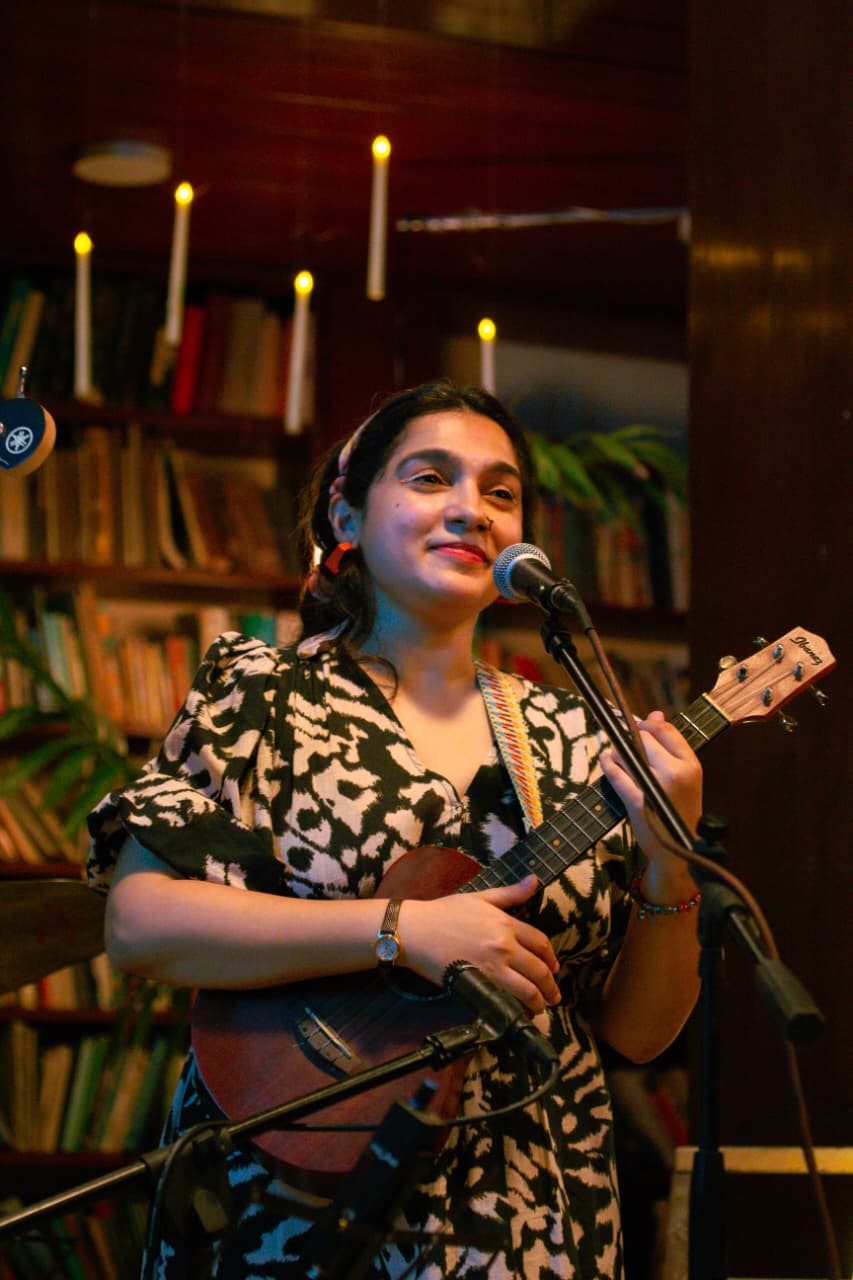
It was just my partner with a guitar and I with a ukulele, there was no spectacle to hide behind. Another space that has embraced independent music is CFAW (Centre for Arts-Based Methods and Wellbeing). Both places were open and accepting of the work I wanted to bring into the world.
This year, we decided we would no longer wait for people to hand us shows or decide whether people deemed our music worthy of hearing.
We started Ktown Jams at the Clifton Urban Forest Park, which at the time was under private management.
We brought the community together, mostly other artists and students who were hungry for a different musical experience in the city.
It was a resounding success; we played alongside Dulhay Mian and Natasha Humera Ejaz.
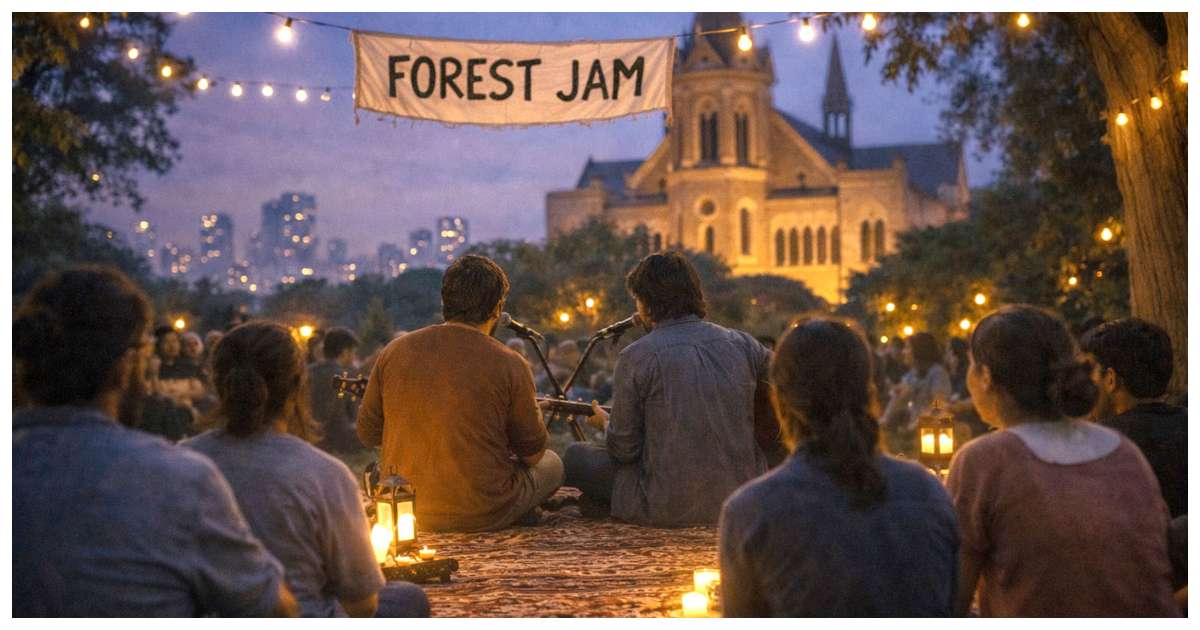
Without proper equipment, people still came, sat, and listened. A kind of musical picnic where the boundary between artist and audience dissolved. We were walking the same ground, breathing the same air.
The opposite of massive concerts where security separates thousands from a distant stage. Here, art was alive, breathing, present, accessible, and intimate.
Read More: Why We Hear With Our Hearts
At the next Forest Jam, even more people arrived. This time, the lineup included Mehdi Maloof, who had already garnered audiences for his introspective songwriting through Coke Studio.
The event was beautiful and was even covered in a newspaper article.
Around the same time, KMC appointed Maloof as head of its culture wing, and he began looking for ways to reactivate Karachi’s historic public spaces through art and music.
With his team, we planned a Library Jam at Frere Hall, featuring Maloof, Tarbooze and Misbah, another indie songwriter and a close friend.
Before this, Frere Hall had not witnessed live music in living memory. It felt like the old library with creaking shelves was swaying with sound. An unforgettable event for artists and audience alike.
I believe this new way of listening is emerging in collective consciousness as a crucial need. When culture becomes one-sided, real-time art is needed to bring it back into balance.
Real-time art, that is pulled directly from the unconscious, like something plumbed from the ocean’s floor.
Not music designed according to statistics or trends or algorithms. But songwriting that defies categories and powerfully, courageously explores the human journey.
Songs that shift something inside you and leave the listener carrying that alchemy into other parts of their life.
Experiences like this can challenge the ear and encourage people to stop consuming what is simply popular and instead use art as a way back to the soul of everything, back to the essence of life.
More unique musical ventures are also unfolding. Dream Sequence, an atmospheric and experimental show curated by Lyla, took place inside the Sadequain Gallery at Frere Hall beneath the cosmic presence of his mural Arz o Samawat. Sadequain called this work his Sistine Chapel.
Like many true artists, he created for the sake of art alone. Weaving mythological symbols into a vast visual narrative that remains unfinished because he passed before its completion.
That space challenged me to step beyond my usual form and move deeper into experimentation.
With my husband, as Tarbooze, I created a new set from scratch, knowing I would be performing beneath Arz o Samawat.
Somehow, the word Kainat from the mural found its way into my lyrics. As though the space itself was speaking through the sound.
It became an opening for my inner life to move freely through music, undirected by ego or prewritten structure.
We used a looping pedal with a drum machine to build a fluid body of sound on which my voice could play, dance, and drift.
The audience arrived prepared to lie down and look up at the mural. This was not an escape or a rave. It was an inward journey guided by sound and image.
The 160-year-old space deepened the experience in a way that was almost impossible to explain.
Everyone left carrying a fragment of the feeling created in that room by all the artists present, including Saffron Sweaters, Tarbooze, Changez, and Zair, featuring Teymour.
It makes me genuinely happy to see live music beginning to return to the city in different venues and forms, reaching different audiences.
My only hope is that it remains sincere and unconcerned with performance for the sake of entertainment. In my view, art is not meant to distract us or frivolously entertain us
As I reflected through Jung at the beginning, art exists to keep the human psyche alive by translating real experience, emotion, dream, and darkness into sound.
If we continue to do that honestly, art will keep doing its quiet and necessary work of regulating and healing the culture itself.