


A single post can spark a global debate, destroy a reputation, or reshape public perception. In the digital age, influence belongs not to those who control information, but to those who shape the context in which it is understood. More than ever, reputation is determined not just by what happens, but by what people believe happened.
In 1982, several people in Chicago died after taking cyanide-laced Tylenol capsules. Johnson & Johnson faced what could have been a catastrophic reputational collapse. Instead, the company immediately recalled millions of bottles, communicated openly with the public, and prioritised consumer safety over short-term profit. Decades later, the Tylenol case remains a benchmark for crisis management.
What made the difference was context. The facts were tragic regardless, but the company’s response shaped how those facts were interpreted. We often assume power belongs to those with the loudest voice, the biggest platform, or the deepest pockets. Increasingly, however, power belongs to those who can shape perception. In an age where information travels instantly and opinions form within seconds, controlling the context has become one of the most valuable skills in business, politics, media, and public life.
Context is not merely background information. It is the framework through which people understand events. It determines whether a mistake is viewed as incompetence or accountability, whether a policy is seen as reform or restriction, and whether a public figure appears authentic or opportunistic. The battle is rarely over facts alone, but over what those facts mean.
The Power Behind the Narrative
This idea is not new. Political scientist Steven Lukes argued that power extends beyond visible decisions and includes the ability to shape what people pay attention to and what they consider normal or acceptable. Similarly, communication scholar Robert Entman described framing as the process of making certain aspects of reality more prominent in order to influence interpretation. In simple terms, the person who frames the story often influences how the story is understood.
A recent example is the rise of Zohran Mamdani. During his political campaigns, Mamdani faced misconceptions about his policies, background, and political positions. Rather than relying solely on traditional media coverage, he invested heavily in digital communication, using social media, direct voter engagement, and accessible explanations of complex issues. Instead of avoiding criticism, he addressed questions head-on and responded directly to concerns circulating online. By actively participating in the conversation rather than allowing opponents or misinformation to define it, he shaped the context in which voters evaluated him. His success demonstrated that perception is influenced not only by what people hear about a candidate, but by how effectively that candidate engages with the public.
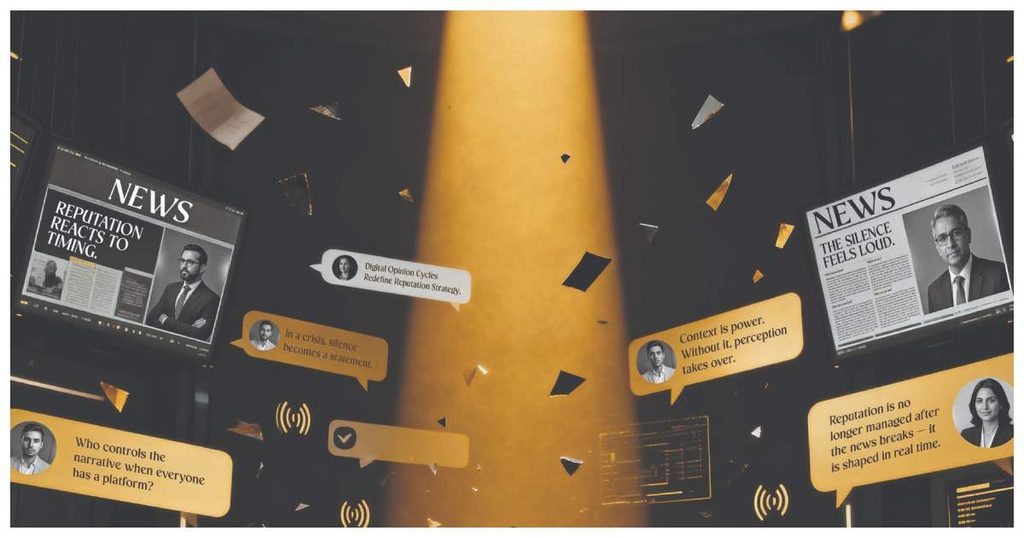
The same principle applies to corporate communication. When a company faces criticism, its initial response often determines the direction of public discussion. A prompt acknowledgement of a problem can establish a narrative of responsibility, while delays, evasiveness, or silence can create a narrative of concealment.
When the Narrative Moves Online
The digital age has made this process far more complex. While governments, media organisations, and corporations once dominated public narratives, today anyone with a smartphone can influence the conversation. A single post can shape public perception and spark global discussion within minutes.
Timing has therefore become just as important as messaging. The viral Coldplay concert incident involving former Astronomer CEO Andy Byron and Chief People Officer Kristin Cabot illustrates this perfectly. A few seconds on a stadium jumbotron generated millions of views, memes, and media headlines. By the time Cabot appeared publicly months later to provide additional context and address public assumptions, much of the audience had already formed an opinion. The episode highlights a central challenge of modern reputation management: once a narrative gains traction, later attempts to reshape it often face significant resistance.
Credibility Is More Than Communication
Yet controlling the context does not mean controlling every conversation. Instead, it means influencing how people interpret events. One of the most effective ways to do this is through credibility. Economist Michael Spence’s theory of signalling suggests that people are more likely to trust signals that are costly and difficult to fake. A public apology may attract attention, but tangible actions often carry greater weight. Product recalls, independent audits, leadership changes, transparent investigations, and policy reforms demonstrate commitment in ways that statements alone cannot.
This helps explain why some organisations recover from crises while others struggle for years. Reputation is not built on messaging alone but on the relationship between messaging and behaviour. Context can be shaped in the short term, but lasting reputation depends on whether communication is supported by observable actions.
Social media platforms have further complicated this dynamic. Algorithms influence which stories gain visibility, which voices are amplified, and what captures public attention. Platforms do not simply host conversations; they help shape the conditions under which those conversations take place, raising important questions about accountability, transparency, and trust.
Despite these changes, the fundamentals of reputation remain remarkably consistent. Speed matters because early narratives often become the reference point against which later information is judged. Transparency matters because audiences are generally more forgiving of mistakes than attempts to conceal them. Consistency matters because trust is built through repeated alignment between words and actions. Above all, authenticity matters, modern audiences are quick to recognise communication that feels scripted, performative, or disconnected from reality and increasingly expect evidence to support the narratives being presented.
The Limits of Reputation Management
This creates a paradox. Organisations invest heavily in shaping perception, yet the most effective reputation management often comes from narrowing the gap between perception and reality rather than widening it. The ultimate goal is not narrative domination but narrative credibility.
Resilient reputations tend to belong to individuals and institutions whose narratives continue to align with evidence over time. In a world where screenshots are permanent and archives are searchable, short-term image management is rarely enough. Context can influence interpretation and guide public understanding, but it cannot permanently conceal contradictions or replace accountability.
In the end, the most powerful narrative is not necessarily the one that spreads the fastest. It is the one that remains credible once the full story is known.