
From elite engineering spectacle to binge-worthy drama, Formula 1 has redefined itself as culture, commerce, and content, where speed meets storytelling, and the paddock becomes as compelling as the podium.
The Redline Revolution: De-Coding the Paddock
Once a technical fortress for insiders, Formula 1 has successfully rebranded from a niche sport into a global entertainment powerhouse. Since Liberty Media’s 2017 takeover, the focus has shifted from engineering specs to storytelling, fuelling a 63% surge in the global fanbase to 827 million as of 2026. By opening its gates to pop culture, F1 has transformed from a “dying” series into the world’s most vibrant lifestyle brand.
The Heritage of Speed: Blood, Oil, and Tobacco
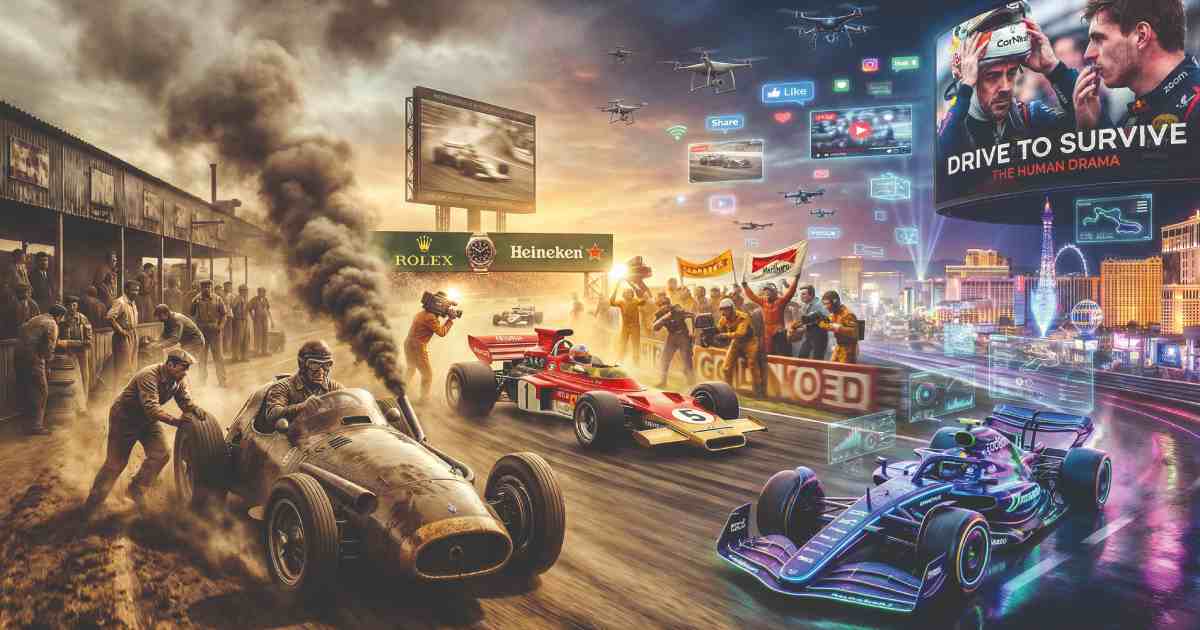
To understand F1’s current cultural weight, one must look back at its Blood and Oil era. The raw genesis of the sport began in 1950 at Silverstone. In this decade, safety was a secondary concern to speed. Drivers like Juan Manuel Fangio manhandled front-engined cigar tubes like the Maserati 250F, wearing nothing but cotton shirts and leather helmets. This era established the ‘gladiator ethos’ that still underpin the sport: a test of human courage against mechanical volatility.
The most significant pivot occurred in 1968. Before this, cars were painted in national racing colours (British Racing Green, Italian Rosso Corsa). However, when Team Lotus struck a deal with Imperial Tobacco, the iconic green Lotus was replaced by the red and gold of Gold Leaf Tobacco. This commercial Big Bang invited corporate brands into the sport’s DNA, changing it forever from a battle of nations to a battle
of sponsors.
The Ecclestone Empire defined the late 20th century. Bernie Ecclestone transformed disconnected races into a global TV ritual, packaging the sport for an elite audience and partnering with luxury icons like Rolex. He built the foundation of extreme luxury that paved the way for the digital masses we see today.
The Liberty Media Era: Breaking the Fourth Wall
In 2017, Liberty Media acquired F1 for $4.4 billion with a mandate to open the gates. They recognised that the sport’s greatest asset was the personalities behind the engineering. By relaxing social media rules, they allowed drivers like Lando Norris and Daniel Ricciardo to showcase their humour, effectively turning drivers into content creators.
This culminated in the Netflix Effect. Drive to Survive stripped away the helmets to reveal human vulnerability, turning technical DNFs into Shakespearean tragedies. It gave fans a reason to care about who came in 12th place, as these athletes literally drive to survive for a place in the paddock. This momentum was so powerful that by 2025, a Hollywood blockbuster starring Brad Pitt grossed over $630 million, cementing F1’s status as a cinematic powerhouse.
The Digital Velocity: The Gen Z Takeover
F1 has mastered viral velocity. In 2026, nearly half of the new fans are women, and 43% of the total fanbase is under 35. Unlike traditional sports that gatekeep footage, F1 leans into the chaos of the internet. This digital intimacy has created a community that thrives on memes and aesthetics, ensuring the conversation continues 24/7.
The Psychology of the Grid: Why It’s a Sport
To the uninitiated, F1 is often dismissed as just driving, but the demands are closer to those of a fighter pilot. Drivers endure lateral forces of up to 6G, meaning their heads effectively weigh 30kg during a 200mph turn. To combat this, they possess bull neck specifically trained for these loads. In humid races like Qatar, drivers lose up to 3kg of body mass in sweat, with heart rates mimicking marathon runners while making life-or-death tactical decisions.
The importance of this sporting status is best seen in the fall of the Indian Grand Prix (2011–2013). The Indian government classified F1 as entertainment rather than a sport. This semantic distinction was catastrophic, denying the event tax exemptions and burying teams under bureaucratic hurdles. It remains a reminder that in F1, how a nation defines the athlete is critical to the race’s survival.
The Commercial High-Stakes: Tech, PR, and Tourism
In 2026, F1 is the world’s most expensive travelling circus. Hosting fees alone are massive, with countries like Qatar paying $55 million annually. For cities like Las Vegas, the payoff is a $1.5 billion economic stimulus, with hotel rates surging by 500% during race weekends.
The livery landscape has also shifted. Where the 90s belonged to tobacco, the 2026 grid is dominated by Silicon Valley. Big Tech and AI companies like Oracle, AWS, and Google Cloud are the primary financiers. These brands use F1 as a proof of concept; Oracle, for instance, helps Red Bull run billions of simulations to find the best race strategy.
This tech influx has sent team valuations skyrocketing. In five years, the average team value jumped from $500 million to $3.5 billion. Teams are no longer hobbies for billionaires; they are high-value assets similar to NBA or NFL franchises.
Formula Pakistan: Engineering The Future
While global giants battle in Vegas, a revolution is happening in Pakistani classrooms. Formula Pakistan, founded by NUST alumni, is a national STEM competition challenging 14 to 19 year olds to replicate the F1 ecosystem. With over 4,000 students across 33 teams, it is rewriting the narrative of local engineering.
The Technical Challenge: Students design 10-inch miniature racers using professional CAD/CAM software. They perform Computational Fluid Dynamics (CFD) simulations to analyse drag, learning the same principles Adrian Newey uses at Red Bull.
The Enterprise Pillar: Teams are judged on a 700-point scale that includes securing real-world sponsorships and managing strict budgets. This ensures a team principal from a local school develops skills in brand management and strategic networking. This initiative is de-mystifying the global motorsport industry, proving that Pakistani students have the grit and savvy to lead the next generation of global innovators.
Breaking the Glass Ceiling: Women on the Paddock
The world of F1 is no longer just a boys’ club. From the command centre to the cockpit, the female footprint is growing.
The story began with trailblazers like Maria Teresa de Filippis, who defied 1950s sexism to finish 10th in a Grand Prix, and Lella Lombardi, who remains the only woman to score points in a World Championship race (1975). After a 30-year gap in participation, modern efforts like the F1 Academy are working to restart that legacy.
Susie Wolff, the Managing Director of the F1 Academy, is the architect of this change. She has brought all ten F1 teams and global brands like Charlotte Tilbury on board to support rising stars like Bianca Bustamante and the Al-Qubaisi sisters. Beyond the drivers, women are the real power players on the pit wall. Hannah Schmitz, Lead Strategy Engineer at Red Bull Racing, has become a global icon for the split-second decisions that secured Max Verstappen’s championships. In the Formula Pakistan circuit, we see this influence directly, with young girls taking on leadership as Team Principals and mastering CAD software.
The Final Lap
As the chequered flag falls, Formula 1 has engineered a new kind of magic. By blending high-stakes drama with high-fashion aesthetics, the sport has become a cultural mirror of our fast-paced world. Whether through a Netflix lens or the grit of a Pakistani student designing an aerodynamic wing, F1’s legacy is now written in the aspirations of a new generation. It proves that while the cars are the heart of the show, the human story is what truly keeps the world’s foot on the throttle.