
If the question is what traffic law looks like in Pakistan, quoting rules or discussing right-of-way hardly explains it, because on most roads, the rulebook is not what decides who moves and who waits. What determines this is social hierarchy, and once that is recognised, much of what appears to be “random chaos” begins to look like a predictable system.
It is easy to dismiss it as bad driving or poor planning. The truth is both simpler and uglier: on the road, power is more convincing than the law, urgency becomes a convenient excuse for anything, and negotiation has replaced enforcement so completely that the abnormal now passes as routine.
I realised this again recently while driving, the light was red, traffic was lined up, and an ambulance was stuck behind a line of cars. Sirens were on, and the lights were flashing, and still, cars hesitated. Some moved slightly. Some didn’t bother, and then came a pickup truck, which even tried to overtake the ambulance because they didn’t want to wait.
That moment stayed with me because it exposed the whole mindset. An ambulance is the only vehicle legally allowed to break a signal, that is literally the point of an ambulance, but even then, people treat it like an option “haan theek hai dekhte hain,” When someone’s impatience outranks another person’s medical emergency, it stops being “traffic” and starts looking like what it really is: a collapse of basic public behaviour disguised as normal.
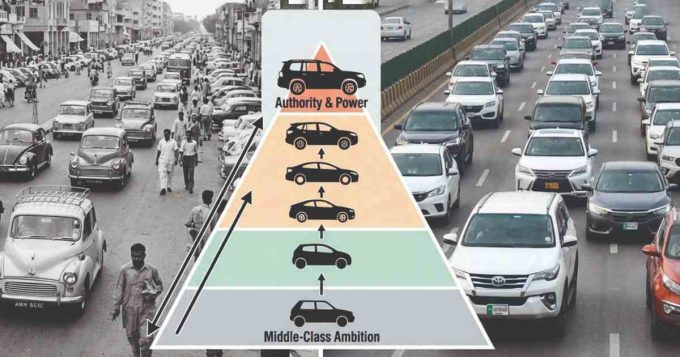
The Road has a Caste System, and Vehicle Size is One of its Loudest Symbols
Let’s be honest with ourselves. Reactions on the road change depending on what’s behind or beside the vehicle. A bike comes close, and irritation rises. A rickshaw cuts into the lane without looking, and the response is anger.
A bus decides to stop wherever it wants, right in the middle of the lane. Even though it ruins everyone’s flow, people brake because what else is there? Pick a fight with a bus? But when it is an SUV with tinted windows, especially the kind that looks like it belongs to someone important, the reaction shifts.
It does not just take space; it expects it, and people usually give it up without thinking. Not because the SUV is right, but because after a quick mental risk assessment: Will the driver stop and get out? Is this someone who enjoys escalating things? Are there guards? A gun? Or just the confidence that comes from living in a system that rarely tells people like him to behave? On paper, the Motor Vehicle Ordinance applies equally. On the road, it clearly does not.
Unequal Law: What You Drive and Where You Drive Matters
Interestingly, sometimes it is not only about vehicle size, it is also about where you are. In some neighbourhoods, rules suddenly become more real, not because people are ethical but because enforcement is more visible and the roads are even more controlled, while in other areas it is survival mode and everyone is driving like they want to. That’s what uneven law looks like: same country, same rulebook, but totally different outcomes depending on the area, the vehicle, and the perceived status.
There is Always Something More “Urgent” Than You
Every driver in Pakistan believes they are in a genuine hurry, and that is part of the culture now: late for work, late for school pick-up, late because traffic was bad yesterday too. The problem is urgency here doesn’t just excuse rule-breaking, it starts justifying it like it’s your right. Red lights become optional after 10 pm, wrong-way driving becomes “bas yahin se cut maarna hai,” parking on the road becomes “do minute ka kaam hai,” and if you object, then somehow, you are the difficult one holding up the system. What’s fascinating is how quickly we adapt to this. The first few times someone drives the wrong way to avoid a U-turn, you are shocked; a few months later, you are leaving space for him because you already know he is coming. That is the moment you realise the unwritten rules have replaced the written ones.
Everyone Plays Their Own Game
Buses stop wherever they feel like stopping, because someone waved or a passenger appeared and suddenly an entire lane is blocked while everyone else swallows it as ‘routine.’ Rickshaws cut in without checking because they spot a passenger, stopping instantly in front of other vehicles as if someone else’s brakes are their responsibility. Bikes do not see lanes; they see gaps. All that matters is slipping through whatever space exists, because in traffic like this, behaving like a model citizen often means not moving at all. When motorcycles become the dominant form of mobility for millions, the road turns into a continuous negotiation of inches.
The Accident Toll is the Price We Pretend Not to See
This negotiation culture turns dangerous quickly, which is why traffic accidents in Pakistan are not just numbers; they are a constant, visible cost of how traffic rules are followed in Pakistan.
In 2025, Rescue 1122 data showed 493,489 road traffic crashes during the year in Punjab, with 4,944 on-spot deaths and 248,471 serious injuries. In Karachi, over 800 people were killed, and more than 11,000 were injured in road crashes in the same year.
You would think the sheer volume of crashes and loss would force discipline into the system. But it does not, because consequences are inconsistent, and when consequences feel optional, safety becomes optional too.
Rs 500 and You are Innocent
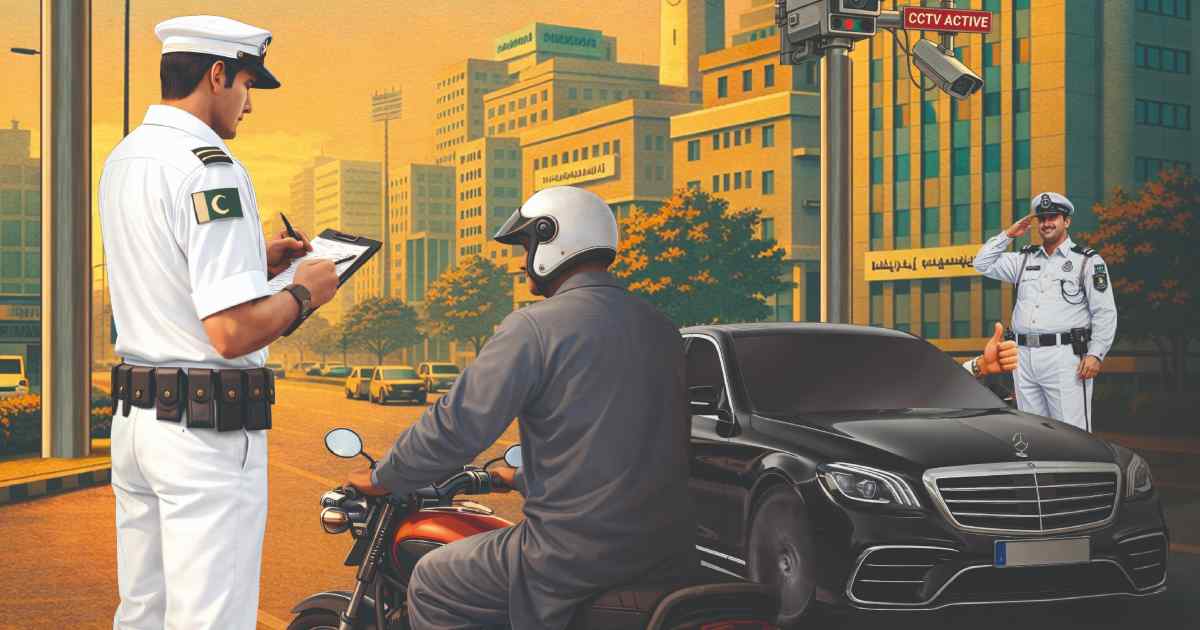
This is the point at which the idea of a traffic system begins to feel like fiction. A driver breaks the law, gets stopped, and gets lectured; for a moment, it feels like perhaps the system will work. Then someone says it quietly, “Bas 500 de dein,” and everything flips. The violation that mattered ten seconds ago suddenly becomes “it’s fine, go ahead.” The law that was being quoted stops mattering.
That exchange does more damage than most people realise because it teaches every driver that the rules are negotiable. And once rules become negotiable, hierarchy takes over, because not everyone negotiates from the same position.
E-Challan: Progress, or Just Surveillance?
People will say, “But e-challan is changing things,” and yes, it is. At least where it is active and consistent. In places where e-challan systems exist, you can see a behaviour shift. People slow down near monitored signals, seatbelts suddenly appear in camera zones, and lane discipline exists for just long enough to get past the cameras.
But even that is something important: the change is often tactical, not internal. People do not necessarily start believing in the law; they start mapping surveillance. They learn where the cameras are, which roads are covered, and how to avoid consequences rather than how to drive responsibly.
The Road Exposes Inequality in a Way Nothing Else Does
What makes Pakistani traffic different is not just poor planning or weak enforcement. It is that the road forces everyone into the same physical space, but not with the same level of protection or accountability, so you can literally watch class and power play a higher role in driving. The biker delivering food is one bad swerve away from disaster, the pedestrian crossing the road has no guarantee a car will stop, buses bully smaller vehicles because they are racing against time and thin margins, and meanwhile, the most expensive cars on the road are often the least accountable.
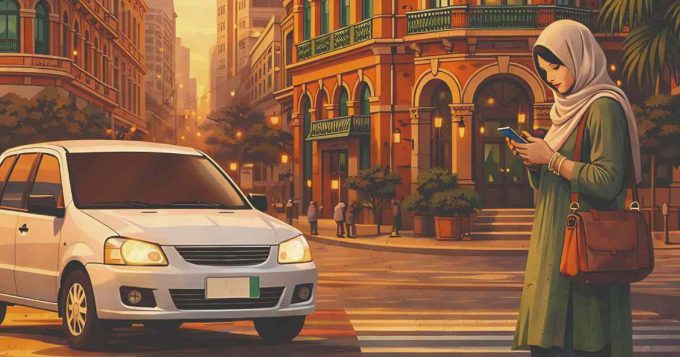
And before I end, there is one more thing that needs to be said because it shows how easily the real problem is dodged: the moment hesitation is shown, a slow turn is taken, or a car is parked awkwardly, “female hogi” is said by someone, as though traffic in Pakistan were a gender issue.
But look at what has just been described: ambulances not being given way, signals being treated as suggestions, rules being broken based on status, violations being turned into a ‘no issue’ through bribery, and roads being shut down for VIP movement. How can any of this be about women? And that is the issue: we love picking on easy targets and turning a broken system into a joke about individuals.
The behaviour that actually makes Pakistani roads unsafe is the bullying, the rule-bending, the way power gets away with things. It’s the same unwritten rulebook the rest of us are following too.