
When I was finishing my degree at King’s College London, I spent a lot of time analysing how hyper-disruptive global brands trade in the attention economy. London’s creative landscape moves in milliseconds, so coming back home and launching TrancePixel Marketing out of DHA, Karachi, I noticed a glaring disconnect in the local advertising space.
Pakistani legacy brands are still pouring millions into over-polished, traditional corporate television commercials (TVCs), slapping a 9:16 crop on them, and wondering why their Instagram reels are tanking.
Here is the brutal truth: Gen Z has developed a hyper-efficient, subconscious defence mechanism against advertising. We have ad-blindness. The second a video looks, sounds, or feels like a traditional commercial, our thumbs swipe away. We don’t care about your massive production budget. We care about aura.
If you want Gen Z’s wallet share, stop publishing vanilla brochures. Get a grip on the raw, sensory codes that actually force a thumb to stop.
1. Colour Palettes: The Death of the Sterile Pink Grid
For the last five years, corporate direct-to-consumer (D2C) brands have been trapped in a minimalist prison. Everything has been safe, pastel, perfectly lit, and desaturated.
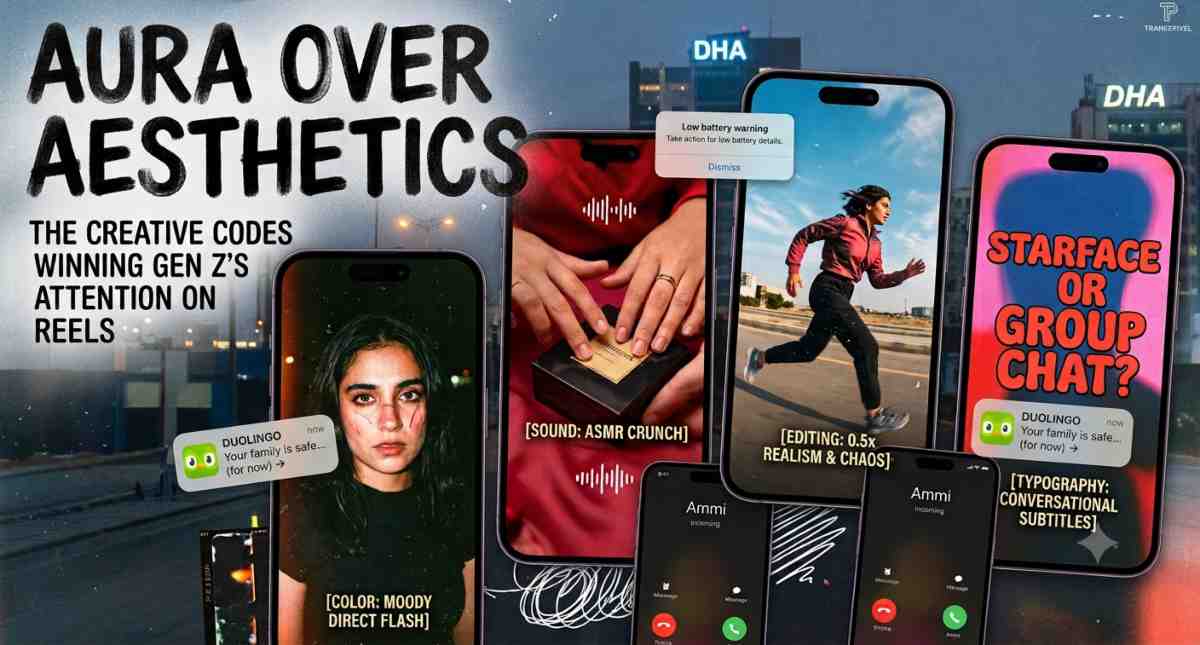
Gen Z has completely abandoned this aesthetic. Today, attention belongs to high-contrast realism and analogue imperfections. We are seeing a massive shift toward moody, direct-flash photography tones, low-fi 35mm film saturation, and the gritty, raw textures reminiscent of early-2000s camcorders.
Case in point: look at how Rastah completely flipped the script on Pakistani fashion imagery with raw, street-level flash photography, or how Generation redirected its visual engine from generic catalogue setups toward rich, high-contrast heritage storytelling.
Imperfect colour grading signals human authenticity. When content looks like it was shot in real-world lighting by a friend on an iPhone rather than a ten-person production crew under clinical studio lights, the viewer’s psychological guard drops.
Your customer acquisition cost (CAC) doesn’t decrease because you bought a more expensive camera; it decreases because you made your brand look human enough to trust.
2. Music & Sound Design: Asymmetrical Audio Triggers
Most local agencies treat sound as an afterthought; they produce a video, browse the Instagram audio tab, and slap a generic trending track on top. That is a losing battle.
Gen Z doesn’t just listen to music; we listen to subcultures. The audio landscape is dominated by sped-up remixes, slowed-and-reverbed alternative tracks, and independent local talent (such as raw South Asian indiepop or underground Lyari drill). But the real secret weapon isn’t the music track; it’s the sound design.
The modern scroll-stop relies heavily on Autonomous Sensory Meridian Response (ASMR) and audio pacing. Think about the crisp crunch of an unboxing or the satisfying click of a luxury lid. That sound instantly snaps a scrolling viewer back to reality.
Good audio is what actually keeps people watching. Throw clean ASMR under your backing track to cheat the algorithm because when people watch your video to the end, the platform does the heavy lifting and pushes it to everyone.
3. Editing Styles: High-Velocity Chaos and 0.5x Realism
Traditional ads love those slow, sweeping drone shots and predictable pans. On vertical video, that is basically lighting your budget on fire.
Gen Z loves a bit of visual chaos. Right now, everyone is obsessed with that shaky, wide-angle 0.5x iPhone view. Look at Ethnc or Outfitters when they drop a new campaign targeted at a Gen Z audience. They completely ditch the static tripods, grab the camera, move it fast, tilt it, and shoot their products from weird, real-world angles.
But does that mean a steady camera is completely dead? No, not at all. Perfectly still, locked-in reels work beautifully only if you have a killer concept behind them. For example, Jacquemu’s “Just a Dream” campaign and Zara’s collab with Caramel London. Here, the stillness is a total power move that lets the brand’s pure aura do the talking.
At the end of the day, our brains are hardwired to ignore things we can predict. If your video feels familiar, people swipe away without even thinking about it. Whether you’re shaking things up with fast cuts or keeping it dead-still, you have to break the pattern.
4. Typography & Fonts: Conversational Subtitles over Corporate Text
The internet is conversational, so your text needs to match that energy. If your brand vibe is totally vintage, slapping a stark, modern font on your reel breaks the illusion instantly. Similarly, if you’re a high-end minimalist brand, chaotic Y2K text is just going to confuse people, so you’ve got to figure out your brand’s personality first, pick the lane that fits it, and stick to it.
For example, look at global cult-favorites like Starface. They completely lean into bold, bubbly retro typography mixed with neon text-bubble overlays that make their Reels look like an unhinged group chat rather than a skincare ad. On the other hand, Gymshark goes completely minimal, using raw, native app text or literally turning funny tweets into on-screen video memes using standard iOS fonts.
View this post on Instagram
Think about it: up to 75% of people watch vertical videos with the sound completely turned off. That means your typography is your literal script.
So while it all boils down to picking a font that actually aligns with your brand, you still have to keep it human. When your subtitles look like a casual text message from a best friend instead of a stiff corporate announcement, it changes the entire vibe. It instantly feels more urgent, intimate, and native to the platform, and that’s what actually hooks your audience.
5. Animation & Micro-Triggers: Low-Fi Digital Scribbles
When traditional agencies think of animation, they think of expensive, highly polished 3D vector motion graphics that take weeks to render. To Gen Z, those look like corporate training videos.
The animations that get the most attention are lo-fi, 2D hand-drawn digital scribbles, stop-motion scrapbook layouts, and interactive UI-mockup notifications.
Look at how global giants like Duolingo master this; you will never see them only posting videos of their mascot. They overlay fake iOS push notifications sliding down from the top of the video frame, saying something like “Your family is safe for now, do your French lesson.” It forces an instant double-take because the viewer literally thinks a notification just popped up on their phone.
Locally, Krave Mart does a brilliant job of hacking this psychological trigger. During late-night match screenings or rainstorms in Karachi, they’ll drop a casual reel that features a mock incoming WhatsApp call UI from Ammi or a low-battery warning graphic popping up right when the video hits its climax. (Nothing triggers immediate panic more than Ammi’s calls and low-battery warnings!)
These micro-animations act as pattern-interrupts. They gamify a standard product demonstration or service explainer, converting a commercial pitch into an organic piece of digital entertainment. It feels clever, self-aware, and highly creative.
The digital ecosystem in Pakistan is undergoing a massive cultural shift. The brands that will survive the next decade will be those with the highest ‘cultural velocity’.
At TrancePixel, this is the brief. When we worked with Design by Samar, a luxury interior brand, we scrapped the wide clinical room shots entirely. We rebuilt their visual language around texture, warmth, and the feeling of actually being inside the space. The reach followed. But more importantly, 71% of it came from people who had never encountered the brand before, which is the only number that actually matters when you’re trying to build cultural relevance, not just reward existing followers.