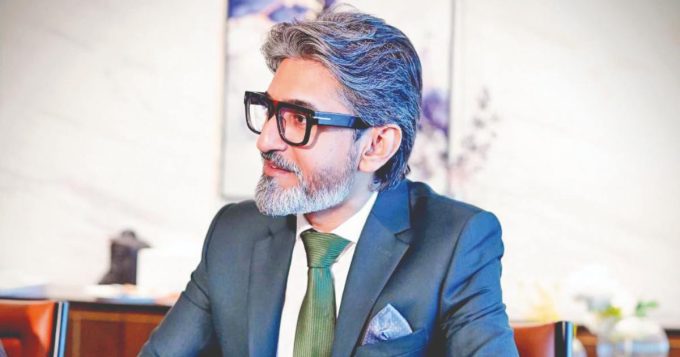


Minahil Temur, the mind behind Minoqtopus, explores the intersection of automotive culture, digital media, and consumer behaviour. Her content moves beyond surface-level reviews to examine how systems, market forces, technology, and access quietly shape both industry trends and public understanding.
Synergyzer: How much of Minahil Temur is “Minoqtopus,” and where do you draw the line between your private self and your digital persona?
Minahil Temur: Minoqtopus is not a character I switch on, but it is an amplified version of me. The ‘me’ I generally hid from people growing up, because not many people want to know how the GPS works randomly. I have always been a very curious person, always asking why, so much so that it borderline annoyed my elders and teachers.
Soon I realised that people around me do not have the answers I’m looking for. So, I went into libraries and books to learn more, then it was the internet, where I could get information about anything and everything from all over the world, but with caution, of course, due to the false information around.
My private self is different from my digital self because I don’t really share anything from my personal life; it is only the curious aspect of my personality that is online, from an optimistic lens. The difference between my private and digital self is the energy. Online, it is a distilled version of me, structured, intentional, optimised for clarity. Offline, I am quieter, more reflective, less performative. But my values are the same, just less curated. The major line I draw is privacy, particularly in my relationships, vulnerabilities and unprocessed emotions. Minoqtopus shares ideas, and Minahil lives life.
Synergyzer: The automotive and mechanical engineering space in Pakistan is notoriously male-dominated. What was your experience like navigating that world as a woman?
Minahil Temur: I have been in male-dominated spaces for a very long time. In university, I was the only girl in a class of 100 boys, so this is not new to me. Growing up, my parents never differentiated between my sisters, me and the male gender; we did not have boys around to compare ourselves to, so I did everything regardless of gender. I played every sport, rode horses, and had my own petrol scooter at six years old.
I grew up in an environment where I never really thought of myself as a ‘girl’ in a restrictive sense. It was not until university that people started pointing out how I was ‘different’ from the rest of my batch. But because I never saw myself as different, I never felt different. To me, we were all just students.
When I make content in the automotive space, I do not approach it the way people expect. I am not ‘reclaiming’ any space because I never really lost it.
Synergyzer: As an automotive influencer in the country. How does it feel to be a reference point for young girls in Pakistan who want to understand cars or bikes but have never had a female role model in that niche?
Minahil Temur: Although I am not an automotive influencer, but a digital journalist, and in the influencer space, my niche is education. My content ranges from science and technology to finance to business, and beyond. Being a mechanical engineer and being interested in how cars work, I do make videos on them as well.
Young girls have many creators to look at. There is nothing that I’m doing because I’m a “woman” and they need to look at me, especially to understand cars. The only thing that sets my content apart is my focus on teaching: I try to offer something new in every video because that is simply how my mind works. Young girls don’t need a specifically ‘female’ role model to understand cars; they can learn from any video, regardless of who is behind it. Knowledge isn’t gendered.
Synergyzer: Mobility is one of those spaces where technology, class, and aspiration collide. When you look at car culture in Pakistan, what do you think it reveals about how we define progress?
Minahil Temur: Pakistan’s car culture is not dependent on what Pakistanis want at all. Our market is too niche and nascent for brands to even research our actual preferences. Brands come to us, market their cars, and we buy them. In this entire buying-selling cycle, the culture is not in our hands.
For the longest time, we had only three big names. And people only bought cars based on what they could afford; we did not have many choices. Recently, plenty of Chinese and Korean brands have entered our market, regardless of whether we wanted them or not, and yes, they have introduced many different cars in the market.
The market is now saturated with crossovers, but this shift feels more like a forced trend than organic progress. While we are seeing genuine growth in localisation, with players like Kia increasing domestic parts production, the market lacks a mature ‘culture.’ Instead, it remains driven by hype and basic affordability, especially as runaway inflation dictates every choice.
Synergyzer: When you test or analyse a car, what’s the first variable you instinctively pay attention to?
Minahil Temur: I focus on how the car drives. When I press the accelerator, how does it rev up and pick up speed, or maintain a constant speed for a long time? The acceleration and the deceleration. Most new cars available today have a very similar engine, motor and battery and specification, considering cars with similar drivetrains here.
The difference lies in how the car body is shaped, its size and weight, and how these factors impact the drive. For example, bigger cars with the same engine will have a slight delay in acceleration and will be heavier in tight corners. Whenever someone is deciding which car to buy, they need to consider what their own driving style is.
Daily driving habits, including destination and duration, are the primary factors in determining vehicle practicality. Practicality depends on physical ergonomics: height, weight, and age, which would dictate interior needs. For instance, a taller driver requires deeper seat bases for thigh support.
This is critical for long, continuous hauls, whereas it is less taxing for daily commutes under 70 km with frequent breaks. Because a car is a personal asset, the assessment must be tailored to the individual’s anatomy and driving frequency.
Synergyzer: Do you think digital creators are gradually replacing institutions as interpreters of reality, or are we simply building parallel systems of trust?
Minahil Temur: It is really difficult for creators to stay honest and genuine, especially if they are making commercial content, which is essential to earn money. I do not think the audience should blindly look at creators as trustworthy; everyone should do their own research before making any decision influenced by a creator.
Most people bypass that empirical check, letting digital narratives dictate their reality. On a quantum level, observation alters the observed; on a macro scale, this means reality is entirely fragmented by our perceptions.
“Practicality” is therefore not a fixed specification, but a subjective experience that varies for every individual. So, even though I don’t like it, digital creators are replacing institutions because most people don’t put in the effort to verify information themselves. Whether the responsibility lies with creators or the audience to verify the information provided is highly debatable.
Synergyzer: Corporate sponsorships in the automotive sector often require ‘sanitised’ reviews. As someone with an MBA, you understand the value of partnerships, but as an engineer, you understand the value of technical truth. Where is the line where ‘Brand Collaboration’ ends and ‘Engineering Compromise’ begins?
Minahil Temur: I cannot speak for other creators, but I ensure every fact is verified and only endorse what I fully believe. In our industry, technical inaccuracies are rampant, like labelling Chinese crossovers as “SUVs.”
This is misleading and distorts consumer understanding. Sponsorships are optional; any creator can decline collaborations that conflict with their principles. While brand partnerships are a primary income source for me, financial gain should never compromise engineering integrity or technical accuracy.
Synergyzer: Do you see Pakistan’s auto industry as true manufacturing, or mostly just assembling imported kits with little local innovation?
Minahil Temur: Currently, we are merely assembling. True manufacturing only begins when we produce engines, motors, batteries, or drivetrains locally. Brands are localising and expanding vertically, but building a manufacturing ecosystem takes time; a car comprises tens of thousands of parts requiring dedicated sub-industries. For now, we are simply joining LEGO pieces together.