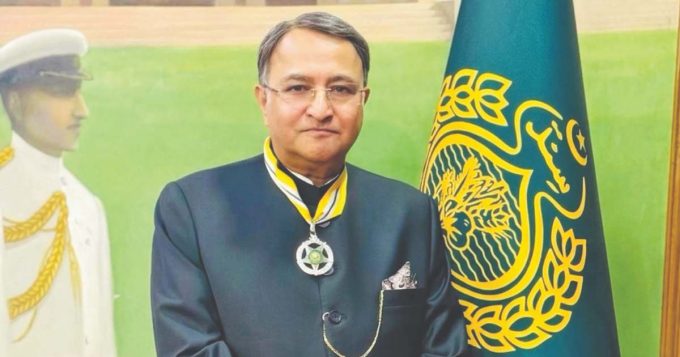

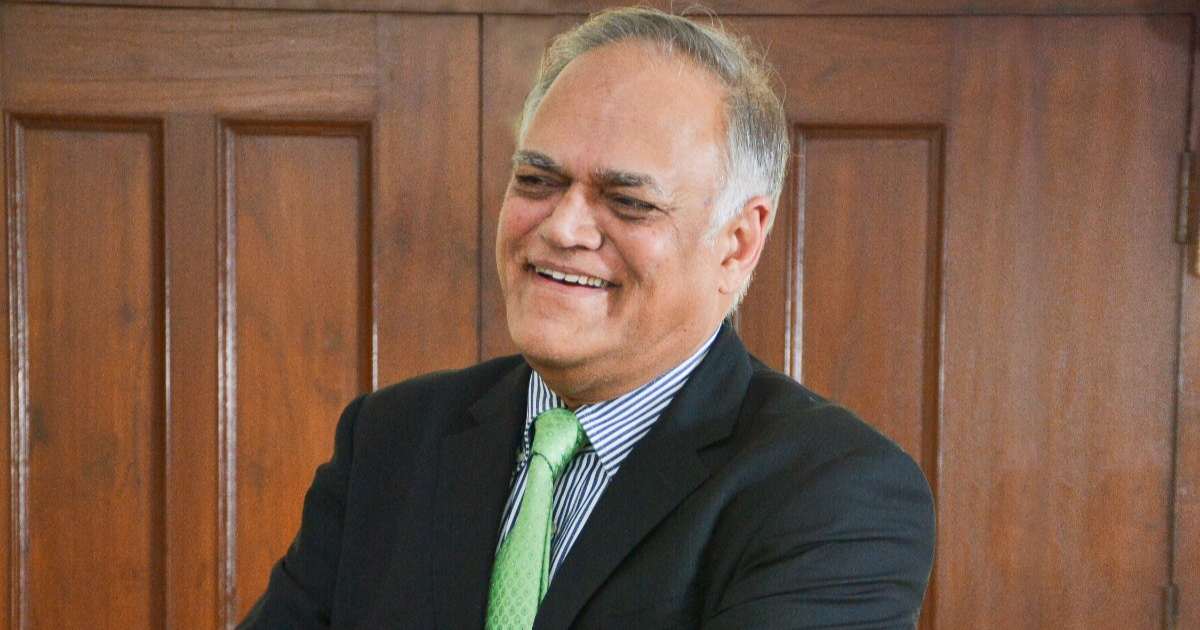
Before Pakistan learned to package narratives as strategy, Javed Jabbar was already shaping them across cinema screens, television studios, Senate halls, newspaper columns, and national debates. He directed commercials when advertising still had poetry, made films when Pakistani cinema was struggling to survive. At 81, he remains difficult to categorise: filmmaker, policymaker, historian, philosopher. Sitting across from him felt less like an interview and more like stepping into a living archive, a conversation that moved through cinema, politics, identity, and storytelling in unexpected directions.
Synergyzer: You entered advertising when campaigns were slower, language mattered more, and audiences remembered lines for decades. What do today’s brands misunderstand about building a narrative that actually lasts?
Javed Jabbar: People often say the world was slower then and faster now. Yes, today, many things have happened simultaneously, and technology has interrupted the continuity of experience. In our time, you could engage with content uninterrupted. There were no mid-breaks, only one television channel, and far fewer distractions. But now, there is multiplicity, simultaneity, and endless choice.
In another sense, nothing has changed. A story is a story; it remains timeless: throughout history, stories have always revolved around the irreducible fundamentals of human life: love, hate, tenderness, joy, happiness, music, sound, silence, touch, fragrance, and emotion. Those fundamentals are as valid today as they were fifty years ago. What has changed is attention. Earlier, you could hold undivided engagement with audiences much longer. Now narratives are constantly interrupted. Yet if you continue to tell a good story, people will stay loyal to it. Look at television serials that people follow for months. Even cinema, a film like Oppenheimer, held audiences’ attention for nearly three hours. So, the medium and pace have changed, but the essence remains the same. If you have a good story to tell, and you know how to tell it, there is no change.
Synergyzer: In your experience, what makes people trust a story instead of merely consuming it?
Javed Jabbar: People trust a story when it touches them emotionally, or even tickles them enough to pay attention. Touching and tickling are different things. One can move you deeply; the other can disarm you through humour or warmth, but both create engagement.
I would hesitate to make a sweeping distinction between brands fighting for attention and those striving for meaning. Some brands absolutely do communicate meaning. Others fail because either the company itself has little substance to offer or the campaign lacks sincerity and depth. Trust itself is complicated. People instinctively respond to sincerity, even in advertising.
Interestingly, advertising is perhaps the least deceptive form of media because it openly declares what it is. The viewer knows, within seconds, that the brand wants to persuade them. There is no disguise. In that sense, advertising is remarkably upfront.
Other forms of media content often conceal intention beneath layers of editing, positioning, or narrative framing. Advertising, by contrast, puts its purpose on the table immediately. The real challenge, then, is whether the story being told carries enough emotional honesty for people to believe it, rather than simply consume it and move on.
Synergyzer: Do you think nations, like brands, survive on facts alone, or on the narratives they repeatedly tell about themselves?
Javed Jabbar: Pakistan is a uniquely created nation. Most countries have evolved over centuries, even millennia. Pakistan, by contrast, emerged almost at a ten-weeks’ notice. The very name “Pakistan” was invented only in 1933, and even the 1940 Resolution did not mention it. So it is natural that a country with such unusual origins continues to negotiate questions of identity, religion, modernity, territory, and history. Nations do not survive on facts alone. They survive through the stories they tell themselves repeatedly, and through the symbols around which people gather. As one French philosopher observed, nationhood often requires both selective memory and the creation of a shared sense of belonging. In Pakistan’s case, that process is still evolving because we are an amalgam of many histories, languages, territories, and emotional loyalties.
At the same time, a nation is far more complex than a brand. Brands are usually built around singularity: a product, a promise, a recognisable symbol. Nations are built on enormous diversity. Yet both rely on narrative continuity. Some brands sustain the same story for decades because people emotionally identify with it. I witnessed this firsthand with the Peek Freans Pied Piper campaign. What began as an advertising symbol became so deeply associated with the company that it eventually entered the brand’s permanent identity and packaging.
So, the narrative of what a brand is can be completely different from how a country comes to symbolise itself with a flag or a currency.
Synergyzer: Today, every institution wants to control its image. In your view, what is the difference between a narrative and propaganda?
Javed Jabbar: Propaganda will not comprise any negativity about the institution or the individual projecting it. It tends to be heavily positive in favour of the person, country, or institution putting out the message, while directing negativity toward whoever the propaganda is against.
Whereas a narrative, to be credible, has to be realistic. It should not try to project fantasy, because people will not accept fantasy unless, from the very beginning, you are saying: my purpose is simply to entertain you. Then the viewer knows this is fantasy, like entering the world of Snow White and the Seven Dwarfs.
But if you are building a narrative, let’s say about Pakistan, it has to be rooted in realism. You cannot project Pakistan as simply a land of milk and honey and pretend that this alone is Pakistan’s narrative. A narrative has to be realistic. Therefore, it has to be credible.
Preferably, a narrative should also sometimes be self-critical, which a brand story usually cannot afford to be. No brand will openly say that one part of its product may not be good for you if consumed excessively. So, a narrative has to be far more truthful than propaganda.
Synergyzer: You have spent a lifetime moving between film, politics, media and literature. Looking back at all these worlds, what do you think people misunderstand most about power in Pakistan?
Javed Jabbar: People assume that power in Pakistan rests mainly with the historical, feudal, tribal, military and capitalist classes. I think that is only part of the story. Yes, they have resources, organisations, and control over institutions. But people also exercise power whenever they get the chance.
That power comes through the ballot box. In the eleven general elections of Pakistan’s history, from 1970 to February 2024, the people have consistently voted for moderation, balance, pluralism, and peaceful forces. They have never voted for religious extremists or for violence as a political method.
I salute the people of Pakistan because in February 2024, when a certain political party was prevented from using its name or symbol, its candidates were scattered across different symbols: someone got a kaddu, or a ladder, even a bicycle. Yet for the first time, instead of parties looking for voters, the voters went looking for the party. They said: this kaddu represents me, this symbol is mine. Together, these unrelated symbols received more votes than many established party symbols. Look at the intelligence of the people of Pakistan. Fantastic. So, when you ask what people misunderstand about power, this is power. The people of Pakistan do have power, and whenever they can exercise it, they show it through their actions.
Synergyzer: You once said Pakistan is not a failed state, only a deeply challenged one. After eight decades of watching this country argue with itself, what still gives you hope?
Javed Jabbar: What gives me hope is what I see when I move around the country as part of my voluntary work. I visit villages, towns, and cities. I see women, men, Muslims, non-Muslims, and enormous diversity. Even though we have failed to ensure universal education, even though 26 million children remain out of school, this country is blessed with intelligence, innovativeness, creativity, and enterprise. Illiterate village women, their eyes sparkle with intelligence and with the ability to survive very difficult conditions. My God, they look after livestock, husbands, children, cook food, work in the fields, and help cultivate crops. Urban women, millions of them, supplement family income while also raising children and managing homes. What comes through to me is this great sense of energy and confidence that, come what may, the Almighty will help us.
And then there is something called the World Happiness Index. Pakistanis are happier people than Malaysians, Japanese, and Turks. In South Asia, we are happier than Indians, Sri Lankans, Bangladeshis, and Afghanistanis. Because we are capable of recognising that we have strengths, and that we can help make our world better.
Synergyzer: You worked in advertising long before “narrative building” became fashionable. When did storytelling stop being about truth and start becoming noise?
Javed Jabbar: Even in the earlier part of advertising history, it was not always about truth. There was a lot of noise then as well: mediocrity, substandard material, and all kinds of things put out as advertising. But at the same time, there were also good examples of creativity and integrity. Even now, there are examples of good advertising with good intent. So, I would not say that narrative building has been completely replaced by noise. But yes, in some cases, there has been too much reliance on volume and frenetic change, as if change itself is the way to hold attention.
The best example is the degradation of how news is presented on television. Cameras zooming in, zooming out, music constantly blaring, everything screaming for attention. How can you have clarity, comprehension, conviction, and credibility when everything is shouted instead of spoken with sobriety?
That tendency has also entered advertising. Sometimes advertising becomes too loud, too eager and shouts at the consumer rather than speaks with the consumer.
Synergyzer: The National Anthem was re-recorded with your help after nearly seventy years. What did that experience teach you about memory, identity, and the emotional power of sound?
Javed Jabbar: It was a singular honour to preside over the committee for the re-recording of the national anthem. One of the first decisions we took was that instead of relying only on professional singers, we wanted all of Pakistan to be represented. We advertised across Karachi, Lahore, Peshawar, Quetta, and Hyderabad, and selected voices from ordinary Pakistanis, from all religious communities: Muslims, Hindus, Christians, Sikhs, and Zoroastrians. Identity, therefore, was reflected through participation itself.
We also preserved the sanctity of the original musical score composed by Ahmed Ghulamali Chagla Sahib. It is one of the most beautifully composed national anthems in the world, written entirely for brass instruments. We could not alter the words, but we used the most advanced recording systems and brought in Rohail Hyatt to lead the sound committee. The original 1954 recording used only seven or eight voices. In our case, there were more than 120 voices from across Pakistan, men and women together. So, the emotional power of the anthem came not only from the orchestral sound, but from the fact that it became a truly participative recording, where the sound of Pakistan itself could be heard.
Synergyzer: Directing Pakistan’s first English-language feature film was a bold move at a time when local cinema itself was struggling. Looking back, did that decision feel ahead of its time?
Javed Jabbar: It was the first one when I was just researching. 2026 marks exactly 50 years since the release of ‘Beyond the Last Mountain’ in 1976. I wrote, directed, and produced it in 1974. With some further filming in 1975, it went to festivals during the same year. Then it was released in 1976. Did I feel ahead of my time? I would like to pat myself on the back and say yes, I felt forward. But, no, I didn’t.
I feel English is a huge part of the Pakistani society that even illiterate people understand what the word says. It is on our currency notes, number plates, shop signs, passports, and ID cards. English is all around us, the language is also now accompanied by Minglish. English words have become part of Urdu, like ‘tension’, which has become an Urdu word. Urdu words have become part of English, like tikka is now well known in the UK. We are living in an incredible era, and Pakistanis are so multilingual.
We are a multilingual society. But English has a very special role in our country. So, I wanted to capture what it felt like to be thoroughly Pakistani and yet conversing in English, without becoming parrots of the English nation. We remain Pakistani while speaking English.
Synergyzer: If you could force every Pakistani under thirty to read one book, watch one film, and visit one place before calling themselves “educated,” what would you choose?
Javed Jabbar: The book I would recommend would be, ‘The Dawn of Everything: A New History of Humanity’ by David Graeber and David Wengrow. It blows your mind, takes you into areas of the world we didn’t realise, and even tells you about Mohenjo-Daro in ways we hadn’t thought of. At a time when Pharaohs built statues and pyramids, Mohenjo-Daro had no grandeur, no ruler statues, and everyone was more or less equal. That is remarkable, and the book reflects it.
The film would be 2001: A Space Odyssey by Stanley Kubrick. It probably has the greatest cut in cinema history: an ape flings a bone in triumph, and it becomes a spaceship. One cut takes you thousands of years. And the film foresaw the challenges we now face with artificial intelligence.
The place is Nagarparkar in Tharparkar. After the rains, the landscape becomes like a heaven on earth. It is the only corner of Pakistan not connected by air or rail, so you must go by road.